Holy relics are a clear anticipation of the transfigured body after universal ressurection.The very fact that the bodies of the saints are kept in a state of incorruptibility is a foretaste, an anticipation of their future incorruptibility after resurrection and after their full theosis, deification. "But we all," writes St. Paul to the Corinthians, "with unveiled face, beholding as in a mirror the glory of the Lord, are being transformed into the same image from glory to glory, just as by the Spirit of the Lord" (II Cor.3:18).
We all know the importance of Confession, but yet so few take advantage of it. Here Elder Paisios shows us why it is so important.
A young man went to see the Elder. I arrived the moment he was ringing the bell, and waited behind him. After a while, Father Paisios opened the door and came to the fence.
- What's up, young man, what do you want? asked the Elder.
- Father, I would like to see you and get your advice on something.
- Have you gone to confession? Do you have a spiritual father?
- No, Father, I don't have a spiritual father and I haven't gone to confession.
- Well, then you better go to confession and then come to see me.
- Why can't I see you, Father?
-I will explain to you, so you can understand. Your mind is confused and troubled by the sins you have fallen into; as a result, you cannot realize the situation you are in. So, you will not be able to give me a clear picture of your problem. However, if you confess your sins, your mind will clear up and you will see things very differently. Note how he relates confession to a clearing of the mind. So often we think of it as having our names taken off the list for breaking some kind of law. Elder Paisios is lifting this sacrament to its true value, one of clearing our mind so we can more clearly see God, receive His grace, follow His commandments and understand the spiritual nature of our life.
The story continues as the young man does not take heed of the Elder's advice.
Father, maybe I am confused and troubled and unable to tell you what exactly is wrong with me, but you yourself can understand the nature of my problem and tell me what to do.
- Listen, even if I can see with a certain clarity what is wrong with you, you still have the problem inside you. Since your mind is troubled, you will neither understand, nor remember what I will say to you. If you go to confession and you are tuned in the same spiritual frequency with us, then we will be ale to communicate. So, go to a spiritual father for confession and I will wait for your visit. Without the cleansing that comes with confession, all the counseling we receive will fall on deaf ears and without the right understanding. We also need to take responsibility for our troubles and be willing to take them to our spiritual father and to offer them to God seeking forgiveness and direction about how to change our lives. Only then will we be able to listen and do something with the advice we receive. In this way the Holy Spirit works to cleanse our mind. It is only when the mind is cleared of our troubles are we able to be open to hear the wisdom of an Elder like Paisios.
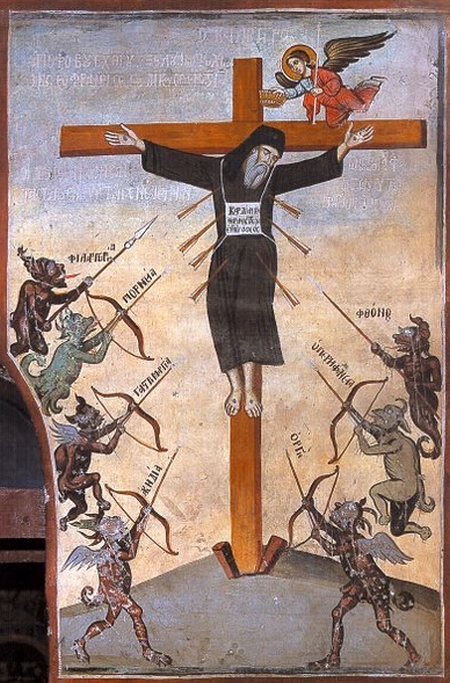
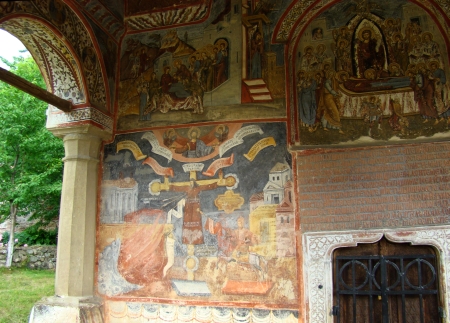
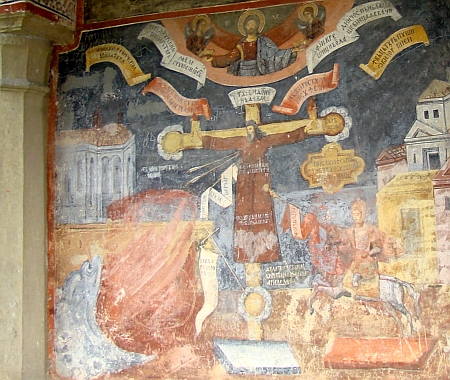
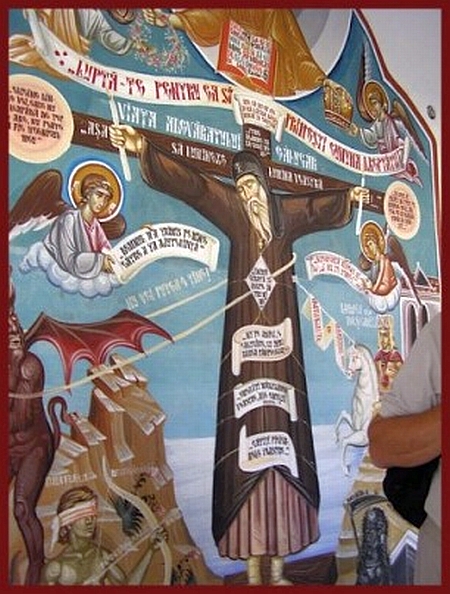
This fresco depicting “the life of the genuine monk” is especially found in older Orthodox monasteries. Although this fresco depicts “the steadfast monk – the Christ’ follower,” we should also affirm that it represents “the one true Christian” who regardless of his social status, is a follower of Christ through his actions.
The genuine monastic is he who dies for the world to take on a permanent battle with his passions and his thoughts until his last breath. Ordinary Christian, married or not, has the same duty, to die to the world and start the same battle towards passions until the end.
Since the path to Christ’ Kingdom is narrow and rough, it is clear that the Christian whether be a monk or a layman, faces similar difficulties. St. John Chrysostom referring to the great labor toward salvation of both monastics and laymen alike, said: “The only difference between a layman and a monk is that the first is married and the other is not.” The fresco representing the true monastic is usually depicted in the entrance of the church near other icons such as “the Ladder of Divine ascent” and “the Dreadful Judgment.” In the center of the icon, the monk is showed as been crucified, dressed in his black cassock, barefooted, with his feet nailed to the bottom of the cross; his face is peaceful and his eyes and his mouth closed. To his right it is written: “Place a watch oh Lord upon my mouth.” In his hands, he holds two burning torches, and an inscription near this says: “Thus, let your light shine before men that they may see your good deeds.” On his chest, he lays a parchment baring the words: “Create in me a clean heart, O God, and renew a right spirit within me.” On his womb, another writing will say: “Oh man, do not be deceived by gluttony.” Bellow his womb, another inscription writes: “Kill the members of thy earthly man!” Then, bellow his knees: “Prepare your feet for the Gospel of peace.” At the top of the cross, a paper chiseled in stone depicts the following: “As for me, I will boast only in the cross of my Lord. Both arms of the cross bare a seal at the end. The seal on the right bares the word: “And ye shall be hated by all for my name’ sake, but he who endures to the end shall be saved.” The seal at the left says: “Anyone of you, who does not renounce all that he has, cannot be my disciple.” And the seal at the bottom of the cross, placed under his feet, writes: “Narrow is the gate and rough is the path that leads to salvation and few are those that find it.” A dark cave with a dragon coiled inside is represented at the right side of the cross, near which it is written: “the consuming/eternal hades.” Above the mouth of the dragon, a naked young man with his eyes tied by a knot, holds a bow with its arrow pointing at the monk asking: “Commit fornication!” A name is written over the young man as: “the lover of fornication.” Many snakes are depicted above the cave, which suggest: “our thoughts.” A demon is portrayed near this scene with a rope pulling away the cross and saying: “You cannot bare it!” And on the right side of the cross, another small cross is placed with a flag upon which is written: “I can do all through Christ, Who has clothed me with power.” A tower and a gate are seen at the left side of the cross. A man clothed in gold and fur, riding a white horse passes through this gate holding a glass of wine in his right hand and a spear in his left hand. Above his spear it is written: “Take pleasure in the riches of this world, the vain world!” A hole is drawn behind this rider and death coming out, wearing a big coat over its shoulders and a clock upon its head, upon which it is writing: “Death and the grave.” Two angels are depicted near the monk arms on both sides, each holding a paper in his hands; the angel from the right bares: “God sent me to your strength ” and the angel from the left: “Do good and do not be afraid.” At the top of the cross lies the open sky, where Christ stands with the open Gospel upon His chest that reads: “If any man wants to come after me, let him deny himself, take up his cross and follow me. ” In His right hand He holds a crown, and in His left a wreath of flowers. Immediately below our Savior, two angels are looking at the monk holding a long parchment where it is written: “Fight the good fight so you may receive the crown of righteousness.”
'' Today, while the overall teachings of the fathers is under attack and the shipwrecks of Faith are numerous, the mouths of the faithful are silent.''
'' An obvious fall from faith and pride is to either subtract something from what is written or to introduce something new to the unwritten. ''
'' Anyone who is capable of speaking the truth but remains silent, will be heavily judged by God, especially in this case, where the faith and the very foundation of the entire church of the Orthodox is in danger.
To remain silent under these circumstances is to betray these and the appropriate witness belongs to those that reproach ( stand up for the faith ). ''
What do we do when we are bothered by a seductive thought or a temptation?
First of all, don’t be afraid. Second, do not attempt to expel it. The important thing is to turn your attention to Christ.
The simplest way to do this is by making the sign of the Cross.
Elder Porphyrios says, The most important weapon to use against the devil is the Holy Cross, of which he is terrified. … communication with the Christ, when it takes place simply and naturally without force, makes the devil flee. Also as you make your Cross say the words “Lord Jesus Christ, have mercy on me.’
The Elder says, This is our method. We will raise our ams to Christ and He will give us grace. This the same approach as given to us by Saint Neilos the Ascetic. Whenever a temptation comes to you, or a dispute excites you, either to express at once anger towards your adversary or to utter a senseless cry, remember prayer and the judgment concerning it, and at once the disorderly movement in you will subside. (The Philokalia vol 2, trans. Constantine Cavarnos, p65) What we are doing is showing contempt for evil.