Thursday, January 4, 2018

Sin is a wound; repentance is a medicine. ( St. John Chrystotom )

Do not be ashamed to enter again into the Church. Be ashamed when you sin. Do not be ashamed when you repent. Pay attention to what the devil did to you. These are two things: sin and repentance. Sin is a wound; repentance is a medicine. 
Just as there are for the body wounds and medicines, so for the soul are sins and repentance. However, sin has the shame and repentance possesses the courage.

St. John Chrystotom

Tuesday, January 2, 2018

God has endowed us all with gifts, but not all of us utilize them for the salvation of our souls.. ( St. Paisios )

Those who withdraw themselves from Christ are deprived of divine enlightenment, for like fools they forsake sun-drenched places so as to retire to the shade. Hence, it is natural for them to be cold and fall spiritually ill. 
God has endowed us all with gifts, but not all of us utilize them for the salvation of our souls and the salvation of our fellow men. 
Instead, most of us, most of the time, use them to the detriment of others and ourselves.

St. Paisios

Friday, December 29, 2017

Widsom from the Saints: Dealing with Anger, Animosity, Bitterness


Because of human weakness and propensity to misunderstanding, even a passing unkind word or a small thoughtless act can lead to serious consequences in personal relationships. Therefore much vigilance is required to sustain good will between people, and where trust is compromised, much care is needed to make things right.

Overcoming the Vice of AngerResentment

True happiness comes not from the abundance of possessions but from the quality of human relationships. Healthy relationships are marked by respect for others, humility, honesty, truthfulness, willingness to speak calmly and clear up misunderstandings, readiness to settle disputes fairly, and having the ability to reconcile and move on through good will and the gift of forgiveness. Wherever such traits are present in a marriage, a family, a community, or society in general, there also are to be found expressions of harmony, contentment, peace and true joy.

The enemies of healthy human relationships are ignorance, insensitivity, selfishness, evil desires, arrogance and blind pride. Such dispositions degrade human life and cause untold suffering and pain. They produce all sorts of misunderstandings, conflicts, animosities and bitterness between people. Because of human weakness and propensity to misunderstanding, even a passing unkind word or a small thoughtless act can lead to serious consequences in personal relationships. Therefore much vigilance is required to sustain good will between people, and where trust is compromised, much care is needed to make things right.

 
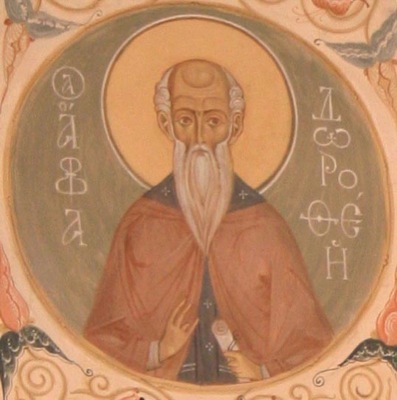
In a discourse on “Rancor,” Dorotheos of Gaza (sixth century) provides helpful teaching on how to deal with issues of conflict and their consequences. St. Dorotheos’ first line of advice has to do with knowledge. Clear knowledge gives a person better leverage in dealing with conflict. The saint draws a distinction between stages in the process of conflict: provocation, disturbance of mind, anger, rage and animosity or rancor. He illustrates his teaching with the help of the following example.

When someone lights a fire, he must start with a spark, let us say, by striking a match. The spark is a brother’s or sister’s provocative word or act. If you can deal with it sensibly, the spark goes out. But if you pick up on it and allow it to grab your attention, you give it life. It is like adding “a small bit of wood to the flame, or some bit of fuel, and you produce some smoke, that is disturbance of mind.” The more you think about it, the more your feelings turn into anger and anger turns into inward rage. It is like piling logs on the fire which blazes potentially beyond control. You torment yourself and are ready to fly at the offending person, and also others at any time, because of the inner turmoil. Unless resolved, time turns these feelings of anger into lingering animosity or rancor. The Greek word is mnesikakia, literally remembrance of evils or wrongs done. This state is defined by deep seated ill will, spiteful animosity and bitterness toward another human being.

But how is a person to deal with provocations sensibly? St. Dorotheos counsels to keep his teaching in view and to know the difference between annoyance, temper, losing one’s temper, and lapsing into rancor. With this knowledge be prepared ahead of time. Make it a matter of spiritual strategy to cut off the process of conflict at the start. Stand back, take a deep breath, think before you speak or act, and have alternative ways of responding to situations when sparks are ready to fly. Do not allow annoyance to turn into anger and anger into rancor. “When a passion arises, when it is young and feeble, cut it off, lest it stiffen and cause you a great deal of trouble. It is one thing to pluck out a small weed and quite another thing to uproot a great tree.”

Each of us can think of positive ways of responding to provocations. Sometimes it is best to keep silence and take up the matter at a more opportune time. Or a person can speak softly and ask questions of clarification: “What makes you feel that way? Can you please explain what you mean?” Or a person can humbly excuse themselves, saying “I am very sorry you feel that way. I did not mean to offend you. Let’s calm down and talk about it.” We can let the moment pass and at another time address an offender with patient words: “John or Mary, what you said the other day really hurt me. Can we take some time and talk about it. I value our relationship. Let’s try to clear up the misunderstanding.” There are ways to find the right words and speak with the right tone voice to keep the fire from flaring up with the risk of consuming those involved.

St. Dorotheos pays special attention to the human tendency and desire to get even and render evil for evil. He recalls Psalm 7:5 where we pray to God, “If I have paid back evil for evil, let me fall down defenseless before my enemies.” To commit evil for evil is to work against our own self. The saint explains: “The ‘falling’ means no longer to have the power to get up. The ‘defenseless’ means not to have anything good left in us by which we may at length get up again.” We are in danger of losing “our capacity for acting virtuously, or power of right action” by wanting to get even.

There are different ways of rendering evil for evil, not only by words and actions but also by attitudes, movements and looks, all of which must be discerned and avoided. A cold shoulder speaks volumes of resentment in the heart. A disdainful glance can serve as an arrow tipped with malice. Furthermore, although a person may not harbor a complaint or resentment against a brother, but then that same person is amused and is glad when someone else reviles that brother. Another person may not be annoyed by a brother, but then the same person is not gracious enough to be glad when something good happens to that brother or when that brother is praised by others. All these ways are, according to St. Dorotheos, subtle forms of rendering evil for evils and expressions of hidden rancor. They must be carefully discerned, combated and confessed to God. Christ’s charge was to love our enemies and pray for them. St. Paul taught: “Do not be overcome by evil, but overcome evil with good” (Romans 12:21).

However, knowledge alone and defense strategies are not enough in themselves to deal effectively with provocations and wrongs committed. The intervening grace of God is absolutely crucial in limiting conflict and bringing about reconciliation and healing. At the first spark of conflict, prayer is the most positive and effective response as both background and inspiration to all other useful approaches. Prayer is an inner secure place of peace and reflection, where a human being can find the resources to deal most thoroughly with conflicts and personal hurts.


In the Orthodox tradition the “Jesus Payer” (“Lord Jesus Christ, have mercy on me”) is given as a “battle ax” against all trials and temptations. It can be adapted to a short invocation as circumstance require, such as “Lord, have mercy!” or “Lord, give me strength, or give me patience, or give me light to deal with this problem.” When sparks light up, invoking the Jesus Prayer helps the soul to take refuge in its own spiritual home, defusing anger, and holding back words or actions that would prove regrettable.

St. Dorotheos suggests a silent and humble prayer of the heart which lifts up the dignity of the offender himself. “O God, help my brother and me, through his prayers!” With these words a person intercedes for his brother or sister, a sure sign of sympathy and love, and he is humbling himself by asking help from God through the offender’s prayers. St. Dorotheos asks: “Where there is sympathy and love and humility, how can wrath and other passions develop?” He quotes a saying from Evagrius the Ascetic: “The man who prays for his enemies is a man without rancor.” Praying for the wellness and salvation of our adversaries provides the surest path to being healed from resentments and to preparing the ground for healing and peace. St. Dorotheos ends his treatise with this prayerful counsel: “May God give us to remember and keep what we have heard [learned], lest it bring us a heavy sentence on the day of judgment.” Pray for us. O saint of God! 
 
http://www.pravmir.com/widsom-saints-dealing-anger-animosity-bitterness/

Tuesday, December 26, 2017

The Thoughts of Angels Compared With the Thoughts of Men ( Elder Thaddeus of Serbia )


"The angelic hosts are not enslaved by their thoughts, or by the things of this world. They gaze upon created things, but their thoughts do not become enslaved by them; for the center of their thoughts is in servitude only to the power of God, through which they love all creation. As for us, when we see an object that attracts us, we immediately become attached to it. This is terrible and it is also deadly. If this lasts for a length of time, then this object becomes our idol. An object takes the place in our heart that belongs to God - no matter whether it is an inanimate object, a living thing, or a person."

  Elder Thaddeus of Serbia

Saturday, December 23, 2017

A Christmas Tradition on the Island of Tinos

 
Tinian people preserve their local manners and customs as sacred. Besides, many of those stem from ancient religious traditions. These customs survive mostly in the villages, although the Main Town also has its own traditions. In addition, the locals often combine their deep religious faith with their love for dancing and singing, regularly organizing local festivities and fairs.

A custom that proves the deep religious faith of Tinians is the lighting of Vigil Lights. It is an unwritten law, binding the locals to light all the country chapels this way every Saturday afternoon and on the eve of the celebration of a saint’s memory. Every chapel has a permanent or temporary owner, responsible for keeping the custom. Non-fulfillment of this obligation is considered a moral offence not tolerated by the locals.


This custom sometimes takes the form of a solemn religious promise. Thus, many Tinians often as a token of gratitude, supplication or thanks to a Saint, vow to go to the chapel dedicated to the Saint’s name. The pilgrims arrive at the chapel early in the morning. If the oil lamps are already lit, they add some oil to keep them burning and they leave the oil bottle they brought with them next to the candelabrum so it can be used later.

In every case, the ritual includes candle lighting and incense burning. These three ritual elements are the only material sacrifice that has survived since the early Christian years. Its nature is symbolic. Its value is not measured by the materials offered, but by the pilgrim’s devoutness. In general, oil lamp lighting represents the light in their souls. The flame symbolizes the light of the Holy Spirit and the resplendence of all the Saints who are deep in the locals’ hearts.


An old Christian custom, of monastic origin, is held during the Christmas season in Tripotamos. Every year, one family, whose leader receives the title of ‘Kavos’, takes on the responsibility of taking care of the village church, which is dedicated to the Presentation of the Virgin Mary. Among their responsibilities is to keep the oil lamp (vigil light) hanging over the Icon of the Nativity lit all year round. In addition, they keep the church clean, they pay the costs for the Christmas Divine Liturgy, the provision of candles, while they are also responsible for the making of a huge candle for the New Year’s Day Service.

On Christmas day, at noon, the Kavos invites the priest and the men – the head of families of the village – for lunch. Each one of the guests has to bring his own fork, spoon, bread and wine, all wrapped in a napkin. The Kavos has to make provisions for a lavish meal, with soup, veal stew, and braised meat with tomato sauce, stuffed vine leaves and several other local specialties. Wine is served in goblets, special mugs of hemispherical shape made of brass that are used only on this occasion.

After the meal, the priest and some of the table-companions carry the Icon of the Nativity from the church to their host’s house chanting Christmas hymns. The Icon is placed on the table, the priest hands out the holy bread, while everyone lights candles, similar to those used in the morning service. This is the moment when the priest appoints the next ‘Kavos’. After eating the traditional sweets, the Icon is taken back to church while the crowd chants Christmas hymns.

On the next day (26th of December) all the men of the village gather again in the house of the former Kavos, to finish up the leftovers from the previous day. Typically, the responsibilities of the former Kavos end with the Christmas meal. However, the oil lamp has to remain lit till the last day of the year. After Divine Liturgy on the 31st of December, there is a procession of the Icon around the houses of the village according to the custom of ‘podariko’ (= first visitor at a house on New Year’s Day is considered to bring good luck).

Today the list for the title of Kavos runs till 2025, which means that this custom is very popular with the locals. In earlier days though, the Kavos would be a last-minute choice, since most of the families were not well-off