Tuesday, December 26, 2017

The Thoughts of Angels Compared With the Thoughts of Men ( Elder Thaddeus of Serbia )


"The angelic hosts are not enslaved by their thoughts, or by the things of this world. They gaze upon created things, but their thoughts do not become enslaved by them; for the center of their thoughts is in servitude only to the power of God, through which they love all creation. As for us, when we see an object that attracts us, we immediately become attached to it. This is terrible and it is also deadly. If this lasts for a length of time, then this object becomes our idol. An object takes the place in our heart that belongs to God - no matter whether it is an inanimate object, a living thing, or a person."

  Elder Thaddeus of Serbia

Saturday, December 23, 2017

A Christmas Tradition on the Island of Tinos

 
Tinian people preserve their local manners and customs as sacred. Besides, many of those stem from ancient religious traditions. These customs survive mostly in the villages, although the Main Town also has its own traditions. In addition, the locals often combine their deep religious faith with their love for dancing and singing, regularly organizing local festivities and fairs.

A custom that proves the deep religious faith of Tinians is the lighting of Vigil Lights. It is an unwritten law, binding the locals to light all the country chapels this way every Saturday afternoon and on the eve of the celebration of a saint’s memory. Every chapel has a permanent or temporary owner, responsible for keeping the custom. Non-fulfillment of this obligation is considered a moral offence not tolerated by the locals.


This custom sometimes takes the form of a solemn religious promise. Thus, many Tinians often as a token of gratitude, supplication or thanks to a Saint, vow to go to the chapel dedicated to the Saint’s name. The pilgrims arrive at the chapel early in the morning. If the oil lamps are already lit, they add some oil to keep them burning and they leave the oil bottle they brought with them next to the candelabrum so it can be used later.

In every case, the ritual includes candle lighting and incense burning. These three ritual elements are the only material sacrifice that has survived since the early Christian years. Its nature is symbolic. Its value is not measured by the materials offered, but by the pilgrim’s devoutness. In general, oil lamp lighting represents the light in their souls. The flame symbolizes the light of the Holy Spirit and the resplendence of all the Saints who are deep in the locals’ hearts.


An old Christian custom, of monastic origin, is held during the Christmas season in Tripotamos. Every year, one family, whose leader receives the title of ‘Kavos’, takes on the responsibility of taking care of the village church, which is dedicated to the Presentation of the Virgin Mary. Among their responsibilities is to keep the oil lamp (vigil light) hanging over the Icon of the Nativity lit all year round. In addition, they keep the church clean, they pay the costs for the Christmas Divine Liturgy, the provision of candles, while they are also responsible for the making of a huge candle for the New Year’s Day Service.

On Christmas day, at noon, the Kavos invites the priest and the men – the head of families of the village – for lunch. Each one of the guests has to bring his own fork, spoon, bread and wine, all wrapped in a napkin. The Kavos has to make provisions for a lavish meal, with soup, veal stew, and braised meat with tomato sauce, stuffed vine leaves and several other local specialties. Wine is served in goblets, special mugs of hemispherical shape made of brass that are used only on this occasion.

After the meal, the priest and some of the table-companions carry the Icon of the Nativity from the church to their host’s house chanting Christmas hymns. The Icon is placed on the table, the priest hands out the holy bread, while everyone lights candles, similar to those used in the morning service. This is the moment when the priest appoints the next ‘Kavos’. After eating the traditional sweets, the Icon is taken back to church while the crowd chants Christmas hymns.

On the next day (26th of December) all the men of the village gather again in the house of the former Kavos, to finish up the leftovers from the previous day. Typically, the responsibilities of the former Kavos end with the Christmas meal. However, the oil lamp has to remain lit till the last day of the year. After Divine Liturgy on the 31st of December, there is a procession of the Icon around the houses of the village according to the custom of ‘podariko’ (= first visitor at a house on New Year’s Day is considered to bring good luck).

Today the list for the title of Kavos runs till 2025, which means that this custom is very popular with the locals. In earlier days though, the Kavos would be a last-minute choice, since most of the families were not well-off

Thursday, December 21, 2017

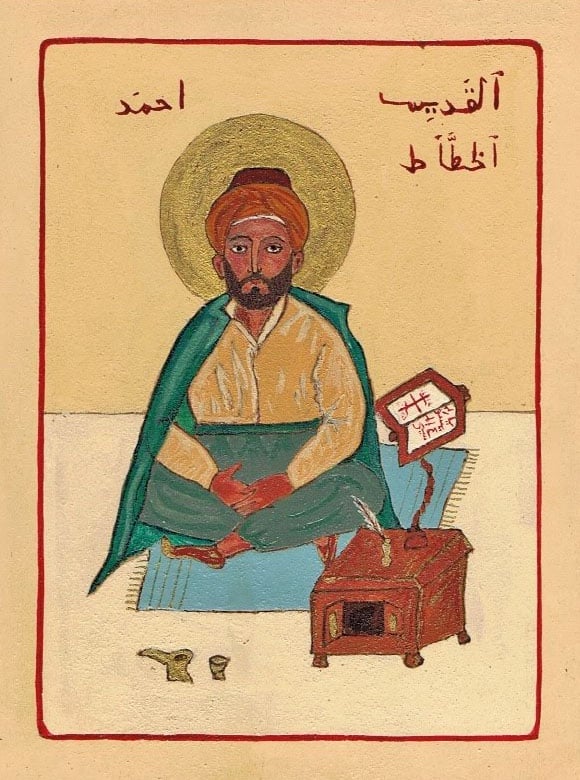
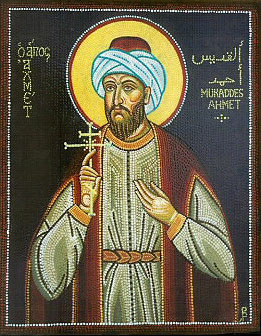
Saint Ahmed the Calligrapher


The holy New Martyr Ahmed was born in the seventeenth century to a Muslim family in Constantinople. By profession he was a copyist in the Great Archives. In accordance with Ottoman law, since he did not have a wife, he had a slave instead, a Russian woman. Another captive from Russia lived together with her, an old woman, also a slave. Both these women were very pious.

On feast days the old woman would go to church. Taking the blessed bread or antidoron, she would give it to the young woman to eat. The old woman would also bring her holy water to drink. Whenever this occurred and Ahmed was close to her, he would smell a beautiful and indescribable fragrance coming out of her mouth. He would ask her what she was eating to make her mouth smell so fragrant. Not realizing what was happening, the slave would say that she was not eating anything. However, he persisted in asking. Eventually she told him that she was eating the bread which had been blessed by the priests, which the old woman brought her whenever she returned from church.

On hearing this, Ahmed was filled with longing to see the Orthodox church and how Orthodox received this blessed bread. Therefore he summoned a priest and told him to prepare a secret place for him, so that he could go when the Patriarch was serving the Liturgy. When the appointed day arrived, dressed as an Orthodox, he went to the Patriarchate and followed the Divine Liturgy. While he was in church, he saw the Patriarch shining with light and lifted off the floor, as he came out of the altar and through the holy doors to bless the people. As he blessed, rays of light came from his finger tips, but though the rays fell on the heads of all the Orthodox, they did not fall on Ahmed’s head. This happened two or three times and each time Ahmed saw the same thing. Thus, Ahmed came to the faith. Without hesitation he sent for the priest, who gave him rebirth through baptism. Ahmed remained a secret Orthodox for some time, concealing his baptismal name, which is why it has not come down to us.


However, one day Ahmed and certain noblemen were eating together. Afterwards they sat talking and smoking, as is the Muslim custom. In the course of the conversation they began to discuss what the greatest thing in the world. Each gave his opinion. The first guest said that the greatest thing in the world was for a man to have wisdom. The second maintained that woman was the greatest thing in the world. And yet a third said that the greatest thing in the world, and by far the most delightful, was good food – for was this not the food of the righteous in paradise?

Then it was Ahmed’s turn. They all turned to him, asking him for his opinion on this matter. Filled with holy zeal, Ahmed cried out that the greatest thing of all was the Faith of the Orthodox. And confessing himself to be a Christian, he boldly censured the falseness and deception of the Muslims. At first, on hearing this the Muslims were aghast. Then, filled with unspeakable rage, they fell on the holy martyr and dragged him to a judge, so that he could be sentenced to death. He was beheaded, receiving the crown of martyrdom on the orders of the ruler on 3 May 1682. According to St Nicodemus the Hagiorite, his memory is celebrated on December 24th.

Holy Martyr Ahmed, pray to God for us! 
 
http://pemptousia.com/2016/12/saint-ahmed/

Monday, December 18, 2017

A Prayer of the Optina Elders

O Lord, help me to confront everything I encounter today with tranquility of soul. Help me to completely surrender myself to Your holy will. Enlighten me at each and every hour of the day, and strengthen me in all that I do.
 
Teach me to accept all the news I receive today calmly and with the unshakable conviction that nothing takes place unless You allow it.
Guide my thoughts and my feelings in everything I do and say. During unforeseen circumstances, do not allow me to forget that all things are permitted by You.
 
Teach me to conduct myself sincerely and prudently with each member of my family and with all other people, so that I do not upset or annoy anyone.
 
O Lord, grant me the strength to endure the difficulties and all the various events this day will bring. Direct my desires, and teach me to pray, to have faith, to be patient, to forgive, and to love. Amen.
http://www.stnektariosmonastery.org/

Saturday, December 16, 2017

St. John of Kronstadt and the Education of Children


St. John of Kronstadt brings homeless children to the shelter.

A child’s soul is divine beauty
St. John of Kronstadt considered love for children to be the foundation of a teacher’s work—a foundation that is very often denied by modern-day so-called technicians of secular educational sciences and activities. He said to the students of the gymnasium where he taught, “You are my children, for I gave birth to you and continue to give birth in you to the good tidings of Jesus Christ. My spiritual blood—my instructions—flow in your veins. You are my children, because I have you always in my heart and I pray for you. You are my children, because you are my spiritual offspring. You are my children, because truly, as a priest I am a father, and you call me “batiushka” (“little father”, an affectionate term for a priest).

In Fr. John lived a kind of unearthly, angelic love for children, which inspired him and motivated the entire educational process. It was a special gift of God’s grace, which burned in him so strongly that in later years, when he was no longer teaching, he often healed sick children with the power of love and prayer, continually blessing and instructing them in the faith. How often did he weep over sick children, especially if they were spiritually sick! Once he stroked the head of an emotionally ill boy, and another time he kissed a seriously ill girl in the hospital, kneeling before her bed. “My dear, are you in pain? My little sufferer!” Fr. John lamented.”

Father John’s strictness
Nevertheless, Fr. John could be abrupt. One day a sixteen-year-old boy who was extremely lazy and morally spoiled, expressed his disbelief before the entire class in the divinity of the Holy Spirit. Fr. John called him godless and a miscreant, but he did answer his question. Later he summoned him for a separate conversation, after which the boy felt renewed and strengthened in spirit.
Some recall how a noblewoman complained to Fr. John about the degradation of religious and moral education of her children. “Their teachers,” she said, “taught them everything they need to pass the exams and be clever.” “You should say that they pounded them and not taught them,” Fr. John corrected her. “When being pounded with spiritual knowledge, they have the same feeling as when they are learning arithmetic and so on. But how about you? Do you take care of their souls? Have you directed them so that besides human approval they would strive for God’s approval?” “I suggest it to them according to my strength,” the lady answered him. “After all, one can’t find the door to one’s own child’s heart.” “You didn’t find the door to the heart, so you’ll get beasts instead of humans,” Fr. John replied. “You have forgotten that the Lord has shown mankind an example in the bird species. A bird first gives birth to an egg, and until this egg has been kept for the proper time in maternal warmth, it remains an inanimate object. It is the same with people. The born child is that egg—with the beginnings of earthly life, but inanimate with respect to his blossoming in Christ. The child who has not been warmed by his parents and family to the root of his soul, to the root of all his feelings, will remain dead in spirit for God and good works. And it is precisely from these children not warmed by love and spiritual care that those generations come into the world, from which the prince of this world will recruit his armies against God and His holy Church.”

The loftiness of trust and responsibility in the education of God’s children
Fr. John warned that God and parents have entrusted their children to the teacher, and this requires responsibility and a careful relationship to them. He often noted that everything beautiful, individual, and unique has already been placed in the child’s heart as in a seed. God also provides everything needed for their growth and development; but for our modest, but extraordinarily difficult and painstaking work—education—we must have love, and care for the children. But as great is the responsibility, so great also is the reward for conscientious work entrusted by God; for children are His inheritance. In them is not only our future, but also our present, and especially the eternal future. “Be strongly vigilant,” Fr. John reminds teachers, “that you never disdain in your heart any of these little ones (cf. Matt. 18:10) whom you might dislike for some reason. You are disdaining God’s angel, which was assigned to watch over him. You are disdaining God’s child; you are disdaining the Lord Himself, the Father of all children, first of all.” Thus, whoever violates the least of these commandments out of negligence, considering it insignificant, and teaches others to do the same, will be called the least in the Kingdom of Heaven (according to St. John Chrysostom’s exegesis, “the violator of the law will be the least, that is, the last, cast out and unworthy of the Kingdom of Heaven”), and whoever keeps and teaches [the commandments] will be called great in the Kingdom of Heaven (cf. Matt. 5:19).


St. John’s commandment to teachers
What does Fr. John command the instructors of children for the discernment of and caution against sin? What does he command the children themselves so that they would know of the danger and consequences of sin? He said, “Warn the children about sin and its consequences!” And he instructed, “Do not leave children without attention with regard to uprooting from their hearts the chaff of sin, wicked, evil, and blasphemous thoughts, sinful passions, inclinations, and habits, from which our lives are also made. The enemy of salvation and the sinful flesh does not spare the children either, and the seeds of all the sins are also in them. Present a picture to the children of the whole danger and sorrowful consequences of their sins, so that they out of ignorance and unreasonableness would not be formed by their elders on the path of life in sinful passions and habits, which multiply and grow with age.”
Christian upbringing is the first line of defense in the struggle for the salvation of a child’s soul. Fr. John, who himself had difficulty learning as a child, was according to the recollections of his contemporaries a remarkable pedagogue. He never resorted to methods of teaching that were often found in schools: neither to excess strictness, nor to the moral humiliation of slow learners. Well known was his warm, soulful relationship to the students as well as to the work of teaching itself. He had no “slow learners”. Everyone at his lessons without exception greedily soaked in his every word. They couldn’t wait for his lessons to start. His lessons were more of a pleasure for the students than a heavy burden and obligation. It was living conversation, engaging speech, and interesting, attention-grabbing stories.
There were often cases when Fr. John would defend a lazy student who had been “condemned” to expulsion, and he would take the child’s correction upon himself. A few years would pass, and the child who seemed to be a hopeless case would be raised up as a worthy individual.
Christians, first of all, should take care that the children grow to be unwavering in the Christian faith, true children of God, living members of the Church, so that Christ would be formed in their hearts (cf. Gal. 4:19), so that more than anything in earthly life they would love and prefer God, then their neighbor as themselves (Mt. 22:37-40). So that the goal of their lives, in the words of St. Seraphim of Sarov, would be the “acquisition of the Holy Spirit” unto the salvation of their souls.


Archpriest Alexander Zelenenko

Translation from Pravoslavie.ru

By Nun Cornelia (Rees)
http://orthochristian.com/99885.html