
St. John the Russian, depicted with St. Seraphim of Sarov and St. John of Kronstadt
In one of the two children's hospitals of Athens, a mother lied at the head of her child day and night. She brought the child from Patras, because the child's chronic affliction, paralysis of the lower extremities, had worsened in the last few days...
One evening, while the sun was setting, and the last few sunbeams lit up the hospital room, the mother remembered how she would go to a chapel of the Panagia high above Patras, and prayed, lighting the vigil lamps, sometimes with her husband, other times with her children. Her nous was fixed on that chapel. She prayed noetically: “My Panagia, my sweetest Mother who feels our pain, help my child. My Panagia, send me a Saint, look at my poor child, how in his life, he is struggling to stand on his feet. Help, my poor little boy.”
“Mother,” the child said, “who are you talking to?”
“My Georgie, remember when you read in your church book how our Lord lived in Palestine, and healed demoniacs, opened the eyes of the blind, lifted up Paralytics and made them to walk, and raised the dead? Tell him, my Georgie, and He will hear you, my good boy, tell Christouli to make you well.”
The helpless child, with his innocent gaze, looked at his mother, and at the sun which was setting. He looked on high towards the heavens.
That midnight, George saw a dream of a beautiful horseman, on a glorious horse. He stopped before him and said:
“Get up, Georgie, jump up on my horse!”
“But I am a paralytic, my feet don't move and hold me up.” he replied.
“Give me your hand, Georgie, get up on my horse. I am St. John from Russia, and our Lord sent me to bring you His grace and His healing power!"
The child, half awake, then awoke his mother, who picked him up so that he wouldn't fall out of bed.
“Mother, hold me, St. John from Russia told me to get up.”
In the morning when the night resident told the professor that the paralyzed child from Patras began walking that night, went with a hammer in hand, checked the child's reflexes, and plucked his feet with a sharp instrument, and he saw that his body was functioning normally.
“Go,” said the professor, “God had something to do with you."
(8/17/77 – from the book “Life and new miracles of the Venerable John the Russian”, by Priest Ioannis Vernezou, 1999
http://full-of-grace-and-truth.blogspot.ca/2015/09/a-paralyzed-boy-healed-by-st-john.html
"Drink Holy Water, the more often, the better. It is the best and most effective medicine. I'm not saying this as a priest, I'm saying it as a doctor, from my medical experience."
St. Luke the Surgeon, Archbishop of Simferopol

Whoever strives towards God and really wants to become Christ’s follower must follow Him, endeavoring to improve himself and become a new person, not retaining anything within oneself that is peculiar to the ancient person — for it is said:" if anyone is in Christ, he is a new creation."
St. Macarius the Great
 Animals, such as cows, that are raised in order to be slaughtered and butchered are allowed to graze and eat freely, and they are fed to be fattened. Conversely, animals that will be used for work or provide some service to man are trained, disciplined, and kept an a strict diet. This is what God does as well. He allows malicious people in this present life to grow fat as they indulge in carnal pleasures and sinful enjoyments because
such unfortunate people will finally end up in eternal Hell.
On the contrary, He tests and disciplines virtuous and righteous people in order to keep them in His heavenly mansion forever. Fruit-bearing trees that yield a crop and produce a bountiful harvest are pruned, they are sprayed with pesticides, and have
heavy weights attached to the end of their branches, which bend and pull the branches
downward. All these harsh measures, however,
are conducive to the tree bringing forth fruit.
Conversely, trees that do not produce fruit and are of no value to man are neither pruned nor clipped like fruit-bearing trees. However, once such trees grow and reach maturity, they are cut down,
completely uprooted from the ground, and subsequently used as firewood. This is what happens with man in this world as well. Virtuous people who produce useful and good works receive sorrows and lashes, whereas the
Righteous Judge does not punish evil and sinful people here because He is waiting to consume them eventually in the fire of Hell.
The prosperity and good fortune of ungodly people is actually a severe misfortune! For when such people observe nothing bad happening to them and that they are not punished in any way, they shamelessly and impudently proceed to carry out even greater sins and worse crimes.
Furthermore, when such a person remains
undisciplined, it is a sign that he will be punished and condemned, because the enemy does not disturb or assault his own friends. Thus it is apparent, just as we have illustrated above, that the more God loves someone, the more He allows one
temporarily, and for the time being, to experience discipline that is beneficial and ultimately life
-saving for the soul.
from The Salvation of Sinners
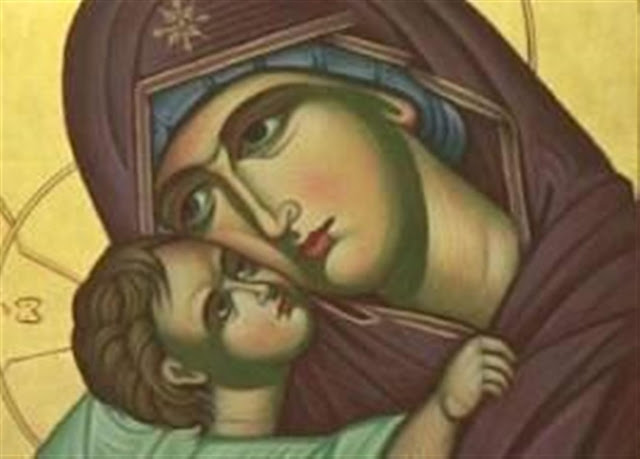
So, the Lord Jesus gives us this possibility to unite with God and return to the primary purpose which God ordained for man.
Therefore He is described in Holy Scripture as the way, the door, the good shepherd, the life, the resurrection, the light. He is the new Adam who rights the wrong of the first Adam.
The first Adam separated us from God with his disobedience and his egotism. With His love and His obedience to the Father, obedience unto death, to “death on the cross,” the second Adam, Christ, brings us back once more to God. Once again He orients our freedom towards God, so that by offering Him our freedom, we unite with Him.
The work of the new Adam pre-supposes the work of the new Eve, the Panagia who put right the wrong done by the old Eve. Eve drove Adam to disobedience.The new Eve, the Panagia, contributes to the incarnation of the new Adam who will guide the human race towards obedience to God. Therefore, as the first human person who achieved Theosis –in an exceptional and, of course unrepeatable, way– the Lady Theotokos played a role in our salvation which was not only fundamental, but both necessary and irreplaceable.
According to St. Nicholas Cabasilas, the great
14th century theologian, if the Panagia, in her obedience, had not offered her freedom to God, had she not said “yes” to God– God would not have been able to incarnate. Once God had given freedom to man, He would not have been able to violate His gift, so He would not have been able to incarnate if there had not been such a pure, all-holy, immaculate psyche as the Theotokos, who would offer her freedom, her will, all of herself totally to God so as to draw Him towards herself and towards us.
We owe so much to Panagia. This is why our
Church honours and venerates the Theotokos so much, so that St. Gregory Palamas, summarising Patristic theology, says that our Panagia holds the second place after the Holy Trinity;that she is god after God, the boundary between the created and the uncreated. “She leads those being saved,” according to another fine expression by a theologian of our Church. Recently St.Nicodemus of the Holy Mountain, the steadfast luminary and teacher of the Church, pointed out that the angelic ranks themselves are illumined by the light they receive from the Panagia.
Therefore, she is praised by our Church as “more honourable than the Cherubim and incomparably more glorious than the Seraphim.”
The incarnation of the Logos and the Theosis
of man are the great mystery of our Faith and Theology.
Our Orthodox Church lives this every day with its Mysteries, with its hymns, with its icons, with its whole life. Even the architecture of an Orthodox Church witnesses to this. The great dome of the churches, on which the Pantocrator is painted, symbolises the descent of Heaven to earth; it tells us that the Lord “bent down the Heavens and descended.” The Evangelist St.John writes that God became man “and dwelt among us” (John 1:14).
So, we represent the Theotokos in the apse of the altar to show that God comes to earth and to men through her, because He became man through the Theotokos. She is “the bridge by which God descended,” and again, “she who conducts those of earth to Heaven,” the Platytera of the Heavens, the space of the uncontainable,who contained the uncontainable God within herself for our salvation.
To continue, our Churches show deified men; those who became gods by Grace because God became man. In our Orthodox Churches we can picture not only the incarnate God, Christ, and His immaculate Mother the Lady Theotokos,but we also show the saints around and below the Pantocrator; on all the walls of the Church we paint the results of God’s incarnation: sainted and deified men.
Thus, when we enter an Orthodox Church and see the beautiful holy icons, this is an immediate experience through which we learn what God’s plan is for man; what is the purpose of our life.
Everything in the Church talks to us about the incarnation of God and the Theosis of man.
Taken from"THEOSIS" THE TRUE PURPOSE OF HUMAN LIFE
ARCHIMANDRITE GEORGE
ABBOT OF THE HOLY MONASTERY
OF ST. GREGORIOS ON MOUNT ATHOS


