
Today we lead such busy lives that many say, "I don't even have time for prayer. At the end of the say I am so tired. With Children and the trend of both parents working this is a common problem these days. The only solution is to make sure you have the right priorities in your life. To lead a balanced life you need to struggle to simplify it. First examine why it is necessary for a mother to work while the children are living at home. Is this a necessity or is it just to gain material things.
St. Paisios advises:
It's better for a mother to be involved with the nurturing of her children... A mother [if she is not working a full time job] can speak to her children about Christ; she can read the Lives of the Saints to them. Thus, at the same time she will be occupying herself dusting off her own soul so that it will be spiritually shiny. The mother's spiritual life will then quietly help the souls of her children. Thus, her children will live happily, and she will be joyful because she will have Christ within her. If a mother doesn't find the time to say even the Trisagion, how can she expect he children to be sanctified?
When she does her housework, can't she pray at the same time? It was my mother who taught me to way the Jesus Prayer. When we were children and had done some mischief, and my mother was about to get angry with us, I remembering her saying, "Lord Jesus Christ, have mercy on me." When she put the bread in the oven, she would say, "In the name of the Christ and Panaghia." And whenever kneading, or cooking, again, she constantly said the Jesus Prayer. In this manner, she herself was blessed, as were the bread and the food whe was preparing, and so were those who partook of it later.I wonder if in today's world we appreciate the significance of a spiritual upbringing. The elders of our Church tell us the mother's traditional role is a most important one. Elder Paisios says, "The mother's devotion has great significance. If the mother has humility and fear of God, then family life is smooth." The challenge today with its materialistic orientation is to seek to simplify life so one parent can dedicate themselves to the nurturing of their children both physically and spiritually. Children are geared to learn by observation. You are the models they will begin their life with. Make that model as close to the image of God as is possible.
A good friend told me a story of his early child raising days. He had the habit of not going to Church each Sunday, but he instead stayed in bed and then getting up after his wife and children had gone to church to read the Sunday paper in peace. One day, is young son made the comment to his Mom, "I cant wait until I get as old as Dad. Then I won't have to get up and go to Church each Sunday. I can stay home and read the paper and relax." He over heard his son saying this and this woke him up. He realized he was setting a bad example for his son. From that day on he never missed a day in Church.
Reference: Elder Paisios of Mount Athos Spiritual Counsels IV: Family Life, pp 95-96

Pay heed to yourself, O monk, sensibly and diligently, with a vigilant mind, as to when the demons come, by what means they catch one, and by what means they themselves are vanquished. Guard yourself with great caution, because every hour you walk in the midst of passions and nets. Everywhere the passions surround one. Everywhere are set out their traps. Pay heed lest you be attracted by the enemy into his will through passions and traps. There is a great need for us, even essential for us men of flesh, to fight with the fleshless ones—one man with ten thousand enemies. Many tears, much patience, much suffering and caution, and a thousand eyes everywhere are required, for the evil spirits rise up maliciously against us like a lion. They would destroy us if we did not have the Lord with us. They have been very skilled in the art of catching men for more than seven thousand years. Without sleep, food, and rest, constantly, every hour, and by all means, they seek our perdition with every trick and with great effort. Having turned out to be powerless in one way, they think up something else. They start one thing, and contemplate yet another. And they roar about everywhere looking where they might find doors to enter and from where they might begin the battle, and, as it were, trick us into doing evil. Do you not know with whom you battle? How legions of invisible enemies surround you, and every one of them wages his own battle? They sound numberless voices, and desire to swallow up your soul. Should you not be cautious? Is it possible that having drunk your fill and given yourself over to sleep, lying down and constantly consoling yourself, that you can with all this receive salvation? If you will not be attentive to this, you will not escape their traps. We have come to struggle, as it were, stepping into the fire. If we desire to be true warriors of the King of Heaven and not false participants, then let us put far away from us every passion or other. And according to our desire and fervor they tighten their traps, for the occasion to sin belongs to us ourselves, our attachment, weakness; and let us put away from ourselves every negligence and faintheartedness and effeminate weakness, and thus we shall stand against the cunningness of the demons. Let us labor in prayers and other virtues with all fervor and power, with soul, heart, and mind, just as someone might run swiftly on a road without looking around, or as a stingy man might fast, for such is the cunningness of the evil demons. They are constantly occupied with us. Like watchmen they notice our inclinations and our desires, what we are thinking about and what we love, what we are occupied with besides these. Whatever passion they notice in us, they arouse this in us, and thus they place their nets for us. In this way, we ourselves, first of all, arouse against ourselves every passion, being ourselves the cause of it. Therefore the demons seek in us occasion that through our own inclination and desire we might the sooner be caught. They do not compel us to do what we do not desire, to do that from which our mind inclines away and our will does not agree, knowing that we will not obey them. Rather, they test us some, whether we will accept some passion or other, And according to our desire and fervor they tighten their traps, for the occasion to sin belongs to us ourselves, our attachment, weakness, and negligence. We do not cut off the beginning of every passion, but the final cause of every evil is the demons. Through the demons we fall into every sin, and no kind of evil comes to us apart from them.
Thus the demons cast us into every passion. They compel us to fall to every sin, and we are tangled in every net. By nets I mean the first thought of desires and various foul thoughts through which we bind ourselves with every passion, and fall into every sin. This is the door of demons and passions, by which they enter into us and rob our spiritual treasury. Immoderate sleep, laziness, eating not at the proper time are a cause of the entrance of demons. And having come, they first of all knock on the doors of the heart secretly, like thieves. They introduce a thought, and they notice whether there is a watchman or not, that is, they see if the thought will be received or not. If it will be received, then they begin to cause passion and arouse us to it, and they steal our spiritual treasure. If they find a watchman at the doors of the heart who is accustomed to belittle and banish their suggestions, if one turns away in mind from the first mental impulse and has one's mind deaf and dumb to their barking and directed towards the depths of the heart and so does not at all agree with them, then to such a one they cannot do any evil, since his mind is sober. Then they begin to scheme and place various nets to catch us in passion, for example: forgetfulness, anger, foolishness, self-love, pride, love of glory, love of pleasure, overeating, gluttony, fornication, unmercifulness, anger, remembrance of wrongs, blasphemy, sorrow, brazenness, vainglory, much speaking, despondency, fearfulness, sleep, laziness, heaviness, fright, jealousy, envy, hatred, hypocrisy, deception, murmuring, unbelief, disobedience, covetousness, love of things, egotism, faintheartedness, duplicity, bitterness, ambition, and laughter. then they arouse a great storm of thoughts of fornication and blasphemy so that the ascetic might become frightened and despondent, or so that he might leave off his struggle and prayer. But if the enemies after raising all this cannot hold and take away from his struggle a firm soul and an unwavering soldier of Christ who, like a passion-bearer, has placed his foundation on the rock of faith, so that the rivers of sorrows do not cause him to waver, then they try to rob him by some seeming good, considering it more convenient under the appearance of good to introduce something of their own and in this way to deprive one of perfect virtue and struggle. Thus they try to compel us to make spiritual conversations for the sake of love, to teach men, or to sweeten the food a little for the sake of a friend or for the Feast, for they know, the deceptive ones, that Adam fell for the love of sweet things. First they begin to darken the purity of the mind and heedfulness to oneself, and by this path they suddenly throw us into the pit of sexual sins or into some other passion. If even by this way they do not cause one to waver who is sober in mind, then they arm themselves with false visions and offend and disturb him by various afflictions. A most skillful warrior lets all this go by him and regards it as nothing, as if it has no relation to him, for he knows that all this is the device of the devil.
If even thus they do not conquer, then they battle by means of highmindedness. They introduce they thought that the man is holy, saying to him secretly, "How many afflictions you have endured!" The demons, like a clever hunter, when their first means turns out to be powerless, abandon it, go away, hide themselves, and pretend to be conquered. But beware, O man, pay heed, do not be lax, for they will not depart from you until the grave. But they will prepare a great sedge and will look attentively by what means they can again begin to rise up against you, for they do not rest. When the warmth of fervor grows cold in a struggler, they then secretly, having prepared some net, come again and lay them out and try to catch him. In all the paths of virtue, the devils establish their nets and hindrances when we fulfill heedfully every deed for our salvation and not out of pleasing men, or from some other idea. But if in virtue there is hidden some kind of impurity, pride, vainglory, and highmindedness, then in such a matter the devils do not hinder us, but they even inspire us, so that we might labor without benefit. The demons strive for nothing so much as by every crafty means to steal time and make it idle. In everything that the demons do, they strive to dig three pits for us. First of all, they act against us and hinder us so that there will be no good in all our acts of virtue. In the second place, they strive so that the good will not be for the sake of God. That is, having no opportunity to bring us away from good, they make efforts through vainglory to destroy all our labors. In the third place, they praise us as if we turn out in everything to be God-pleasing. That is, being unable to confuse us by vainglory, they strive by highmindedness to destroy our labors and deprive us of rewards. Every demonic battle against us is in three forms. First, the devils darken our mind and a man becomes forgetful and dispersed in all his works. Then they introduce an idle thought, so that through it we might lose time. Finally, they bring various temptations and afflictions. Therefore, of us it is demanded that at all times we should be very sober of mind, for the enemies ceaselessly are making tricks and acting against us. If one struggles for many years, the enemy seeks a convenient time, so as in a single hour to destroy his labors. Not many men see the numberless traps, devices, and tricks of the demons. As a fleshless spirit the demon does not require rest, and through a long life he has learned to catch men. Therefore, no one can escape the tricks, the ruinous nets, and pitfalls of them, except one who remains in bodily infirmity from constant struggle, and who lives in spiritual poverty, that is, with a contrite heart and in humble thoughts. Such a one will conquer them.
Most of all, the Divine Help cooperates with us. However, in us, as we have said previously, is the beginning of all passions, attachment, weakness, and negligence, because we do not renounce in soul and thought and do not cut off the first impulse of every passion that comes. And the demons add yet more. Seek within yourself the reason for every passion, and finding it, arm yourself and dig out its root with the sword of suffering. And if you do not uproot it, again it will push out sprouts and grow. Without this means you cannot conquer passions, come to purity, and be saved. Therefore, if we desire to be saved, we must cut off the first impulse of the thought and desire of every passion. Conquer small things so as not to fall into big ones. It is evident that God allows one to be overthrown in battle by the demons or some stubborn passion because of our pride and highmindedness, when one considers himself to be holy, or strong, and trusts in himself, and exalts himself above those who are weak. Let such a one acknowledge his own infirmity, acknowledge the Help of God, and be enlightened. Let him understand that without God's Help he can do nothing, and thus he will humble his thought. Or again, this is allowed as a chastisement for sins, so that we might repent and be more experienced in struggle. Or it is allowed for the sake of crowns of victory. However, in that in which you are conquered and from which you suffer, before all other passions you must arm yourself against it and for this use all your fervor. Every passion and suffering is conquered by undoubting faith, by labor of heart and tears, by warm fervor and quick striving to oppose the present passion. This is a high and praiseworthy struggle, as taught by the Holy Fathers. Every warfare of the demons against us comes from and is reinforced by four causes: from negligence and laziness, from self-love, from love of pleasure, and from the envy of the demons. May the Lord preserve us by His Grace from all nets of the enemy and passionate works, unto the ages of ages. Amen.
St. Paisy Velichovsky
Ch. XXXV from Field Flowers.

St. Arsenios of Paros (1800-1877)
The Holy Elder Philotheos (Zervakos) points out the qualities of the good Confessor or Spiritual Father using St. Arsenios of Paros (1800-1877) as his exemplar. These qualities are particularly the following: humility, gentleness, patience, discernment, compassion and love. These virtues, he says, Father Arsenios eminently possessed. Thus, he remarks:
“St. Arsenios received all with love and paternal affection, and gave to all with understanding and discernment the ‘medicines’ necessary for the therapy of their souls. Besides other necessary ‘medicines’ he used to give to all two common ones: the medicine of repentance and the medicine of God’s compassion and love. He exhorted all to repent sincerely, and not to despair on account of their many sins, but to have hope in God’s immeasurable compassion, realizing that God accepts sinners when they repent. As proof of God’s great compassion he cited the examples of the Prodigal Son, the Thief, the Harlot, the Publican, and many others. Through love and gentleness Arsenios led many to repentance and salvation.”
Father Philotheos Zervakos goes on to give a very moving example of how St. Arsenios the New acted as a Confessor. It is as follows:
“A certain girl from the island of Syros (One of the Cyclades Islands, not far from Paros.) went to the Convent of the Transfiguration of Christ on Paros to visit her sister, who was a nun there. The latter had previously been informed that her sister had deviated from the right path; and when she was notified that her sister was outside the gate of the convent and wanted to see her, she at once began to scream and say: ‘Go away, go far away from the convent, because you are defiled and will defile the convent of the nuns.’ “And taking along with her as helpers some other nuns, she went outside the convent. When she saw her sister waiting outside the gate, instead of feeling compassion for her for having been wounded by the soul-destroying enemy, instead of sharing her pain, embracing the kissing her, and taking care to heal her wounds, and leading her to repentance and confession, thereby saving her, she dashed against her like a lioness. And aided by other nuns, she struck her in the face, on the head, wounded her seriously, and with wild shouts and threats drove her away. ‘Go away,’ she kept telling her, ‘you foul harlot, who came here to the convent, to this holy place to defile it also. Go away, I will kill you, to wash away the shame you have brought to our family.’ She replied: ‘I erred, forgive me, my sister, don’t you share my pain?’—’No,’ she replied, ‘you are not my sister, you are a harlot.’— ‘Where shall I go?’ asked her sorrowful sister. ‘Go and drown yourself, go and kill yourself,’ replied the other.
“The miserable girl fled from the convent full of wounds and bloodstained. When she was about 800 yards away, she sat down by the road, weeping bitterly; and groaning painfully she said: ‘What shall become of me the wretch? Where shall I go, when even my sister, to whom I hastened to seek help and consolation, drove me away, wounded me, and filled me with despair? There remains nothing for me now but to go and drown myself in the sea! O my God, help me the wretch.’
“Through the dispensation of God, Who does not want the death of the sinner but his repentance, it happened that St. Arsenios was going up to the convent. When he saw the girl crying and wounded, he felt compassion for her, and approaching her he said: “What is the matter, my child? Why are you weeping? Who has caused you the wounds?’—’My sister, Elder,’ she replied, ‘together with some nuns.’— ‘And why did they wound you?’— ‘Because, Elder, some corrupt men and women led me astray, and I became a harlot. But I realized that I did not do well and I came to the convent to seek protection, help, from my sister. And behold, Father, what they did to me. Is that the way nuns act, having fled from the world in order to save their souls? What do you, Father, counsel me? To go to the sea and drown myself, or to go and hurl myself down a precipice?’ T, my child, do not give you such counsel. I love you as my child, and if you wish I shall take you with me and heal the wounds of your soul and body.’—’And where are you going to take me, Elder?’—’To the convent, my child.’—T beg you not to take me to that convent, where my sister is together with those wicked nuns, because they will kill me—they declared this to me clearly, and if I insisted on remaining there they would certainly have killed me. You, Elder, are a good Father, but those nuns are criminals.’
“Come, my dear child, and be not afraid, they will not kill you, because I shall turn you over to Christ, and no one will be able to harm you.’—’In that case, Elder, since you are going to turn me over to Christ, I am not afraid of them, because Christ is much more powerful than they.’
“After he had encouraged and consoled her, St. Arsenios took her by the hand and led her up to the convent. And like another good Samaritan, by means of fatherly and affectionate words he exhorted her to repentance and confession. When she had repented sincerely and confessed candidly, he cleaned and dressed the wounds of her body and soul. Having clothed her with clean garments, those of repentance, he introduced her into the spiritual fold of the convent and included her with his other rational sheep.
She made such progress in the monastic life — in fasting, self-control, vigils, prayer, temperance and the rest of the virtues, and in the keeping of the Commandments of God — that she surpassed all the other nuns. Thus there was fulfilled the saying of the divine herald Paul the Apostle: “Where sin abounded, grace did much more abound.”
Wishing to correct the nuns who had acted wrongly towards her, the Saint called all the nuns into the church of the convent and sharply rebuked those who wounded her, especially her sister, saying: “The good father of the parable, upon seeing from afar his prodigal son — who had spent his whole life living prodigally — returning to him, hastened to meet him, embraced him, kissed him, took him to his house, removed his old garments and clothed him with new ones and new shoes. He rejoiced greatly, because his son was dead, and was alive again, he was lost and was found. Christ came down from Heaven not in order to save the righteous, who have no need, but sinners. He came to save the lost sheep. He mingled, conversed and ate with publicans, harlots, sinners, towards whom he showed His love and affection. In this manner, that is, through His love, He saved them. But you did the opposite. Although you knew that the incorporeal wolf, the devil, had seriously wounded her soul, instead of feeling sorry for her, and running to embrace and kiss her, to rejoice, to save her from the danger of further sin, you felt hatred for her and ran to kill her. And because you were unable to kill her, you incited her to go and kill herself, to drown herself in the sea. Now learn from me, your Spiritual Father, that you are not nuns, you are not Christians, you are not even human beings. If you had a sheep and saw that it was at a precipice and was in danger of perishing, I think you would have hastened to save it. Why? Because it is an animal. If you show so much concern for an animal, should you not have shown concern for your sister, who is not an animal, but a human being, has a soul, which is worth more than the whole world? She was on the precipice of perdition, and although she came to seek your help, you pushed her so that she might fall down faster.
“Therefore, you are devoid of compassion, devoid of affection, devoid of sympathy; you are murderesses. For this reason I impose upon you the penance of not receiving Holy Communion for three years, if you do not recognize the great sin which you inconsiderately fell into. Repent, confess your sin, sigh, weep bitterly, and ask for forgiveness from God, from me, your Spiritual Father, and from those sisters who did not agree to your sinful act.”
Inasmuch as the nuns became aware of their sin, repented and wept bitterly, St. Arsenios forgave them and moderated their epitimia. Upon the sister, he imposed the penalty of not receiving Holy Communion for a year, because she provided the occasion and cause of the sin, while upon the others, that of not partaking of Holy Communion for six months, because they shared in the responsibility.
This story appears in Blessed Philotheos Zervakos’ book Life, Conduct, and Miracles of Our Father Arsenios the New, which was first published in 1960 and has been reprinted many times. I translated the story into English for inclusion in my book St. Arsenios of Paros, and present it here because it constitutes a very instructive and powerful lesson for priests with regard to the extremely important Mysterion of Confession and to imposing the proper penance on sinners for their spiritual therapy.
In another book of his, Blessed Philotheos has this to say about a good Confessor:
“The good Confessor’s manner, the cheerfulness of his face, the fatherly affection with which he receives the sinner, the sweet language of his teaching, the courage which he gives to the shy, the consolation which he offers to those who have committed many sins and are in despair, citing the example of any who repented and were saved—all these are conducive to sincere repentance and confession of the sinner…. It is to such Spiritual Fathers and physicians of the soul that the sinner ought to entrust the therapy of his soul.”
One cannot speak adequately about priests serving as confessors without saying something about the possibility of their being adversely affected thereby. In the Old Testament we read: “With a holy man thou shalt become holy, with the perfect man thou shalt be perfected, and with a perverted man thou shalt become perverted.”
We may call the principle involved here “the Principle of Assimilation.” Contemporary psychoanalysis terms it the “Principle of Identification,” and calls attention to instances where this principle operates in a negative manner.
By Dr. Constantine Cavarnos
http://agapienxristou.blogspot.ca/2014/10/qualities-of-true-spiritual-father.html
http://tokandylaki.blogspot.ca/2014/01/qualities-of-true-spiritual-father.html
Striving to Live a Christ-centered Life: Five Reasons to Visit a Monastery

Introduction:
Journeying by boat to visit their beloved spiritual father, Constantine Palamas – the father of St. Gregory – suddenly realized he and his family had forgotten to bring food with them for the monastery. While his wife and five children looked on, he raised his voice in prayer and put his hand into the sea; immediately he caught a massive fish. Taking it out of the water, he glorified God for the miracle. Out of his great admiration and respect for the monastic life, Constantine Palamas worked a miracle so that his family would not arrive at the monastery empty-handed. In this way, and in countless others, he instilled in the hearts of his children a firm love for and reverence of monasticism.
This practice of going out into the wilderness to seek a word from a holy monastic is a tradition well established in the Church as early as Christ’s own times. St. John the Forerunner was the first monk, and people sought him out, as St. Andrew of Crete testifies: “The Forerunner of grace dwelt in the desert and all Judea and Samaria ran to hear him.”[1] He, like many of our prophets before him, preached amendment of life. The central difference between him and the prophets, however, was that St. John would become the first and greatest “Father of Monasticism.” Generations of monastics would take his way of life, his asceticism, his bold dedication to discipleship to Christ as the epitome of the monastic life, and they would follow him. “Verily I say unto you, Among them that are born of women there hath not risen a greater than John the Baptist” (Matt 11:11).
The radical lifestyle of St. John changed the world, especially the Christian world, because many who came after him decided to imitate him and live outside the cities solely for Christ’s sake. Thus, slowly the monastic life was established, and those in the world began to look to it as a shining example of the Christian lifestyle. It is an indisputably great and ancient practice of those living in the world to make pilgrimages to monasteries. Below are five of the many reasons one should.
 1. Spiritual Direction
Finding a spiritual guide who has the will and means to guide and direct a believer in his endeavour to live the Gospel precepts in his daily life is not an easy task. It requires prayer and discernment on the part of the seeker, a humble disposition, and an openness to the will of God. This is because once the believer asks a priest or monk to be his spiritual father, he enters into a relationship with that person that cannot easily be dissolved, and which will have everlasting effects on his spiritual life: “A spiritual father… becomes the means of leading the life of men out of hell (by the negative effect of their passions), and into pure Christian life and spiritual freedom.”[2]
Thus, the goal should be to find a spiritual guide who not only preaches Christ, but lives like Christ. As Monk Isaiah wrote to Nun Theodora: “The Holy Spirit is for everyone; but in those who are pure of the passions, who are chaste and live in stillness and silence, He reveals special powers.”[3] This is the primary reason why a person living in the world seeks spiritual direction from those living in monasteries. Not because the Holy Spirit only dwells in those who wear the monastic habit, but because their way of life is far more conducive to acquiring the Holy Spirit. The greatest spiritual guides are those whose manner of life teaches as much or more than their words and advice. If a spiritual guide does not live the commandments of Christ, if he has not experienced temptation, if he does not actively struggle to overcome his passions, then how will he teach others to do likewise? On this point Archmandrite Zacharias of Essex says: “if the word that the spiritual father says is not seasoned with grace, nor proceeds from a heart that is warmed by the love of Christ, it becomes like the work of psychologists or counsellors – a ‘half-blind’ worldly activity. The word of the spiritual father must bear the seal of grace, the seasoning of grace.”[4]
The life of the monk is a macrocosm of the Christian life in the world. And so, it follows that if there are good spiritual fathers in the world, there are great spiritual fathers in the monastery. The reason for this is very simple, as St. Nikodemus states: “monastics, through ascetic struggles and through the monastic way of life, first purified themselves (from the passions and from faults) and then set out to purify others: they were first enlightened and afterwards enlightened others: they were first perfected, and then perfected others, they were, to express it concisely, first made holy and afterwards made others holy…”[5]
For those who have spiritual fathers in the world, they need not forsake them for a priest-monk. They can, however, with the blessing of their spiritual father, seek the counsel of a monastic in certain circumstances that require the guidance of an experienced and specialized “doctor” since, as St. Zosimas says to St. Mary of Egypt: “Grace is recognized not by one’s orders, but by gifts of the Spirit.”
And in fulfilling the instructions of one’s spiritual guide, the layman becomes a candidate for the grace which is for the saints (2 Cor. 8:4). By this, one becomes like a certain youth who, living in the world, “began immediately, with great eagerness, to fulfill the command which the elder had given him… With this work that he did, he was made worthy to lift his mind up to Heaven, where he cried out to the Mother of Christ for compassion; and through her intercessions, he was atoned before God and there came down upon him the Grace of the Holy Spirit….”[6] Ultimately, this is the goal of seeking spiritual direction: to not only be “atoned before God” through a life of repentance, but through the counsels and prayers of one’s spiritual guide – who himself has attained grace – to have the Holy Spirit “come down upon us.”
 2. Spiritual Conversation and Action
One of the greatest benefits of visiting a monastery is the spiritual conversation and activity pilgrims are able to take part in. At a monastery, spiritual stories and uplifting anecdotes abound. Although many monastics shy away from conversation with pilgrims for a variety of reasons, given the appropriate circumstance a conversation with a monastic can rear a multitude of benefits – not to mention conversations with fellow pilgrims.
Whether they share a story they have heard, wisdom from the Mothers and Fathers of the Church, or even a tale from that monastery, their words inform and enlighten the pilgrim and help refocus his busy mind. Even time relaxing in the world does not refresh the soul the way a spiritual conversation does. This type of conversation, though found more rarely in the world, is often a common occurrence at a monastery.
Furthermore, many monastics, despite not living in the world any longer or dealing with its struggles and temptations, have great wisdom to share. Not only did they also once live in darkness (Matt. 4:16), but they have a wealth of experience from speaking with pilgrims who confide in them. Through prayer and reading, the monastic manages to help the pilgrim approach his problems with a bit more clarity and even a new perspective.
Coupled with this beneficial spiritual conversation is the spiritual activity that takes place in a monastery. Work and prayer are two primary tenets of the monastic life. Work, however, is done in a slightly different spirit than work done in the world. An Abbess at a monastery not far from Thessaloniki has often said work in a monastery is a great deed because it is done solely for the love of God, and the love of His saint, the monastery’s patron. She teaches that to even pick up a piece of garbage in a monastery yields a great heavenly reward because it is done in honour of the saint, to keep his house clean. After helping with work in the monastery, she would tell the pilgrims: “The patron saint wrote down the work you have done, and you will find it presented on the Day of Judgement.”
When a monastic bakes bread, he bakes for the glory of God. When he chants in church, he chants for the glory of God. When he sweeps, he does so for the glory of God. And when a pilgrim partakes of such God-honouring work, he begins to look at his own work in a different light, just as the monastic offers all his work for the glory of God, so too can the pilgrim – both while at the monastery, and when he returns to his work in the world. The Christian home is a microcosm of the coenobitic monastery; when the mother, father, or children clean the house, they too can do so for the glory of God.
Both the monastic and the pilgrim can approach work the way Abba Apollo did: “If someone came to find him about doing a piece of work, he would set out joyfully, saying, ‘I am going to work with Christ today, for the salvation of my soul, for that is the reward he gives.’”[7] The only difference between the monastic’s work in the monastery and the layman’s work in the world is that the monastic knows that he left behind his own success to seek the Kingdom of God; the layman merely needs a reminder now and again. He needs to ask himself which of the following he is and who he desires to glorify: “The man who loves himself seeks his own glory, whereas the man who loves God loves the glory of his Creator.”[8]
 3. Humility
The fallen human soul is predisposed toward pride. This is something that occurs with the monastic as much as with the layman. When the Christian keeps his prayer rule faithfully, observes the fasts of the Church, or attends church services regularly, the soul is inclined to become puffed up. The antidote is finding better examples than oneself of Christian dedication to remind the proud soul that she is lacking in virtue.
The layman has the ability to make pilgrimages to monasteries and so finds a helpful means to stay grounded in his spiritual life. Encountering monastics reminds the pilgrim that there are better Christians than himself (not that he cannot also learn this in the parish, he most certainly can, but it is an indisputable fact that one is faced with at a monastery). Hence the famous statement: “Angels are a light for monastics, and monastics are a light for the world.”[9] The monastic is simultaneously humbled and enlightened by reading the lives of the saints, just as the layman is when he compares his life with that of a monastic.
Humility is a virtue that the monastic and layman ought to strive for above all else, for as St. John Cassian says, “Humility of soul helps more than everything else; without it no one can overcome lewdness or any other sin.” And so, the layman makes pilgrimages to monasteries in order to draw the soul away from the distracting world and into an environment of stillness and prayer, where the atmosphere is conducive to taking stock of one’s life alongside that of a dedicated monastic, and to allow the grace of the monastery to help him see his own sinfulness.
The following story, taken from The Wisdom of the Desert Fathers, illustrates this point: There were three friends, all of whom chose different means of work. The first decided to become a peace-maker among men. The second decided to tend to the sick. While the third decided to live in prayer and stillness in the desert. The first two friends found that they were unable to complete the work they set out to do and became disheartened. So they decided to visit their third friend who was living in the stillness of prayer. They confessed their difficulties and asked for guidance. This was the third friend’s response: “After a short silence, he poured some water into a bowl and said to them, ‘Look at the water,’ and it was disturbed. After a little while he said to them again, ‘Look how still the water is now,’ and as they looked into the water, they saw their own faces reflected in it as in a mirror. Then he said to them, ‘It is the same for those who live among men; disturbances prevent them from seeing their faults. But when a man is still, especially in the desert, then he sees his failings.’”
And so it is with the pilgrim from the world. In the stillness of the monastery, he is able to reflect on his failings. Whether it be in comparing his spiritual life with the monastic who left all things behind to live “alone with God alone,” as Elder Porphyrios was wont to say, or simply due to slowing down and reflecting on his faults, the pilgrim returns to the world with greater humility of soul.
 4. Imitation
The command to imitate Christ is found throughout the Gospels. He is the image of perfect obedience, extreme humility, utter chastity, and a life of poverty. To be sure, if a believer only ever read the Gospels, he would be informed on how to live a proper Christian life. However, because man is weak and in need of examples, the monastic life illustrates the Gospel commandments lived out to their perfection. Thus the layman has before him a pragmatic example of how the teachings of the Lord are upheld and practiced. In turn, he emulates those things in an appropriate and prudent way, just as St. Paul encourages: “what ye learned and received and heard and saw in me, these things be practising; and the God of peace shall be with you” (Phill. 4:9).
There is much to be learned and gained from spiritual books, practical guides, and the wisdom of the desert Fathers and Mothers. However, nothing compares to the spiritual benefit brought about by actually being around someone who shares in the grace of God in a deep and intimate way. For whether or not he has “the words of life,” his prayer, his patience, and his virtue are enough to form and inform the humble-hearted that seek his unique, if silent, wisdom. Abba Dorotheos writes: “It is said that a certain brother asked an elder, ‘What shall I do, father, in order to fear God?’ The elder answered, ‘Go and cling to a man who fears God and from the fact that he fears Him, he will teach you to do likewise.’”[10]
Laymen are called to keep the commandments of the Gospel with as much precision as monastics. The monk is not called to one type of life, and the layman to another. No, they are both called to “be perfect even as my Father in heaven who is perfect” (Matt. 5:48), just as St. John Chrysostom taught: “You greatly delude yourself and err, if you think that one thing is demanded from the layman and another from the monk; since the difference between them is in that whether one is married or not, while in everything else they have the same responsibilities… Because all must rise to the same height; and what has turned the world upside down is that we think only the monk must live rigorously, while the rest are allowed to live a life of indolence.”[11]
The only difference between a Christian living in the world and a monastic living in a monastery is that monasticism “rejects any kind of compromise and seeks the absolute”[12], whereas the layman struggles as best he can in the midst of the distracting world. Both are acceptable and blessed in the eyes of God. Both ways are only successful by the grace of God. The layman should not be disheartened by his struggles in “the darkness of the world” (Eph. 6:12). Rather, he should take courage that he is upheld by the prayers of countless monastics, as Bishop Nikolai of Lavreot has stated: “The life of the faithful is supported by the prayers of the monks. This is elucidated by the very fact that the faithful take refuge in such prayers. Just as Moses stretched out his hands and the Israelites conquered the Amalekites, so the monastics lift up their hands to God and we, the faithful who are struggling in the wilderness of this world, conquer the noetic Amalek.” And more significantly, the layman should take courage that “where sin abounded, grace did much more abound” (Rom. 5:20).

5. Encountering Sacred Place
Even if there were no other reason for visiting a monastery, there would remain this one: it is an agios topos, a holy place. “And Moses said, I will go near and see this great sight, why the bush is not consumed. And when the Lord saw that he drew nigh to see, the Lord called him out of the bush, saying, Moses, Moses… loose thy sandals from off thy feet for the place whereon thou standest is holy ground” (Exodus 3: 3-5).
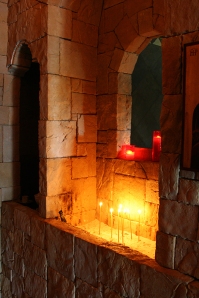
Coupled with the prayers of the monastics, the saints that dwell within the monastery, and the angels that protect it, there are also at least one or more chapels. The presence of a temple of God alone is enough to sanctify a place. And it is in this sanctified place that even without hearing God-inspired words or witnessing miraculous events, the pilgrim is refreshed. His weary and tired body and soul are nourished with more than monastic fare – they are nourished with monastic stillness.
A pilgrim once asked a priest-monk why it was that out of all the monasteries the pilgrim had visited, this one particular well-known monastery was the one in which grace and divine fragrance was the most perceivable. The priest-monk answered that although all monasteries are holy, that that monastery held the typikon to celebrate Divine Liturgy every single day, and confessed people for hours on end, and so as a result it attracted the grace of the Holy Spirit and He dwelt there. As Dr. Constantine Carvanos surmises, “[t]hrough confession at these centers of spirituality, through participation in the moving services of the monks or nuns, and speaking with them, a Christian living in the world is aided by calm refuge from his worldly cares, by being purified, by rediscovering himself, and by tasting of the gifts of the Holy Spirit.”[13]
St. Nikolai Velimirovich records: “When [St. David of Garesja] arrived at a hill from which Jerusalem was visible, [he] began to weep and said, ‘How can I be so bold to walk in the footsteps of the God-man with my sinful feet?’ David then told his disciples that they, being more worthy, should go to worship at the holy places, and he took three stones and began to return.”[14] The saint’s humility was so great that he considered the sight of the Holy Land and even its pebbles to be overflowing with grace. How much more does the grace of a sacred place exceed sight and stones? In this sense the words of St. Theodora hold an even greater significance: “Love stillness. One who is not attached to the vanities of this world is strengthened in soul by stillness, abstinence and silence.”[15] This strength, harnessed by the grace of a sacred place, can then be brought back into the world if treasured and safeguarded through prayer and watchfulness.
 Conclusion:
In conclusion, “if you want to know if someone loves Christ, find out if he loves monasticism,” as the saying goes. Visit monasteries, acquire humble-mindedness, and abstain from judging others – both the believer who is too lax and he who is too strict. “Wherefore seeing we also are compassed about with so great a cloud of witnesses, let us lay aside every weight, and the sin which doth so easily beset us, and let us run with patience the race that is set before us, looking unto Jesus the author and finisher of our faith” (Heb. 12:1-2).
All photos that appear in this article belong to Nektarios and are used with permission.
[1] The Great Canon of Repentance, Song 9, [11].
[2] Archimandrite Zacharias, The Enlargement of the Heart, 174.
[3] Monk Isaiah to Honourable Nun Theodora, Matericon, 160.
[4] Archimandrite Zacharias, The Enlargement of the Heart, 174.
[5] St. Nikodemos, Handbooks of Counsel [Greek], 15-16.
[6] St. Symeon the New Theologian, from Dr. Constantine Carvanos’ article A Discourse for those living in the world, Orthodox Info: http://orthodoxinfo.com/praxis/discourselivingworld.aspx.
[7] Abba Apollo, Sayings of the Desert Fathers, 36.
[8] Philokalia, St. Diadochos of Photiki: “On Spiritual Knowledge and Discrimination: One Hundred Texts”, vol. 1, [12], 255.
[9] St. John Climacus, The Ladder of Divine Ascent, op. cit., 128.
[10] Abba Dorotheos, Practical teaching on the Christian life, “On the Fear of God,” [52], 113.
[11] St. John Chrysostom, Pros piston patera (To the faithful father) 3, 14, PG47, 372- 74.
[12] Professor Georgios Mantzarides, Images of Athos by monk Chariton, http://www.stanthonysmonastery.org/monasticism.php
[13] Constantine Carvanos, Discourse on those living in the world, Orthodox Info: http://orthodoxinfo.com/praxis/discourselivingworld.aspx.
[14] St. Nikolai Velimirovitch, Prologue, May 27.
[15] St. Theodora, Matericon, 85.
http://lessonsfromamonastery.wordpress.com/visiting-monasteries-2/
http://agapienxristou.blogspot.ca/2014/10/five-reasons-to-visit-monastery.html
http://lessonsfromamonastery.wordpress.com/visiting-monasteries-2/

How often do you find yourselves being asked by your parents to say, "thank you?" Whenever you are offered a treat from a friend or an adult helps you out, you hear a voice from over your shoulder, "Now, what do you say?" Of course your parents want you to be respectful and use good manners, and this is why they teach you to say, "Thank you," but I wonder if we truly know what it means to be thankful.
Thankfulness is a state of being and a way of life for all Orthodox Christians, for you and me. A thankful spirit is a key characteristic of a Christian. It sets us apart from the world. It makes us different.
Thankfulness is more than a comparison of our own circumstances to someone else's. It is more than having enough food to eat, a nice home, good health, or financial security, because any of these can be lost in an instant. Thankfulness is being grateful to God for who we are, His sacrifice for us, and the hope and joy of everlasting life.
But how do we show our thankfulness to God?
Faith in Good Works:
First, the Orthodox Christian life is a life of faith — faith in a Lord who laid His life down for our salvation. No one would deny the fact that the Christian life is one full of faith. But St. James tells us that if we have true Christian faith, it will be shown in our good works. He writes, "What use is it, my brethren, if someone says he has faith but he has no works? Can that faith save him? Even so faith, if it has no works, is dead, being by itself (James 2:14,17)." He is telling us that if you have faith in Christ, and your life is locked into that faith, then your faith will naturally lead you to do good works.
The proof of your faith is in good works. Can the proof be found in your life? Again St. James says, "But prove yourselves doers of the word and not just hearers who delude themselves" (James 1:22). Too often we join the people who hear but fail to produce the works that would make us doers. By doing the good works that Jesus taught us to do, we show by our actions that our faith is real. The proof of thanksgiving in the Christian Life is Faith that produces good works.
Love Equals Sacrifice:
But it doesn't just stop here. The Christian Life is a life of Love. Love not in just words but in action, and love in action is Sacrifice. Love is sacrifice. St. John tells us "We know love by this that He laid down His life for us (1 John: 3)." We must sacrifice our will for the will of Christ, just as He sacrificed His will for the will of the Father.
Many of you might be involved in sports and many of your games might take place on a Sunday morning. What do you? Do you continue to participate in a league that causes a conflict between you and your faith that holds Sunday morning as a time dedicated to the sacred worship? A faith that offers the Body and Blood of Jesus Christ in Holy Communion for all the faithful to receive Him and become one with Him.
Which will you choose? If you sacrifice your participation in this league that plays on Sunday mornings, it is a real way of showing that you put God first. It shows that Christ is so important in your life that you want to show it by offering thanksgiving and worship to Him at Sunday Divine Liturgy.
We have already said that Works are the proof of Faith, and Sacrifice shows our Love. But there is one more aspect of our thankfulness to Christ that we need to think about.
Discipleship/Apostles for Christ:
What does it mean to be a disciple? We know the original 12 Disciples followed Jesus, and traveled with Him during His ministry. They lived with Him and ate with Him, took on His ways, His teachings, His values, and His character. Not only that, but they also became apostles by teaching the faith to others, helping others to know Jesus.
They were true followers, true disciples of Jesus. We as Orthodox Christians in the 21st Century are also disciples by living as He taught us. In the Gospel of John, Jesus says, "If you abide in my word you are my disciples indeed (John 8:31)." Jesus was saying that if you are trying to live your life the way I have taught you, then you are my follower. You can truly be called a Christian.
If you love the way He has told you to love — by SACRIFICE — then you are part of Him and the proof of your thankfulness is clear. If you try to walk in Faith, do His Works, and are obedient to His will, the proof of your thankfulness is clear.
A tree branch stays alive and bears fruit only because it is attached to and draws nourishment from the tree. We are the branches and Jesus is the tree. We draw nourishment through Him.
Being thankful to God is not just an idea. Often we say things but there is no substance behind it. Today we talked about real ways of showing our thanks to God -- not just in words but in the way we offer our lives to God:
Faith leads us to do works of charity, help those in need, offering our time and talents;
Love encourages us to sacrifice our lives and be obedient to the will of God, so that our will is the same as the will of God; and
Living a Christ-centered life and walking in His ways, as His disciples and apostles did, bring us to the very center of our Faith.
May the mercy and love of our Lord and Savior Jesus Christ be with all of you. Amen!!
http://agapienxristou.blogspot.ca/2013/10/saying-thank-you-to-god.html


