Elias Miniatis, bishop of Kerniki and Kalavryta
“No one can serve two masters; for either he will hate the one and love the other, or else he will be loyal to the one and despise the other.
You cannot serve God and mammon” (Mt. 6:24 )
God and the world(1)are two opposites that are completely foreign and infinitely distanced from each other. These are the two masters Christ is referring to when He states that it is impossible for someone to serve both simultaneously.
If someone decides to draw near to one, he necessarily distances himself from the other. If he begins to love one of them, he will inevitably develop hate for the other.
If he chooses to concern himself with and admire one, he must neglect and loathe the other.
“For someone will either hate the one and love the other, or be loyal to the one and despise the other.”
Our eyes cannot simultaneously look at the sky and the ground. Our mind cannot concurrently be devoted to heavenly and earthly matters. Our heart cannot at the same time love both God and the world. It is either one or the other; because
it is impossible for a person to have both:
“You cannot serve both God and mammon.”
There are two reasons for this. The first one is this: God wants man entirely to serve only Him. However, the world also wants man to completely submit himself to it. Thus, it is impossible for man in total to be in both places. The second reason is that God’s law is diametrically opposed to the world’s ordinances. It is likewise impossible for someone to follow two totally different sets of instructions.
On account of these two reasons, it is impossible for someone at the same time to be the slave of two different masters; namely, God and the world.
The first and great commandment that God gave in the Old Testament, and which Christ repeats many times throughout the Gospel, is this:
“Hear, O Israel, the Lord our God is one Lord. You shall love the Lord our God from your whole heart, from your whole soul, and from your whole
power” (Dt. 6:4-5).
In other words, God says, “you have only one natural and genuine master, O man!
It is Me the Lord. For I created you out of nothing, I gave you life and your soul, I ransomed you with My own blood, I granted you salvation, and I have prepared the Kingdom of Heaven for you. You are My creation, My possession ,you belong entirely to Me.”
Thus, “You shall love the Lord your God with all your heart, with all your soul, and with all your mind” (Mt. 22:37).
1
The term “world” takes on various meanings when used in Scriptures. It can refer to i) the earth, or the universe; ii) the people, or mankind. More often, however (as in this present text),it is used to refer collectively to the worldly, earthly, and sinful mindset and lifestyle prevailing in the majority of people on earth, in contrast to the spiritual, godly, and holy way of life practiced by the minority of people who chose to follow Christ’s commandments.
http://www.stnektariosmonastery.org
Do not say, "this happened by chance, while this came to be of itself." In all that exists there is nothing disorderly, nothing indefinite, nothing without purpose, nothing by chance ... How many hairs are on your head? God will not forget one of them. Do you see how nothing, even the smallest thing, escapes the gaze of God?
St. Basil the Great
Always have the fear of God in your heart, and remember that God is always with you, everywhere, whether you are walking or sitting.
St. Gennadius of Constantinople

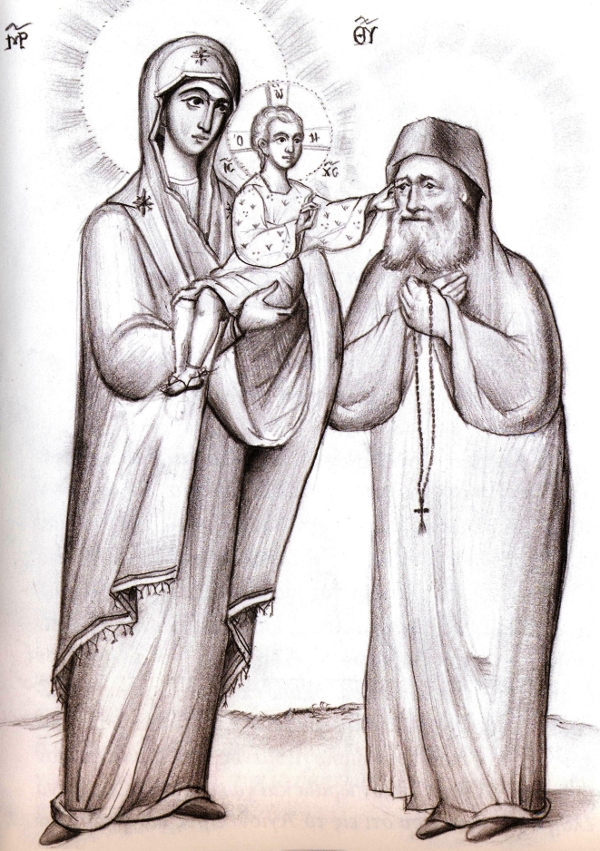
Q.: I’ve noticed, Elder, that sometimes babies smile at the time of Divine Liturgy.
A.: They don’t do that only at the Divine Liturgy. Babies are in constant contact with God, because they’ve got nothing to worry about. What did Christ say about little children? ‘Their angels in heaven continually gaze upon the face of my Father who is in heaven’. They’re in touch with God and with their guardian angel, who’s with them all the time. They smile in their sleep sometimes, and at other times cry, because they see all sorts of things. Sometimes they see their guardian angels and play with them- the angels stroke them, tease them, shake their fists and they laugh. On other occasions they see some kind of temptation and cry.
Q.: Why does temptation come to babies?
A.: It helps them to feel the need to seek their mothers. If there wasn’t this fear, they wouldn’t need to seek the comfort of being cuddled by their mothers. God allows everything so that it’ll turn out well.
Q.: Do they remember what they see as babies when they grow up?
A.: No, they forget. If a little child remembered the number of times it had seen its guardian angel, it might fall into pride. That’s why, when it grows up, it forgets. God’s wise in His doings.
Q.: Do they see these things after baptism?
A.: Of course after baptism.
Q.: Elder, is it all right for an unbaptized child to reverence relics?
A.: Why not? And they can be blessed with the holy relics. I saw a child today, it was like a little angel. I asked, ‘Where are your wings?’ It didn’t know what to say! At my hermitage, when spring comes and the trees are in blossom, I put sweets on the holm-oaks next to the gate in the fence and I tell the little boys who come: ‘Go on, boys, cut the sweets from the bushes, because if it rains they’ll melt and spoil’. A few of the more intelligent ones know that I’ve put them there and laugh. Others really believe that they’ve grown there and some others have to think about it. Little children need a bit of sunshine.
Q.: Did you put lots of sweets, Elder?
A.: Well, of course. What could I do? I don’t give good sweets to grown-ups; I just give them Turkish delight. When people bring me nice sweets, I keep them for the kids at the School [the Athoniada]. ‘See, last night I planted sweets and chocolates and today they’ve come up! See that? The weather was good, the soil was well-turned because you’d dug it over well and they came up just like that. See what a flower garden I’ll make for you. We’ll never need to buy sweets and chocolates for kids. Why shouldn’t we have our own produce?’ (Elder Païsios had planted sweets and chocolates in the freshly dug earth and put lilac blossoms on top to make it seem that they were flowering).
Q.: Elder, some pilgrims saw the chocolates you planted in the garden because the paper stood out against the soil. They didn’t know what to make of it. ‘Some kid must have put them there’, they said.
A.: Why didn’t you tell them that a big kid put them there?

Q.: Elder, why does God give people a guardian angel, when He can protect us Himself?
A.: That’s God looking after us especially carefully. The guardian angel is God’s providence. And we’re indebted to Him for that. The angels particularly protect little children. And you wouldn’t believe how! There were two children once, playing in the street. One of them aimed at the other to hit him on the head with a stone. The other one didn’t notice. At the last moment, apparently, his angel drew his attention to something else, he leapt up and got out of the way. And then there was this mother who went out into the fields with her baby. She breast-fed it, put it down in its cradle and went off to work. After a bit, she went to check and what did she see? The child was holding a snake and looking at it! When she’d suckled the child, some of the milk had stayed on its lips, the snake had gone to lick it off and the baby had grabbed hold of it. God looks after children.
Q.: Elder, in that case, why do so many children suffer from illnesses?
A.: God knows what’s best for each of us and provides as necessary. He doesn’t give people anything that’s not going to benefit them. He sees that it’s better for us to have some sort of defect, a disability instead of protecting us from them.
Source: Discourses 4, Family Life, published by the Holy Monastery of Saint John the Theologian, Souroti, Thessaloniki
The Differences between the Trials
Trials (peirasmoi) are so called because they engender experience (peira), since in the unseen war they do indeed afford spiritual knowledge to those who are attentive. Anything is called a trial if it is in opposition to our struggle for faith and true piety while we are pressing on towards submission to God, but they are subdivided into various kinds, according to the understanding of the Fathers. There are the trials of those taking part in the struggle, so that they may make additional gains and progress in their struggle. There are the trials of the slothful and unwilling, to make them beware of things that are harmful and dangerous. There are the trials of those who are drowsy or sleeping, in order to wake them up. Then again there are the trials of those who have distanced themselves and gone astray, to make them draw near to God. Different again are the trials of the righteous and friends of God, so that they may inherit the promise. There are also trials of the perfect, which God permits in order to bring them forward in the Church for the strengthening of the faithful and as an example to be emulated. There is also another kind of trial, again of the perfect, such as those endured by our Lord and the Apostles, who fulfilled the law of communion with the world by taking up the trials which are ours.
Spiritual Fathers also participate in this law of ‘communion’ by bearing the burdens and the weaknesses of their spiritual children through prayers and other struggles which supplement what is lacking in others. There is also another way, according to the Fathers, in which one person may be a sharer in someone else’s trials, and this is as follows: the accuser shares in the trials of the accused, the slanderer in those of the slandered, the wrongdoer in those of the wronged – especially when those who are wronged endure the harm done to them without a murmur.
We shall speak at this point of the trials of those who are making progress as a result of their attentiveness and willingness to struggle, which – again in the judgement of our Fathers – are usually the following: indolence, heaviness of body, languor of the limbs, listlessness, confusion of the mind, suspicion of bodily sickness – faintheartedness, in other words – darkening of the thoughts, being abandoned by human help, constriction in their external needs and the like. All these things, when – by God’s consent – they befall participants in the struggle, give rise to a sense of dereliction. Their faith then begins to be waver, as if the hope which had given them heart up till then had been cut off. But secretly grace consoles them so that they do not change their regime, because it convinces them that the trial has not come from themselves, since everything testifies that they have not abandoned their consistent good practice. After facing this difficulty and receiving the mystical consolation of grace, they turn with faith and yearning towards God who has power to save them, and fall down in humility asking His salvation, which is the end to which they have endured these trials. Such, according to the Fathers, are the trials of those who are advanced and making progress in spiritual matters.
In those who chance to neglect their duties or, which is the most terrible, fall into self-conceit and pride, the trials are different and harsher, in the same way as surgical operations and excisions are called for in cases of serious illness. The demons at first make war on them openly and quite shamelessly and insistently, and beyond their strength (cf. 1 Cor. 10:13). They experience a darkening of the intellect so that they lose the power of discrimination altogether, and imbecility and idiotic thoughts abound; an intense war of the flesh, pressing their will to go contrary to nature; anger for no reason and intractability in whatever concerns their own will; quarrelling on the spur of the moment and rebuking people at random; blasphemous thoughts against God; a loss of courage in the heart; being mocked by the demons, secretly and openly; lack of restraint in idle talk and, in general, a desire for the world and for idle vanities. After that, trials which are severe and hard to dispel: strange and unaccustomed symptoms of illness and painful wounds, a poverty and dereliction that is unaccustomed and defies consolation and everything else that is impossible and insoluble, which gives rise to despair and fear because the heart is devoid of hope. All these things are consequences mainly of pride, and come upon the person who has been led astray into believing in himself; and all these are the medicines for his healing, to make him sober up and humble himself and vomit out the bile of this devastating perversion.
As in matters of grace there are means of assistance which augment our progress both in time and in quantity, so also on the side of error there are factors which contribute to its fluctuation. On the side of grace, when by the grace of Christ someone treads the strait and narrow way (Mt 7:14) of the commandments according to the measure of his understanding, he increases the aid and illumination given by grace if he also acquires humility and sympathy in the service of love. Something comparable happens on the side of error. If impatience and grumbling are added to it, one’s cross becomes twice as heavy if not more. Faintheartedness and lack of hope are the most excruciating horrors of the unseen war, and are reserved for hard and unhumbled characters as the harshest lesson, which is a taste of hell itself and of punishment, a palpable sign of desertion and dereliction. Here it takes the prayers of saints and the intervention of a miracle for the heart to be softened. Many prayers and tears are needed for this sick soul to be reunited with grace and so be healed: otherwise it is inevitable that error will conquer, and that way lies madness and destruction.
O blessed humility and gratitude! Who is wise and will keep thy ways and understand thy statutes, that he may win thee totally and have thee as his intimate companion: that thou mayest go before him and follow him in all his ways, until thou presentest him to thy Master and King, who has taken thee as His delight and sharer of His throne and has revealed thee to us! For he says, ‘Learn from me, for I am gentle and lowly in heart’ (and not just in appearance) ‘and you will find rest for your souls’! (Mt 11:29).
It was not our intention to repeat so many problems and explanations well known from our Fathers; we were carried away by our train of thought, since almost unintentionally we found ourselves amidst the whirlwinds of trials to which we so often fall victim through our many deficiencies and lapses in attention.
The ever-memorable Elder never stopped explaining to us at every stage of our life, in his own delightful way, the aim and purpose of these ‘contractual afflictions’. We saw the movement and functioning of these afflictions constantly within the framework of the spiritual law which regulated everything in our lives in detail. Indeed, how much wisdom is concealed here in those who have understanding in the science of the spiritual life, when they chart their course over this ocean of life using nothing but this lodestone of the spiritual law, ‘the law of the spirit of life’! (Rom. 8:2).
http://agapienxristou.blogspot.ca/2013/09/experiences-teachings-and-struggles.html


