Tuesday, May 1, 2018

How to Recognize the Holy Apostles in Icons...


Icons are painted as windows into Heaven, and therefore to show the Heavenly, rather than earthly, reality. Nevertheless, Icons are made of the people we love: of the heroes of the faith who are remembered and whose earthly lives are considered instructive and worthy of imitation. Therefore it is natural that, as well as depicting them in a stylized “spiritual” way, the Saints are also depicted as recognizable people, with distinct features. This guide is just a brief description of how the Holy Apostles are depicted in Icons, so that they can be more easily recognized when encountered in churches, monasteries, or wherever else an icon is found.
St. Peter


The fiery and impulsive Leader of the Twelve, Peter is easily recognizable by his white, short, curly hair and beard. He is often shown holding a scroll, which may have words taken from one of his Epistles written upon it. In some icons he may also be shown with keys hanging from his belt, a reference to the words Jesus said to him: “And I will give unto thee the keys of the kingdom of heaven: and whatsoever thou shalt bind on earth shall be bound in heaven: and whatsoever thou shalt loose on earth shall be loosed in heaven.” He is often found in Icons with St. Paul, who were both martyred in Rome, holding together the Church, and showing their shared pre-eminence among the Apostles.

St. Paul


Though not one of the original Twelve, St. Paul has always been known as an Apostle (literally meaning “one who is sent out”), and moreover a leader of the Apostles. As such, he is often shown in Icons of the Apostles, including the one at the top of the page. Paul is always depicted with brown hair and beard tapering to one or two points. He is balding with a high forehead (signifying great wisdom and learning) but with a tuft of brown hair in the centre. He is often shown carrying a large Gospel book, an affirmation of the number of epistles he contributed to what became the New Testament. In addition, the Evangelist Luke was a physician who followed St. Paul on his missionary trips, so it is fair to say that Paul would also have had an influence upon the Gospel of Luke and the Book of Acts.

St. John
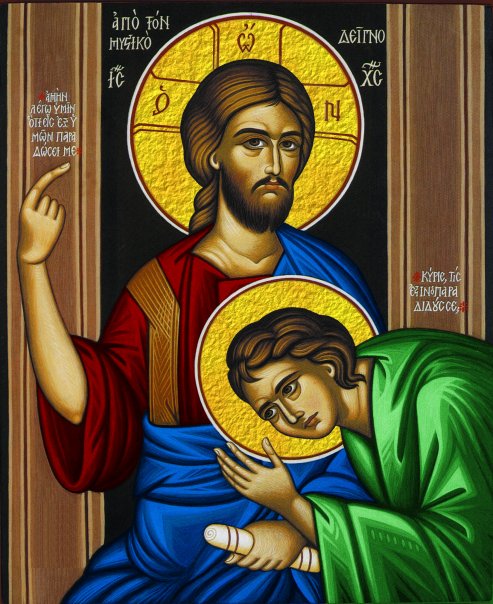


John the “Beloved Disciple”


St John theTheologian
There are two common depictions of the Apostle John: as the “Beloved Disciple” and as “the Theologian”. The former Icon is of the young Apostle John – the John who rested upon the breast of Christ during the Last Supper. In any icon showing scenes from the life of Christ (e.g. the Transfiguration, the Crucifixion) or those depicted in the Acts of the Apostles (e.g. the Ascension or Pentecost) then St. John is shown as the beardless brown-haired youth, little more than sixteen years of age.

When John is painted in a “portrait”, rather than as part of a Biblical scene, then he is usually shown as the elderly John “the Theologian”. This is the John who, sixty years or so after the Resurrection of Christ, is exiled upon Patmos and writing both the Gospel of John and the Book of Revelation. He is shown with long white beard and high forehead, holding the Gospel book which led to his title “the Theologian”, often shown open to reveal some verses from the book. He may also be shown with an Eagle, the symbol of both John and his Gospel.

St. Matthew


Like John, St. Matthew also authored a Gospel account, and so likewise is usually depicted holding a large Book. Whether in portrait or in Icons depicting Biblical scenes, Matthew has long, wavy, white beard and closer-cropped hair. As a deliberate anachronism to aid identification, he may also be shown holding the Gospel Book in Icons with Christ depicting Biblical scenes. Matthew may sometimes be shown with a winged man, the symbol associated with his Gospel.

St. Andrew “the First Called”


Andrew, the brother of the Apostle Peter, was formerly a disciple of St. John the Baptist. Because of this, Andrew is depicted with long unkempt hair, in the manner of the prophet he followed. This makes him one of the most recognizable of Apostles when depicted in scenes showing Jesus’ earthly ministry. Andrew holds a small scroll not to indicate he authored any famous works, but to identify him as a preacher of the Gospel, “one who is sent out”, i.e. an Apostle.

St. Bartholomew


Bartholomew, also known as Nathaniel, is shown as a middle-aged man, with short beard and hair. He is also shown holding the scroll of an Apostle. After his martyrdom, St. Bartholomew has appeared to a number of people in vision and dream, so his appearance can be deduced. He has appeared to St. Joseph the Hymnographer, blessing him that he might be able to sing spiritual hymns, saying, “Let heavenly water of wisdom flow from your tongue!” He also appeared to Emperor Anastasius I (491-518) and told him that he would protect the new town of Dara.

St. Simon theZealot


Not to be confused with St. Peter, who was previously named Simon bar-Jonah, the Apostle Simon was from Cana, and is the bridegroom of the famous Wedding at Cana. He is always shown with grey curly hair and beard, though with a higher forehead than St. Peter.

St. Thomas


The Apostle Thomas is most famously known as “Doubting Thomas”, on account of his refusal to believe the accounts of the other disciples that Christ had risen. Often maligned for this, in Orthodox teaching it is recognized that through his initial doubts, Thomas came to confess Jesus Christ as “Lord and God” – a greater confession of faith than any of the Apostles had previously uttered. Sometimes this confession of faith is held in Thomas’ hands in icons depicting him, though more commonly it is the scroll denoting his rank of Apostle that is shown. The most striking thing about the Icons of Thomas is that he is shown as a beardless youth, a teenager as John was. This is a consistent feature of how Thomas is shown in icons, as in this Icon of Thomas touching the wounds of Christ.


The youthfulness of the Apostle Thomas is something worthy of consideration when thinking about his “doubts”.

St. James, Son of Zebedee


There are two Apostles named James. The son of Zebedee is the James often nicknamed “the Greater” in the West. This is largely because among the Twelve he was part of the “inner-circle” which also contained St. Peter and St. John. The Apostle John is also the brother of James and together they were known as the “Sons of Thunder”. James is shown with medium length brown hair and beard. Though often difficult to identify by sight alone in Icons of the Twelve, he is recognizable in the bottom-right of this Icon of the Transfiguration,which along with the young John and curly-haired Peter, James was privileged to witness.


He is depicted as a young man (short beard, not white) in all icons, as he never got to live to an old age, being martyred a little over 10 years after the Resurrection.

St. Jude


St Jude Thaddeus
Jude is also sometimes called Levi or Thaddeus, and “Jude” is sometimes rendered Judas. Nevertheless, he is not to be confused with the Apostle Matthew (also called “Levi”), St. Thaddeus one of Jesus’ seventy disciples, or especially Judas Iscariot. The author of the Biblical Epistle which carries his name, the “Apostles’ Scroll” in his hand may sometimes show a quote from his own writing. Otherwise, St. Jude is identified as a mature man with curly brown (sometimes grey) beard and hair. As he was related to Jesus Christ through Joseph, husband of Mary, the appelation “brother of the Lord” (or “adelphos” in Greek) may be found on Icons.

St. James Alphaeus


The son of Alphaeus and the brother of the Apostle Matthew, James is shown with brown wavy or curly hair and a pointed beard. He is not to be confused with St. James “Adelphos”, which means “brother of the Lord”. In iconography, the two Jameses are easily distinguished, as “the brother of the Lord” is always shown in the robes of a bishop, being the first bishop of Jerusalem. Here is an Icon of James Adelphos.

St. Phillip


Holy Tradition and Scriptures maintain that the Apostle Philip was well versed in the Old Testament prophecies, and eagerly awaited the coming of the Saviour. He immediately responded to the call of Jesus, and recognized him as the Messiah (John 1:43); and subsequently led Nathaniel (the Apostle Bartholomew) to become a follower of Jesus too. Therefore it is remarkable to come into contact with icons of the Apostle Philip – who is always shown as beardless youth. Like the youthfulness of Thomas, it is something worthy of consideration.

St. Matthias


Matthias is the disciple of Christ who replaced Judas Iscariot as one of the Twelve Apostles after the latter’s betrayal and suicide. His appearance in icons is entirely in keeping with what is known about him. Schooled in the Law by the Prophet Simeon, who received the infant Christ in the temple, Matthias was already a man of maturity before becoming a disciple of the adult Christ. By the time of his martyrdom in 63A.D., Matthias would be the elderly man depicted in Icons of him.

Judas Iscariot


Judas Iscariot at the LastSupper


Whilst Judas is obviously not a saint, and isn’t shown in icons of “the Twelve”, he is nevertheless depicted in icons of the Last Supper or else kissing Christ in the Garden of Gethsemane. In icons of the Last Supper he is easily recognizable as the one dipping his hand into the dish, thus revealing his future betrayal of the Lord. Often, the Apostles are not shown with halos in scenes prior to Pentecost, but needless to say when they are shown with halos, Judas is conspicuous by not having one.

Whatever it may be worth – and it may be worth nothing – in Orthodox Iconography Judas is almost always shown beardless, like John, Philip, and Thomas; thus, like them, he was perhaps still a teenager at the time he betrayed his Saviour.

Thursday, April 26, 2018

Are they from God or from the spirit of evil? ( St. John Maximovitch )

Just as a basic concern is to be careful of anything that might be harmful to our physical health, so our spiritual concern should watch out for anything that might harm our spiritual life and the work of faith and salvation.
 Therefore, carefully and attentively assess your inner impulses: are they from God or from the spirit of evil?

St. John Maximovitch

Monday, April 23, 2018

Prayer is the elevation of one’s mind and heart to God. ( Saint John of Kronstadt )

Prayer is the elevation of one’s mind and heart to God. From this it becomes apparent that if a person’s mind and heart are attached to something carnal, for example, money, esteem, or has hatred or envy toward others, he is unable to pray. This is because passions bind the heart, whereas God gives it genuine freedom.

Attempt to acquire a child-like simplicity in your dealings with people and in your prayers to God. Simplicity is the greatest blessing and attribute in a human being. God is totally simple because he is totally spiritual, totally good. And don’t let your soul be divided into good and evil.

During prayer, remind yourself of the simplicity of truth and say: "Everything is simple!"  "I believe simply and request simply; but your deceptions, my enemy, your doubts and desires , I reject." May the basis and source of all your words and deeds be the humble realization of your personal insignificance and the greatness of God , Creator and controller of everything (1 Cor 12:) He who is infected with pride is inclined to be contemptuous of everything. By its very nature, pride defiles every decent thought, every word and act. It is the death-dealing breath of Satan.


Saint John of Kronstadt

Thursday, April 19, 2018

Why did God not make the path to the Kingdom of Heaven light and pleasant? ( St. Innocent - Bishop of Alaska )

Why did God not make the path to the Kingdom of Heaven light and pleasant? Only God knows. Who would question His divine wisdom? He saw that the narrow path is what we need! We who are below see only bits and pieces, but He, Who is above all creation, sees our lives from the standpoint of eternity. However, though not completely understanding the plans of our Creator, let us consider the following:

1. The Kingdom of Heaven is the highest beatitude and inexhaustible wealth. If great efforts are necessary to obtain meager and temporary earthly advantages, then how can it be possible to obtain such a great and eternal treasure without any effort?

2. The Kingdom of Heaven is the most coveted reward. Where else are rewards given freely and for nothing? If we struggle to get temporary benefits, so much more should we struggle to obtain the eternal reward.

3. We must bear our cross because we want to be with Christ and to participate in His glory. If Jesus Christ, our Master and Teacher, gained heavenly glory through suffering, would it not be shameful for us to share His glory when we faintheartedly shun any trials or sorrows?

4. Besides, lifelong crosses are not the lot of Christians alone. Everyone carries their own cross, both Christians and non-Christians, believers and pagans. The difference is that for some, their crosses serve as a means of attaining the Kingdom of Heaven, while for the others they bring no such value. For the Christian, the cross gradually becomes lighter and more joyful, while for the nonbeliever it becomes heavier and more burdensome. Why is this so? Because where the one carries their cross with faith and devotion to God, the other carries it with grumbling and anger.

Therefore, Christian, do not shun your lifelong cross, but, on the contrary, thank Jesus Christ that He honored you to follow and imitate Him. If Christ had not suffered and died, then none of us, no matter how much we suffered and struggled, would enter the Kingdom of Heaven, for then we would have had to suffer as slaves, and slaves deserve no rewards. Now, however, we suffer as sons for our own salvation. O merciful Lord! How great is Thy love for us. How great are Thy benefits to us. Thou bendest evil itself for our benefit and salvation!

Christian! Gratitude alone to Jesus Christ, your benefactor, obliges you to follow Him. Christ came down to earth for you. Can it be possible that you would prefer some worldly thing to Him? For you Jesus drank the cup full of suffering; can it be that you would refuse to suffer a little for Him?

5. Jesus Christ redeemed us by His death, and, therefore, by the right of redemption we belong to Him and must do all that He wills. Christ wills only one thing: that we should attain eternal bliss.

6. Finally, we cannot avoid the narrow path into the Kingdom of Heaven, since every man has sins and sin in itself is an ulcer that cannot be cured without strong medicine. Suffering is the medicine with which God cures our souls. When somebody is ill, then, regardless of his surroundings — even though he is in the most magnificent of palaces — he will still suffer. Such is the fate of every sinner; no matter where he settles, even in Paradise itself, he will suffer because the elements of hell reside within him. Similarly, a righteous person can be as happy in a shack as in a palace. When our heart is filled with the Holy Spirit, wherever we may find ourselves, there we will always feel joy, since Paradise is within us.

And so, brethren, if you wish to attain the Kingdom of Heaven, you cannot bypass the path taken by Jesus Christ. Indeed, all the prophets, the Apostles, the martyrs, the saints and countless other righteous ones walked along this path. There is no other.

Some might object, saying, how can we who are sinful and weak be like Jesus Christ or the saints! We live in the secular world and have families and many responsibilities. Oh, brethren! This is a cunning excuse and an insult to our Creator. To justify our carelessness by such reasoning means to accuse our Maker of being unable to create us properly. After all, the saints, like us, were not sinless at first but participated in worldly affairs, labored and had various obligations and families to care about. Surely they were not perfect in everything. They had their share of temptations and low moments. Notwithstanding this, living in circumstances similar to ours and having their ups and downs, they steered toward the main objective of their life: the Kingdom of Heaven. Undoubtedly, we also, if we truly desire to, can be good citizens, faithful spouses, loving parents, and simultaneously good Christians. Our faith will not be an obstacle but, on the contrary, will aid all our good undertakings. The essence of Christianity is pure and selfless love, which is inspired by the Holy Spirit.

Therefore, brethren, if you wish to attain the Kingdom of Heaven, follow the path which Jesus Christ took, and He, the all-merciful one, will help you every step of the way.
 
St. Innocent - Bishop of Alaska

Saturday, April 14, 2018

Our intercessors in Heaven - the Orthodox Veneration of Saints ( Bishop Alexander Mileant )


During baptism a person receives a name in honor of a saint, who from that time becomes his heavenly protector. Every Orthodox Christian should be acquainted with the life of his heavenly protector and should appeal to him in prayer for help and guidance. Our righteous ancestors always tried to mark the day of commemoration of their saint – their “Namesday” – by partaking of the Holy Mysteries, and celebrated this day with greater ceremony than their birthday.

What is the reason for the Orthodox worship of God’s saints? Do the saints in heaven know of our needs and difficulties, and do they show any interest in us? Do they hear our prayers and do they try to help us? Should we appeal to the saints for help at all, or does it suffice to pray only to God? Members of sects, who have lost the apostolic tradition, do not understand the essence and the purpose of Christ’s Church and, therefore, reject the need to pray to the saints in heaven. We will briefly expound the Orthodox teaching on the subject.

The Orthodox veneration of God’s saints stems from the belief that all of us, both those who are working on their salvation and those who have already achieved salvation, both the living and the reposed, make up a single divine family. The Church is a great society which encompasses both the visible and invisible worlds. It is a huge, universal organization, built on the principal of love, in which each individual must not only take care of himself, but also be concerned with the benefit and salvation of other people. The saints are those people who, more than others, showed love for their neighbors during their life on earth.

We, Orthodox Christians, believe that when a righteous person dies, he does not break off his tie with the Church, but enters its higher, celestial domain – enters the triumphant Church. Having attained the spiritual world, the soul of a righteous person does not cease to think, desire, feel. On the contrary, these qualities of the soul unfold here more fully and perfectly.

Contemporary non-Orthodox Christians, having lost their living tie with the heavenly-earthly Church, have the vaguest and conflicting notions of the other world. Some of them believe that a man’s soul goes to sleep after death and becomes disconnected from everything; others believe that even if a man’s soul continues its activity after death, it no longer has any interest in the world which it has left. Still others believe that one should not pray to the saints in principle, since Christians are in direct communion with God.

What is the teaching of the Holy Scriptures in regard to the righteous ones who have departed from this world and the power of their prayers? In apostolic times the Church was regarded as a single heavenly-earthly spiritual family. Apostle Paul wrote to newly-converted Christians: “But ye are come unto mount Sinai, and unto the city of the living God, the heavenly Jerusalem, and to an innumerable company of angels, to the general assembly and church of the first-born, which are written in heaven, and to God the Judge of all, and to the spirits of just men made perfect” (Hebrews 12:22-23). In other words, you, having become Christian, have merged with a great family and have come into close contact with the heavenly family and the righteous ones therein. Apostle Peter’s words of farewell to the Christians of Asia Minor – “Moreover I will endeavour that ye may be able after my decease to have these things always in remembrance” (2 Peter 1:15) – clearly confirm that he promises to continue to take care of them when he departs for the other, spiritual world.

The ancient practice of appealing to the holy martyrs and saints for help is based on the realization of live contact between the heavenly and the earthly Church and on belief in the power of their prayers.

We know that the most earnest and righteous people were still in their lifetime called by God His friends and were glorified by Him with gifts of the Holy Spirit and with miracles. Thus, Christ said to His apostles at the Mystic Supper: “Ye are My friends!… For whosoever shall do the will of My Father Who is in heaven, the same is My brother, and sister, and mother” (John 15:14; Matt. 12:50). The Holy Scriptures provide many examples of the saints’ spiritual nearness to God and power of intercession before Him. Thus, for example, Abraham asked God to have mercy upon the denizens of Sodom and Gomorrah, and God was ready to fulfill his request if at least ten righteous people could be found in those cities. Another time God refrained from punishing Abimelech, king of Gerar, because of Abraham’s prayers for the latter. The Bible tells us that God spoke with the Prophet Moses face to face, “as a man converses with his friend.” When Miriam, Moses’ sister, sinned and was punished with leprosy, Moses was able to obtain forgiveness for her from the Lord. There are many other examples of the special power of the saints’ prayers.

The saints do not replace God and do not decrease the need to appeal to the Heavenly Father. After all, adult members in a family do not lessen the authority of the parents when they take care of their children together with them. Moreover, nothing gives greater joy to parents than to see older brothers taking care of younger ones. In the same manner our Heavenly Father rejoices when the saints pray for us and try to help us. God’s saints have a stronger faith than we do and are closer to God because of their righteousness. Therefore, let us appeal to them as to our older brothers who intercede for us before the throne of the Almighty.

It is noteworthy that the righteous ones, while still living on earth, saw and knew much of what is inaccessible to general comprehension. Even more so are these gifts inherent to them in the celestial realm, where they have gone after shedding their mortal flesh. During their life on earth, the saints were able to penetrate into the celestial realm by means of their spirit, and some saw hosts of angels, others were worthy enough to contemplate the image of God, still others were raised up to the third heaven and heard mysterious indescribable words there, as, for example, Apostle Paul. Now, residing in heaven, they are even more capable of knowing what takes place on earth and of hearing those who appeal to them, because the saints in heaven are “equal to angels.” From the Lord’s parable of the rich man and Lazarus we learn that Abraham, while being in heaven, could hear the cry of the rich man suffering in hell, despite the “great abyss” which divided them. Abraham’s words: thy brothers have Moses and the prophets, let them heed them, – clearly show that Abraham knew of the life of the Jewish people after his repose, knew of Moses and his law, of the prophets and their writings. The spiritual vision of the righteous ones’ souls in heaven is, undoubtedly, greater than it was on earth. Apostle Paul writes: “For now we see through a glass, darkly, but then face to face; now I know in part, but then shall I know even as also I am known” (1 Cor. 13:12).

The saints’ nearness to the throne of God and the power of their prayers for the faithful living on earth is evident in the book of Revelation, in which Apostle John writes: “And I beheld, and I heard the voice of many angels round about the throne, and the beasts and the elders: and the number of them was ten thousand times ten thousand, and thousands of thousands.” Further on he describes a vision of the righteous ones, praying in heaven for people suffering on earth: “And another angel came and stood at the altar, having a golden censer; and there was given unto him much incense, that he should offer it with the prayers of all saints upon the golden altar which was before the throne. And the smoke of the incense, which came with the prayers of the saints, ascended up before God out of the angel’s hand” (Rev. 5:11; 8:3-4).

Great is the power of prayer! “Pray for each other, so that ye may be healed: the earnest prayer of the righteous can do much,” – instructs us Apostle James. Prayer for others is an expression of love for them; thus, by praying for us, the saints in heaven show their brotherly love and care for us.

In the Gospel and in other New Testament books we find numerous instances which testify to the power of prayer for others. Thus, for example, the Lord healed the son of a courtier in response to the latter’s plea; the entreaty of the woman of Canaan resulted in her daughter being freed from possession by demons; at the request of a father the Lord healed his possessed son, while at the request of friends He forgave and healed a man sick of the palsy, whom the friends had lowered down from the roof on ropes; the faith of the Roman centurion led to the healing of his servant. Moreover, the Lord performed the majority of His miracles from afar, without actually seeing the sick person.

Thus, if the prayers of plain people had such power, then even more powerful are the prayers of saints who stand before the throne of God. “And this is the confidence that we have in Him, that, if we ask any thing according to His will, He heareth us,” – assures us Christ’s beloved disciple (1 John 5:14).

For this reason from ancient times the Church expounded a teaching on the benefit of prayerful appeals to saints. We see this, for example, in ancient liturgies and other written testimonials. In the liturgy of the Apostle James we read: “We especially commemorate the Holy and Glorious Virgin, the blessed Theotokos. Remember Her, Lord God, and by Her pure and holy prayers have mercy upon us and save us.” In commenting on the liturgy of the church of Jerusalem, St. Cyril of Jerusalem remarks: “We also commemorate (at the liturgy) the previously reposed – primarily the patriarchs, prophets, apostles, and martyrs, – in order that by their prayers and intercession God would accept our own appeal.”

The testimonies of the Church Fathers and teachers on the Church’s veneration of the saints are numerous, especially starting with the 4th century. But even from the beginning of the 2nd century there is direct written testimony of early Christians on their faith in the prayers of saints in heaven for their brothers on earth. Witnesses of the martyric end of St. Ignatius the God-bearer (early 2nd century) say: “Returning home in tears, we served an all-night vigil… Afterwards, having slept a bit, some of us saw the blessed Ignatius arising and embracing us, while others also saw him praying for us.” Similar records referring to the martyrs’ prayers and intercession for us can also be found in other narratives dating from this epoch of the persecution of Christians.

Belief in the holiness of a departed person can be confirmed by special testimonials, such as: martyrdom for Christ, a fearless confession of one’s faith, selfless service to the Church, the gift of healing, etc. This is especially true when the Lord affirms the holiness of a departed person through miracles occurring after the latter’s death and upon prayer to him.

Besides the assistance of prayer, the saints help us achieve salvation by the example of their lives. An acquaintance with the lives of the saints enriches a Christian through the spiritual experience of those who had embodied the Gospel in their lives more earnestly than others. We see here so many vivid examples of living faith, courage, patience. Being people just like us, and having overcome most difficult temptations, they encourage us to travel along the path of our life with patience and humility.

Apostle James urged Christians to imitate the patience of the ancient prophets and of Job the Long-suffering, and to acquire the strong faith of people like the prophet Elias. Apostle Peter instructed Christian wives to take an example of modesty and obedience from the righteous Sarah, wife of Abraham. The holy Apostle Paul exhorts Christians to imitate the spiritual labors of ancient saints, beginning with Abel and ending with the Maccabees. At the end of a detailed instruction on this subject he writes: “Wherefore seeing we also are compassed about with so great a cloud of witnesses, let us lay aside every weight, and the sin which doth so easily beset us, and let us run with patience the race that is set before us” (Heb. 12:1).

The Lord says: “Neither do men light a candle, and put it under a bushel, but on a candlestick; and it giveth light unto all that are in the house. Let your light so shine before men, that they may see your good works, and glorify your Father which is in heaven” (Matt. 5:15-16). The saints are the bright stars which show us the way to the Heavenly Realm.

Let us treasure the saints’ nearness to God and let us appeal to them for help, bearing in mind that they love us and are concerned for our salvation. An acquaintance with the lives of the saints is especially important in our times, when the concept of the Christian ideal has become so shallow and distorted among the wide mass of “Christians” of the most different varieties.

Bishop Alexander (Mileant)