
There are some who say Baptism should only be given to adults because we must first have repentance and faith. Earlier I was asked to comment on this subject and recently found the teaching of Elder Cleopa on this topic.
The Elder begins his explanation by pointing out the precursors to Baptism found in the Old Testament. He writes,
There in [the Old Testament] we read how God appeared to Abraham when he was ninety-nine years of age and, among things, told him to circumcise all the men and to circumcise all the male children who would be born from that time on on the eighth day after their birth. As for him who would not be circumcised , he would perish (Gen 17: 10-14). We see, then, that God did not say to Abraham that children and youth should be circumscribed when they became adults... Some say the Baptism of babies is meaningless since they don't understand anything when they are Baptized. But what did Issac, Abraham's child, understand on the eighth day? Undoubtedly he understood nothing. His parents, however, understood. This is how it is with Baptism as well, as it is practiced in the Orthodox Church, since it is well-known that circumcision symbolizes Baptism in the Old Testament.
He gives another example of the Exodus from Egypt and the passage through the Red Sea which is also seen by Church Fathers as prefiguring Baptism. This is affirmed by Paul who says, "Moreover brethren, I would not that ye should be ignorant, how that all our fathers were under the cloud, and all passed through the sea; and were all baptized unto Moses in the cloud and in the sea" (1 Cor 10:1-2). Moses had told the pharaoh , "We will go with our young and with our old, with our sons and with our daughters, with our flocks and with our herds we will go." (Ex 10:9).
He then points out that on the day of Pentecost the Apostles received the Holy Spirit and preached to the people what the Spirit had tight them, telling them to repent and to be baptized in the name of Jesus Christ for "the promise is unto you, and to your children" (Acts 2:39).
Elder Cleopa says,
"For what promise? The promise of Baptism. Thus, the promise was for the children as well. When it is said that they were baptized, it does not say three thousand men and women were Baptized, but three sous and fouls, which means that among those baptized were children."He next presents examples of families who were baptized as recorded in the New Testament. Lydia with her whole family (Acts 16:14). The prisons guard who took Paul and Silias to his house who was Baptised with his whole family ( Acts 16:33). Then there was Crispus and his family (Acts 18:8), and Stephanos and his household (1 Cor 1:16).
He writes,
Jesus Christ likewise, made it clear that little children ought to be Baptized, for when they brought Him some children to be blessed by Him, and His disciples obstructed them, the Lord scolded them, saying: "Suffer little children, and forbid them not, to come unto me: for of such is the kingdom of heaven; And He laid His hands on them, and departed hence" (Matt 19: 13-15). Hence , if the Lord calls children unto salvation from a young age, why would we obstruct them from receiving Holy Baptism?But how about the question of faith. Is it possible for children to be saved without faith?
The Elder responds,
"It is true that children are not capable of believing at the young age of their Baptism, but neither are they able to doubt or deny Christ. He is not saved who only believes, but he who first of all is baptized... While children do not have faith, they have godparents. These sponsors are adults who accompany the infants to Baptism and make the required confession of faith in their stead. Godparents are the spiritual parents of the children whom they baptize and undertake to guide them into a new life in the Holy Spirit... The priest conducts the Baptism based on the faith of the parents, the sponsors, and the other witnesses present.It is written in Scripture that the faith of a few can save others.
Here are examples given by Elder Cleopa,
"By faith the Roman centurion healed his servant (Matt 8:13). The servant did not believe, but on account of the faith of his master, Christ returned him to full health. Four people brought a paralytic tot he Savior: When Jesus saw their faith, he said unto the sick of the also, Son, thy sons be forgiven thee (Mark 2:3-5)... On the basis of the faith of Jarius the Lord raised his twelve-year-old daughter (Matt 9:18). On account of faith of others, the Lord healed a dumb, demon-possessed man (Matt 9:32). On account of the faith of the woman of Canaan, the Savior healed her daughter, casting out the demon that possessed her (Matt 15:21). Likewise on the account of faith of a father, the Lord healed his epileptic son (Matt 17:14). These and many other testimonies from Holy Scripture make clear to us that on account of the faith of parents, and others who stand as witnesses at Holy Baptism, the Lord grants sanctification and salvation to the baptized children."We also see this practice from the early days of the Church, The earliest explicit reference to child or infant baptism is in the Apostolic Tradition of Hippolytus, about 215 A.D.: "Baptize first the children, and if they can speak for themselves let them do so. Otherwise, let their parents or other relatives speak for them." (Hippolytus, Apostolic Tradition 21:15, c. 215 A.D.)
We must also keep in mind that baptism marks the beginning of our Christian life, each of us who are baptized must continue daily to persevere in our faith until the end of our earthly life. As St. Paul says: Not that I have already obtained all this, or have already been made perfect... I do not consider myself yet to have taken hold of it. But one thing I do... I press on toward the goal to win the prize..." (Philippians 3:12-14)
Elder Cleopa
Reference: The Truth of our Faith, Vol. II, 17-34

John weighed seven pounds, seven ounces on the day he was born. His first days of life were highlighted by bouts of crying and long periods of sleeping. On the drive home from the hospital, a few days later, John’s mother glanced down, looked at her new baby, and for a moment she smiled.
Then she looked ahead. “Honey,” she began, as she stared at her husband, “I know we decided to keep our careers so that we can be financially secure, but now I’m having second thoughts. I want to give our son the most attention we can. I want us to reconsider having me stay at home with him.”
Her husband shook his head in frustration. “We discussed this, remember?” he shot back. “We can’t afford to have one of us at home all the time. It doesn’t make sense.” For the next few minutes the proud new parents shared their thoughts and uneasiness of leaving their child in the care of someone other than his parents.
Conversations like the one above are common among new parents. Every parent wants the best for their child, yet mapping out how to exactly deliver that parenting has become more and more difficult. This struggle of parenting in contemporary society can be encapsulated by one word: time. We know that parenting takes time, but modern parenting has divided the concept of time into two categories – quality time and quantity time.
For so many hardworking parents “quality time” has become a very important concept. But what exactly is quality time? At a very basic level it can be defined as an activity that promotes communicating and sharing. For time to be deemed “quality time” it needs to be enriching and stimulating. Spending time watching television isn’t the ideal, but spending time working on a project or playing a game together is. A quick look at the historical development of the notion of quality time reveals some important information. Quality time arrived on the scene in the early 1970’s. Research indicated that the more actively mothers were involved with their babies, talking and cooing and so forth, the better it was for the babies’ cognitive and social development. The implication was that in order to have high-quality time, a fair amount of pure time had to be invested. Therefore, quality time originally assumed quantity time, but eventually the “quality not quantity” philosophy of parenting won out, simply because in our over scheduled and stressed society there was little opportunity for quantity time. Parents hoped that quality time at least made up for the lack of quantity time—so long as it was better and bigger, and more meaningful time.
Yet this ideology is flawed because parents simply can’t plan special moments of bonding or epiphanies with their child as they are unpredictable. They tend to happen within the every day mundane activities of parenting and within the notion of quantity time.
St. Theophan the Recluse touches on the issue of parenting time in his book titled: On the Upbringing of Children. He advises parents to preserve the blessing that baptism gives their child and to immerse their lives in its upbringing. The father and mother are to “disappear into the child and put their whole soul into his welfare,” he says. One of St. Theophan’s teachings on the upbringing of children centers on the establishment of developing a sound foundation – a foundation that takes a lot of effort and time. The development of this foundation is necessary to stand firm against what he refers to as the “shock waves of youth.” In other words, everything parents say and do in the early years is reflected in the latter ones. A great deal of this depends on the time we spend on our children. Much of good parenting also involves discipline and teaching. It’s through this process that children not only develop a sound conscience as good behavior becomes automatic; but it’s also through this process that good, productive habits become cemented into the child’s life. These skills need close and constant monitoring. And this is why quantity time is also important.
“The reason why the grace of Baptism is not preserved,” St. Theophan states, “is because the order, rules and laws of an upbringing are not kept.” And so the challenge for new parents is not only to establish order and rules, but to be around to see that their children live by them. Spiritually, we know that children form their ideas about God through their parents. It’s in the praying together, the listening of stories about Saints, in reading the Bible and especially in modeling Christlike behavior, that children form a lasting perception of God. When this doesn’t occur there is a void. “The family is recognized as the ‘home church,’ says Sophie Koulomzin in her book Our Church and Our Children, “and the task of parents is really a kind of a lay priesthood. Within a Christian family our Christian faith must be incarnated; it must be brought to life in the daily, hourly experience of living.”
Make no mistake, parenting isn’t simple and there are no cookie-cutter families. There are many legitimate reasons for parents to leave their child to the care of a friend or a day care center. Nowadays, most couples rely on two incomes and many single parents are trying to raise their child with minimum support. However, our faith calls for time to be both quality and quantity; therefore it’s good for parents to openly assess how much of a balance there is in the way they parent. For if parents want their children to develop consistent habits, if they want their children to develop a quality relationship with Christ, they have to sacrifice time and energy.
Next time your child asks you what time it is, and you look to give the chronological answer, remember that the most important time together isn’t measured merely by minutes, but by quantity and quality time.
Fr. Athanasios Papagiannis is a recently ordained priest serving at Assumption Church in Chicago. A licensed clinical social worker and former teacher, he is a 2010 graduate of Holy Cross School of Theology and a 2002 graduate of Aurora University.
The Orthodox Observer
Fr. Athanasios Papagiannis
25 / 10 / 2011
http://agapienxristou.blogspot.ca/2013/02/what-time-is-it-for-your-child.html

The upbringing of children must begin during infancy. This is necessary in order to direct the child’s powers of the soul—as soon as they begin to emerge—toward good, virtue, and truth, while simultaneously distancing them from evil, indecency, and falsehood.
This age is the secure foundation upon which a child’s moral and intellectual understanding will be erected. Thus, Fokilidis says: “It is necessary to teach someone to do good work while he is still a child,” because man sets out from childhood, as from a starting block, to run the race of life.
St.Basil the Great affirms: “It is necessary for the soul to be guided right from the very beginning toward every virtuous exercise, while it is still soft and moldable as wax; so that, as a child begins to speak and to acquire discernment, there exists a road comprised of the elemental concepts and devout etiquette that were initially imparted, giving him the ability to speak good and useful things and inspiring him to acquire a proper moral conduct.” Truly!
Who will not agree that the first impressions during childhood remain permanently ingrained and unforgettable? Who doubts that various influences during early youth become so deeply imprinted upon a child’s tender soul, that they continue to exist vividly throughout the duration of his life?
Nature has appointed parents, but especially mothers, to be instructors during this early stage of life. Hence, it is necessary for us to suitably teach and diligently raise virtuous women, on account of their supreme calling to become teachers; for they will serve as the images and examples that their own children will follow. A child mimics either the virtues or bad habits of his mother—even her
voice and manners, even her ethos and conduct to such an extent, that one can very appropriately liken children to phonographic records that initially register sound, and then play it back as it was originally voiced, in the identical pitch, the same quality, and with the same accent and emphasis.
Each glance, every word, every gesture, and every action of a mother becomes the glance, word, expression, gesture, and action of her child. Hence, Asterios notes: “one child speaks exactly like his mother, another bears a striking resemblance to her personality, while yet another takes on his birth giver’s manner and conduct.” By being in the constant presence of her child and through her repeated counsels, a mother profoundly affects the soul and character of her child, and she first provides him with the initial impetus toward virtue.
Saint Nektarios of Aegina
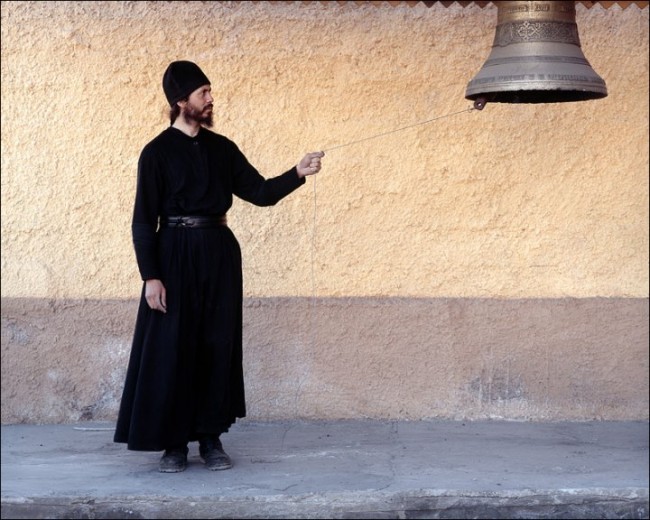
The following talk (slightly condensed) was given [in 1984] at the Saint Herman Winter Pilgrimage in Redding, California.
I should like to ask you to think of something you may not have considered before, How would you feel if your son or daughter expressed the desire to enter a monastery? You may be Orthodox, and very devout; you may he diligent in attending services and reading spiritual books; you may have tried your best to raise your children in an Orthodox manner; you may even admire monasticism. Nonetheless, how would you really feel?
We live in a time and society quite different from Greece and Holy Russia, where monasticism was a visible and acceptable part of life. It was not uncommon for entire families to make pilgrimages to monasteries. Few people today, however, have any significant exposure to monasticism and it is little wonder that in our un-Orthodox and even anti-Christian society, the very thought of one’s child becoming a monastic can seem very threatening.
There are a number of reasons one can give for such a reaction. Lack of familiarity breeds fear. Not a few people imagine monasticism to be very grim and even inhuman. They may envision their child locked behind a grating and subsisting for the rest of his or her life on bread and water. The other extreme is an equally- erroneous view of a romanticized spiritual state in which the child spends his days floating above the ground in an exalted state of endless holiness. In both cases it is imagined that entering a monastery presupposes leaving behind the human race. The reality of the monastic life is a far cry from either of these extremes. Your son or daughter—who is always late, leaves socks and soda bottles everywhere and is generally infuriating–will not turn into an instant anchorite. Anyone who leaves the world for the monastery brings all of his weaknesses and defects with him. He may learn to overcome some of them; others he will have until bodies, In any case, if your child becomes a monastic, he or she will not be living without human warmth and human relationships, and in spite of everything, you will still recognize them as being one of your own progeny.
Whatever your initial reaction to the issue of monasticism and your child, it depends to a great extent on how you as a parent view the Orthodox family and your position as an Orthodox individual in the contemporary secular world. Surrounded as we are by worldly standards and a materialist culture, we forget that Christ calls all of His followers to separate themselves from the world: Be not of this world. This is the trumpet call of monasticism. With this understanding, you should be more ready to peacefully acquiesce to the son or daughter who has found it in his heart to answer this call by taking upon himself the monastic yoke.
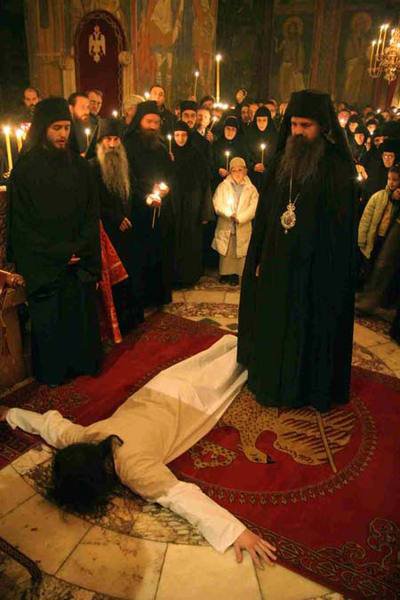
We are, however, the unfortunate products of our fallen nature, and it is rare that even a pious Orthodox parent is thrilled to hear that their offspring desires to enter a monastery. More often there arise some very strong reactions in the heart which, however innocent and well-intentioned, are nonetheless aspects of our fallen emotional and psychological nature – and a sad reflection of our un-Orthodox background and environment. With this in mind we can examine some of the emotional responses which this issue so often evokes.
Verbally, the various emotions stem from the pivotal question, “Why?” Why does anyone leave the world to enter a monastery? If the reason is legitimate, it is because in spite of all his failings and weaknesses, your child loves God more than anyone or anything in the world–more than the life you helped shape him for, more than his automobile, more than the school to which you were going to send him, more than his family… And here the very natural feeling of jealousy arises. As parents you may endeavor to replace God as being central in your child’s affections and persuade him to forsake monasticism, If you succeed, you will only make the child unhappy, and if you fail, you’ re going to feel very hurt.
Secondly. you may feel estranged or shut out from your child’s life. If your daughter goes to a monastery, and it’s a life you have not shared, you may feel you can’t relate to her. If she married, even if she moved a thousand miles away, you would very likely feel that you were still more a part of her life than if she became a nun and lived 50 miles away. A married daughter would still need advice on how to cope with the children’ s illnesses or how to manage a tight budget. On the other hand, if she were in a convent, you could hardly give her advice on how to do Matins, and even if you are Orthodox, you might feel emotionally adrift and very awkward with this suddenly foreign someone in black whose life is so different from your own. Then there is also the fact that most parents look forward to being grandparents, this is a big issue, especially with mothers.
You may feel threatened. You spend your whole life nurturing the well-being of your children: you feed them and worry over them; you help them to discover their abilities and you encourage them to develop their talents. Perhaps your son is a natural musician or your daughter a born lawyer, and you spend your life supporting them–emotionally and financially–and preparing them to be successful in the world. And after all these years of effort and anxiety, they suddenly decide they want no part of it, they don’t want the world, nor the life that you envisioned for them. This can be a very threatening and painful revelation. Very often parents feel that in rejecting the world, their child is also rejecting them. This is not necessarily true at all, but this feeling sparks most of the disputes between parents and their children over the issue of monasticism. Here also parents may feel they have failed in some way in their raising of the child, that he or she should choose such an “aberrant” path in life. This is also a painful thought.
The rather heated emotions which may arise over the issue of monasticism and one’s child frequently result in a barrage of reproaches. The following examples are not in the least hypothetical; they come from a list of actual remarks made by real mothers and fathers, some of whom consider themselves to be devout Orthodox. Their responses illumine the essence of the dispute as it is felt in the heart of those who are Orthodox and yet live in the world. They’ve said that we are not taking responsibility for ourselves; that we are just leaning on someone else so as to avoid having to make our own decisions. They say that if we love our neighbor we should be working to improve society and not dropping out of it into some euphoric dream. We often hear that monasticism is mere ostentation, some kind of fake spirituality: “Why don’t you stick it out in the world like the rest of us, where you have to deal with real life and real problems?” They say monasticism is selfish, egocentric, it divides and ruins the family; monasticism is “financially unstable”: What about your future security? Why don’t you just get a good job and send them all the money?…
While these remarks are quite varied, there is a common denominator, and that is worldliness. They are all rooted in a very worldly orientation. It is the complete and absolute rejection of this perspective on the part of the monastic aspirant which often makes the dispute between parents and child so violent, Although perhaps unconscious, the parents’ message underlying all this is: Conform yourself to the world; fit in; get a secure job; settle down; do what everyone else does…; spirituality is fine, but there’s no need to be extreme. We have already seen, however, that Christianity is otherworldly; by its very notate it is extreme: if you lose your life you shall gain it; if you try to hang onto it you will lose it; God became man that men might become gods. What could be more extreme?
Seek ye first the kingdom of God
Orthodoxy is the means by which we ascend unto God, through surrendering our own ego and self-will. Orthodoxy means war–against one’s fallen nature, against the devil, and against the world. This applies to all Orthodox Christians. Even those who live in the world–who have children and hold jobs–are required to keep themselves in some sense apart from the world. And there can be no compromise. The world is not and cannot be our home, and whether we choose to marry Christ or an earthly spouse, we can in no sense marry’ the world. We see, however, that it is precisely this desire–to have both God and the world–that is at the rooter the conflict evoked by the child’s entrance into monasticism. Experiencing their own reaction to the child’s rejection of the world may make the parents realize, perhaps as never before, their own attachment to the world, and how unwilling they are to sever themselves from the values and desires of the anti-Christian society in which they live.
It is especially difficult to struggle against the accepted view of the family which in this country has received a pseudo-religious status; youngsters are often all but worshipped as gods by their parents who see them as fulfilling their own egos. This is not Orthodox; it is, in fact, very destructive of our Orthodoxy which teaches that children are not the possession of their mothers and fathers: they are not playthings of their parents’ imaginations. Children are given by God for a time that they may be raised up in the knowledge of Him, and after that He summons them as He will. The duty of parents is not to prepare children to settle comfortably in the world, but to shepherd their souls, to prepare them to battle against the fallen world. Those who choose to fight in the front lines are those who hear the monastic calling. If your child wants to enlist in that war, he will swear before God and man that despite his sinfulness and frailties that overwhelm him at every hour of the day, he cannot find rest apart from God.
If such is the inclination of your child, do not hold him back, however logical your reasons For wanting to do so may be. If the desire for monasticism is simply a fanciful notion, they will find out soon enough, and nothing will be harmed by their trying. If, however, such a desire has indeed been planted by God as a means of their achieving salvation, don’t thwart it by trying to persuade him first to finish school or experience life in the world. Bring to mind the countless number of monastics, both men and women, whose spiritual legacy has so greatly enriched our holy Orthodox Church. If your child has the desire and determination to follow in their steps, however weakly, bless him, let him go. And may this blessing be also unto your own salvation and that of others.


