
A saintly hermit told the brothers the following story:
One day, as I was sitting in the desert, I began to feel worried and sad. A thought came to me: “Get up and go for a walk in the desert”. So I walked and came to a water-course and gazing into the distance in the moonlight- night had fallen already- I saw something hirsute sitting on a rock. At first I thought it was a lion and stopped walking in that direction. But then I thought it over and realized that, even if it were a lion, I shouldn’t be afraid, but rather should take courage and believe in the grace of Christ. So I started off again, heading towards the rock. Near the rock there was a small hole. No sooner did the figure see me approaching in the distance than it sprang up and disappeared into the cave.
When I got to the rock, I found a basket with some beans and a pitcher full of water, so I realized that the figure must have been a person, rather than a lion. So I went up to the opening of the cave and shouted: “Servant of God, please, do me a favour and come out and bless me”. No answer. I insisted that whoever it was should come out and give me a blessing, but the reply came: “Forgive me, Elder, but I can’t come out”. When I asked why, I received the answer: “Forgive me, but I’m a woman and quite naked”. When I heard this, I immediately took off the cloak I was wearing, wrapped it up and threw it into the cave. “Take this clothing, put it on and come out, please”. She did so. As soon as she came out, we said the usual prayer and sat down. Then I implored her: “Do me the favour, mother Elder, of telling me how you came to this place, how you spend your time here and how you found this cave”.
Then she began to tell me her life story:
“I was a ‘canonical’, she said [that is a woman dedicated to the Church but not tonsured as a nun], ‘and had dedicated my life to the church of the Resurrection of Christ. But where I used to perform this duty, there was a monk, who had his cell near the gate. This monk started to become familiar and seemed very pleased to be in my company or to speak with me. On one occasion I overheard him weeping and confessing this sinful inclination to God. I knocked on the door, and, when he realized it was me, he didn’t open it. Instead, he continued weeping and confessing to God. When I saw this, I said to myself: ‘Here’s this man repenting his own sin, but I’m unrepentant. He’s repenting and bewailing his transgression, so how can I remain like this, without the attire of mourning within me’.
So I immediately took the decision. I went back to my cell, put on an old and worn piece of clothing, filled my basket with beans and my jar with water. I went into the church of the Resurrection and made a prayer: ‘You, Lord, Who are our great and wonderful God, you Who came to earth to save the lost and raise the fallen, You who hearken to all those who sincerely ask Your assistance, show Your compassion and mercy to me, too, sinner that I am. And if it’s your good pleasure to accept my return and the repentance of my soul, bless these beans and this water, so that they’ll suffice for all the years of my life, so that I won’t be distracted- with the excuse of seeing to the needs of the flesh and the body- from continuous worship’.
Then I went to Golgotha and made the same prayer. I embraced the holy rock and the sacred vessels and again called upon the holy name of God. Then, in total secrecy, I left and, with complete confidence, gave myself into the hands of God. I went down to Jerusalem, crossed the Jordan and took the road that led to the bank of the Dead Sea. I’d never seen the sea-level so high. So I went up into the mountains and wandered in the desert until I came to this water-course. I climbed up onto the rock and found this cave. Since then I’ve come to love this place very much. I like to think that God gave it to me so that I could truly repent. I’ve lived here for thirty years and have never set eyes on another person, apart from you today.
And the beans in my basket and the water in my jar have never run out to this day, even though I’ve eaten and drunk as much as necessary. Of course, as time passed, my first clothes wore out and fell to pieces, but as my hair grew and got longer, I covered myself with it as if it were clothing. And so, by the grace of Christ, neither the cold nor the heat, even the furnace of the summer, do me any harm’.
She finished her story here and invited to me to eat some of the beans she had in her basket, because she’d been told “from the outside”, that I was very hungry. We ate and drank until I was full. But I saw that both the basket and the pitcher were still full, so I gave glory to God.
When it was time for me to go, I wanted to leave her my outer raso [habit], but she wouldn’t take it and said: “Bring me new clothes when you next come”.
I was filled with joy when she said this and begged her to wait for me and to welcome me again. We prayed again, I bade her farewell and left, imprinting the location on my mind so that I’d be sure to find it next time I came. I left and went to the church in the neighbouring village and told the priest what I’d seen and heard. He gathered the faithful and in a speech he made to them said: “Not far from our church, there are some saintly hermits whose clothes have fallen apart and they’re going about the desert completely naked. Anyone who’s got clothes to spare, bring them here and we’ll hand them out”.
Immediately, the Christians brought in a good many clothes. I took what I needed and, full of joy, started out again, hoping to see once more the blessed face of this spiritual mother, in the cave. I went back to the place, and tired myself out looking, but I couldn’t find the cave. When eventually I did find it, the God-bearing woman wasn’t there any more, and that upset me.
I went away, saddened. A few days later, some hermits came to visit me and two of them said: “We two were wandering around the desert on the other side of the sea when we suddenly saw, at night, sitting on a rock, a hermit with long hair. When we quickened our steps to meet up with him and take his blessing, he avoided us and went into the entrance of a nearby cave. We wanted to go in ourselves, but as we approached the doorway, a voice came from out of the depths of the cave, saying: ‘Servants of God, please don’t disturb me. On the rock next to you there’s a basket of beans and a pitcher of water. If you want, you can eat and drink’.
The voice gave us its blessing and we went to the rock as we’d been told to do. There on the rock were the basket of beans and the jar of water. We ate and drank and rested for the remainder of the night.
When we woke up in the morning we went to get the blessing of the cave-dwelling hermit, but saw that the person had already fallen asleep in the Lord. We wanted to prepare him for burial, but realized that it was a woman, covered with her own very long hair. We blessed ourselves with her holy relics and rolled a large rock across the entrance to the cave. Once we’d prayed, we started out on the road back”.
I then realized that it was the same ‘canonical’ who had lived as a hermit and had become a holy mother. So I told them what I had heard from her mouth and, all together we glorified God, to Whom, indeed, glory is due unto the ages of ages. Amen.
P.V. Paskhos, Αγγελοτόκος έρημος, Armos Publications, pp. 137-42.
http://tokandylaki.blogspot.ca
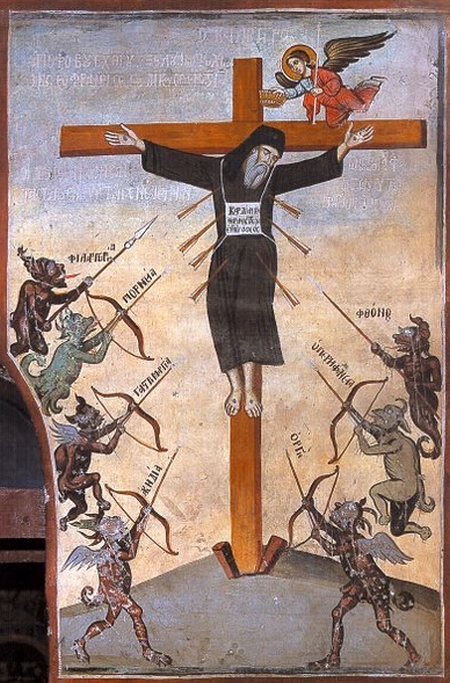
Fresco from Huretzi Monastery, Romania
This fresco depicting “the life of the genuine monk” is especially found in older Orthodox monasteries. Although this fresco depicts “the steadfast monk – the Christ’ follower,” we should also affirm that it represents “the one true Christian” who regardless of his social status, is a follower of Christ through his actions.
The genuine monastic is he who dies for the world to take on a permanent battle with his passions and his thoughts until his last breath. Ordinary Christian, married or not, has the same duty, to die to the world and start the same battle towards passions until the end.
Since the path to Christ’ Kingdom is narrow and rough, it is clear that the Christian whether be a monk or a layman, faces similar difficulties. St. John Chrysostom referring to the great labor toward salvation of both monastics and laymen alike, said: “The only difference between a layman and a monk is that the first is married and the other is not.”
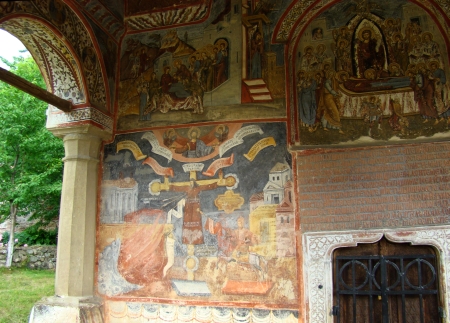
The fresco representing the true monastic is usually depicted in the entrance of the church near other icons such as “the Ladder of Divine ascent” and “the Dreadful Judgment.”
In the center of the icon, the monk is showed as been crucified, dressed in his black cassock, barefooted, with his feet nailed to the bottom of the cross; his face is peaceful and his eyes and his mouth closed. To his right it is written: “Place a watch oh Lord upon my mouth.”
In his hands, he holds two burning torches, and an inscription near this says: “Thus, let your light shine before men that they may see your good deeds.” On his chest, he lays a parchment baring the words: “Create in me a clean heart, O God, and renew a right spirit within me.”
On his womb, another writing will say: “Oh man, do not be deceived by gluttony.” Bellow his womb, another inscription writes: “Kill the members of thy earthly man!” Then, bellow his knees: “Prepare your feet for the Gospel of peace.”
At the top of the cross, a paper chiseled in stone depicts the following: “As for me, I will boast only in the cross of my Lord.
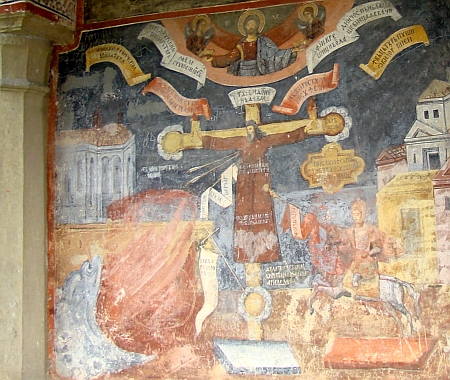
Both arms of the cross bare a seal at the end. The seal on the right bares the word: “And ye shall be hated by all for my name’ sake, but he who endures to the end shall be saved.” The seal at the left says: “Anyone of you, who does not renounce all that he has, cannot be my disciple.” And the seal at the bottom of the cross, placed under his feet, writes: “Narrow is the gate and rough is the path that leads to salvation and few are those that find it.”
A dark cave with a dragon coiled inside is represented at the right side of the cross, near which it is written: “the consuming/eternal hades.” Above the mouth of the dragon, a naked young man with his eyes tied by a knot, holds a bow with its arrow pointing at the monk asking: “Commit fornication!” A name is written over the young man as: “the lover of fornication.” Many snakes are depicted above the cave, which suggest: “our thoughts.” A demon is portrayed near this scene with a rope pulling away the cross and saying: “You cannot bare it!” And on the right side of the cross, another small cross is placed with a flag upon which is written: “I can do all through Christ, Who has clothed me with power.”
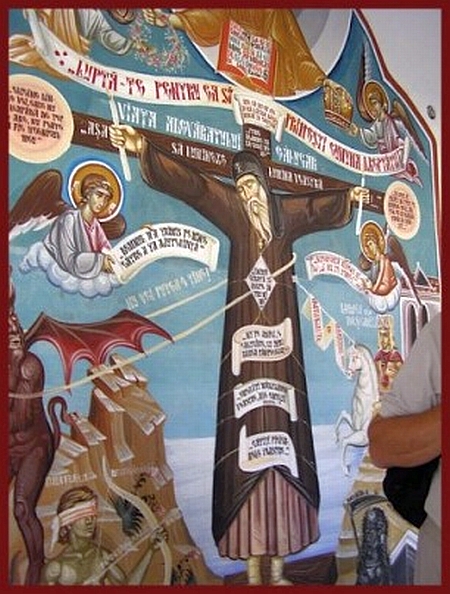
A tower and a gate are seen at the left side of the cross. A man clothed in gold and fur, riding a white horse passes through this gate holding a glass of wine in his right hand and a spear in his left hand. Above his spear it is written: “Take pleasure in the riches of this world, the vain world!”
A hole is drawn behind this rider and death coming out, wearing a big coat over its shoulders and a clock upon its head, upon which it is writing: “Death and the grave.”
Two angels are depicted near the monk arms on both sides, each holding a paper in his hands; the angel from the right bares: “God sent me to your strength ” and the angel from the left: “Do good and do not be afraid.”
At the top of the cross lies the open sky, where Christ stands with the open Gospel upon His chest that reads: “If any man wants to come after me, let him deny himself, take up his cross and follow me. ” In His right hand He holds a crown, and in His left a wreath of flowers. Immediately below our Savior, two angels are looking at the monk holding a long parchment where it is written: “Fight the good fight so you may receive the crown of righteousness.”
http://agapienxristou.blogspot.ca/2012/10/the-rightful-life-of-monastics.html
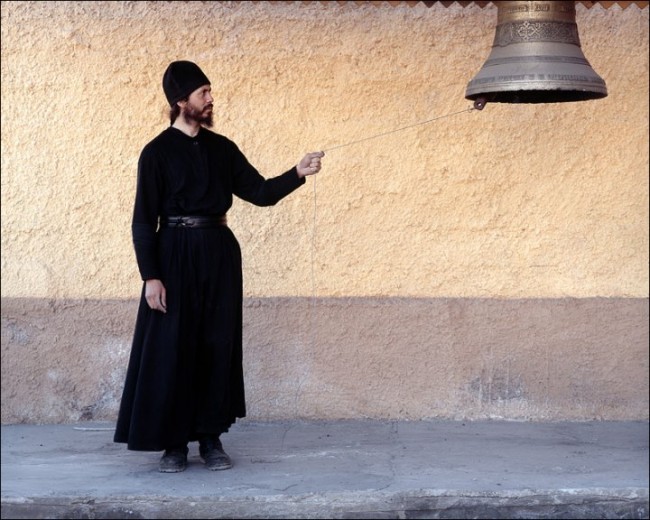
The following talk (slightly condensed) was given [in 1984] at the Saint Herman Winter Pilgrimage in Redding, California.
I should like to ask you to think of something you may not have considered before, How would you feel if your son or daughter expressed the desire to enter a monastery? You may be Orthodox, and very devout; you may he diligent in attending services and reading spiritual books; you may have tried your best to raise your children in an Orthodox manner; you may even admire monasticism. Nonetheless, how would you really feel?
We live in a time and society quite different from Greece and Holy Russia, where monasticism was a visible and acceptable part of life. It was not uncommon for entire families to make pilgrimages to monasteries. Few people today, however, have any significant exposure to monasticism and it is little wonder that in our un-Orthodox and even anti-Christian society, the very thought of one’s child becoming a monastic can seem very threatening.
There are a number of reasons one can give for such a reaction. Lack of familiarity breeds fear. Not a few people imagine monasticism to be very grim and even inhuman. They may envision their child locked behind a grating and subsisting for the rest of his or her life on bread and water. The other extreme is an equally- erroneous view of a romanticized spiritual state in which the child spends his days floating above the ground in an exalted state of endless holiness. In both cases it is imagined that entering a monastery presupposes leaving behind the human race. The reality of the monastic life is a far cry from either of these extremes. Your son or daughter—who is always late, leaves socks and soda bottles everywhere and is generally infuriating–will not turn into an instant anchorite. Anyone who leaves the world for the monastery brings all of his weaknesses and defects with him. He may learn to overcome some of them; others he will have until bodies, In any case, if your child becomes a monastic, he or she will not be living without human warmth and human relationships, and in spite of everything, you will still recognize them as being one of your own progeny.
Whatever your initial reaction to the issue of monasticism and your child, it depends to a great extent on how you as a parent view the Orthodox family and your position as an Orthodox individual in the contemporary secular world. Surrounded as we are by worldly standards and a materialist culture, we forget that Christ calls all of His followers to separate themselves from the world: Be not of this world. This is the trumpet call of monasticism. With this understanding, you should be more ready to peacefully acquiesce to the son or daughter who has found it in his heart to answer this call by taking upon himself the monastic yoke.
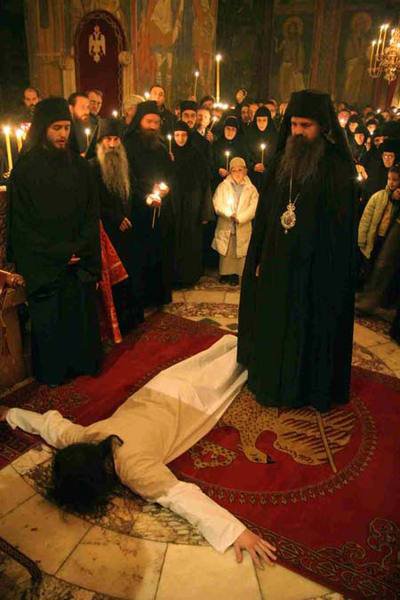
We are, however, the unfortunate products of our fallen nature, and it is rare that even a pious Orthodox parent is thrilled to hear that their offspring desires to enter a monastery. More often there arise some very strong reactions in the heart which, however innocent and well-intentioned, are nonetheless aspects of our fallen emotional and psychological nature – and a sad reflection of our un-Orthodox background and environment. With this in mind we can examine some of the emotional responses which this issue so often evokes.
Verbally, the various emotions stem from the pivotal question, “Why?” Why does anyone leave the world to enter a monastery? If the reason is legitimate, it is because in spite of all his failings and weaknesses, your child loves God more than anyone or anything in the world–more than the life you helped shape him for, more than his automobile, more than the school to which you were going to send him, more than his family… And here the very natural feeling of jealousy arises. As parents you may endeavor to replace God as being central in your child’s affections and persuade him to forsake monasticism, If you succeed, you will only make the child unhappy, and if you fail, you’ re going to feel very hurt.
Secondly. you may feel estranged or shut out from your child’s life. If your daughter goes to a monastery, and it’s a life you have not shared, you may feel you can’t relate to her. If she married, even if she moved a thousand miles away, you would very likely feel that you were still more a part of her life than if she became a nun and lived 50 miles away. A married daughter would still need advice on how to cope with the children’ s illnesses or how to manage a tight budget. On the other hand, if she were in a convent, you could hardly give her advice on how to do Matins, and even if you are Orthodox, you might feel emotionally adrift and very awkward with this suddenly foreign someone in black whose life is so different from your own. Then there is also the fact that most parents look forward to being grandparents, this is a big issue, especially with mothers.
You may feel threatened. You spend your whole life nurturing the well-being of your children: you feed them and worry over them; you help them to discover their abilities and you encourage them to develop their talents. Perhaps your son is a natural musician or your daughter a born lawyer, and you spend your life supporting them–emotionally and financially–and preparing them to be successful in the world. And after all these years of effort and anxiety, they suddenly decide they want no part of it, they don’t want the world, nor the life that you envisioned for them. This can be a very threatening and painful revelation. Very often parents feel that in rejecting the world, their child is also rejecting them. This is not necessarily true at all, but this feeling sparks most of the disputes between parents and their children over the issue of monasticism. Here also parents may feel they have failed in some way in their raising of the child, that he or she should choose such an “aberrant” path in life. This is also a painful thought.
The rather heated emotions which may arise over the issue of monasticism and one’s child frequently result in a barrage of reproaches. The following examples are not in the least hypothetical; they come from a list of actual remarks made by real mothers and fathers, some of whom consider themselves to be devout Orthodox. Their responses illumine the essence of the dispute as it is felt in the heart of those who are Orthodox and yet live in the world. They’ve said that we are not taking responsibility for ourselves; that we are just leaning on someone else so as to avoid having to make our own decisions. They say that if we love our neighbor we should be working to improve society and not dropping out of it into some euphoric dream. We often hear that monasticism is mere ostentation, some kind of fake spirituality: “Why don’t you stick it out in the world like the rest of us, where you have to deal with real life and real problems?” They say monasticism is selfish, egocentric, it divides and ruins the family; monasticism is “financially unstable”: What about your future security? Why don’t you just get a good job and send them all the money?…
While these remarks are quite varied, there is a common denominator, and that is worldliness. They are all rooted in a very worldly orientation. It is the complete and absolute rejection of this perspective on the part of the monastic aspirant which often makes the dispute between parents and child so violent, Although perhaps unconscious, the parents’ message underlying all this is: Conform yourself to the world; fit in; get a secure job; settle down; do what everyone else does…; spirituality is fine, but there’s no need to be extreme. We have already seen, however, that Christianity is otherworldly; by its very notate it is extreme: if you lose your life you shall gain it; if you try to hang onto it you will lose it; God became man that men might become gods. What could be more extreme?
Seek ye first the kingdom of God
Orthodoxy is the means by which we ascend unto God, through surrendering our own ego and self-will. Orthodoxy means war–against one’s fallen nature, against the devil, and against the world. This applies to all Orthodox Christians. Even those who live in the world–who have children and hold jobs–are required to keep themselves in some sense apart from the world. And there can be no compromise. The world is not and cannot be our home, and whether we choose to marry Christ or an earthly spouse, we can in no sense marry’ the world. We see, however, that it is precisely this desire–to have both God and the world–that is at the rooter the conflict evoked by the child’s entrance into monasticism. Experiencing their own reaction to the child’s rejection of the world may make the parents realize, perhaps as never before, their own attachment to the world, and how unwilling they are to sever themselves from the values and desires of the anti-Christian society in which they live.
It is especially difficult to struggle against the accepted view of the family which in this country has received a pseudo-religious status; youngsters are often all but worshipped as gods by their parents who see them as fulfilling their own egos. This is not Orthodox; it is, in fact, very destructive of our Orthodoxy which teaches that children are not the possession of their mothers and fathers: they are not playthings of their parents’ imaginations. Children are given by God for a time that they may be raised up in the knowledge of Him, and after that He summons them as He will. The duty of parents is not to prepare children to settle comfortably in the world, but to shepherd their souls, to prepare them to battle against the fallen world. Those who choose to fight in the front lines are those who hear the monastic calling. If your child wants to enlist in that war, he will swear before God and man that despite his sinfulness and frailties that overwhelm him at every hour of the day, he cannot find rest apart from God.
If such is the inclination of your child, do not hold him back, however logical your reasons For wanting to do so may be. If the desire for monasticism is simply a fanciful notion, they will find out soon enough, and nothing will be harmed by their trying. If, however, such a desire has indeed been planted by God as a means of their achieving salvation, don’t thwart it by trying to persuade him first to finish school or experience life in the world. Bring to mind the countless number of monastics, both men and women, whose spiritual legacy has so greatly enriched our holy Orthodox Church. If your child has the desire and determination to follow in their steps, however weakly, bless him, let him go. And may this blessing be also unto your own salvation and that of others.

