Friday, September 1, 2017

On Pastoral Guidance Before and After Marriage ( Metropolitan Ephrem of Tripoli )


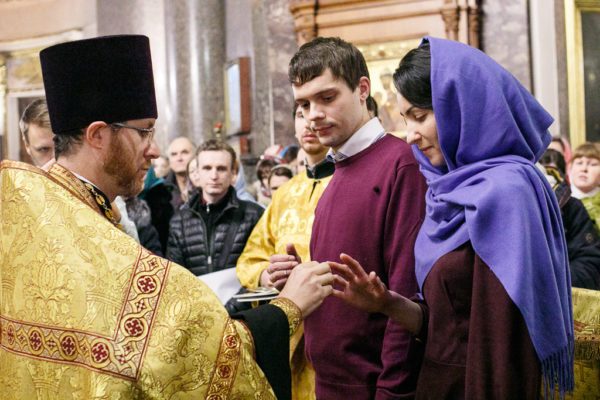
The Christian family is a little church. The marriage bond is a holy bond, not merely a sexual relationship. Hence the importance of educating the family, both parents and children, and raising them spiritually and educationally.

Marital preparation before the marriage has become an urgent matter, as has follow-up after the marriage and keeping up with couples in their daily life under the pressure of the challenges imposed upon us by our time.

Thus there is a need for committed and spiritually and culturally mature pastors who are capable of giving proper guidance.

Among the pressing factors of our time:

1) Social media, which has made it much easier for people to get to know each other, though this is not always with proper intent. For this reason, social media has caused many marital conflicts which have sometimes led to divorce. Additionally, this media has opened the way for long-distance marriage, which is something unacceptable.

2) The economic crisis, consumerism, the woman’s having to work.

3) The influence of customs of the diaspora and a lack of dedication to our Eastern Christian heritage and tradition.

4) Hastiness, in many cases, in the matter of the engagement.

5) The absence of marital pastoral care before and after the marriage.

6) Mixed marriage, which very often leads to inherent disagreements.

Where is the treatment for all this? We have said that we need pastors with ample appropriate training to accompany the spouses before and after marriage. There is an important proposal to establish a committee, association or network, which can itself be a committee specialized in marital preparation, whose task is to exchange experiences and emerging studies and which has a common program with other dioceses under the supervision of the Holy Synod. Its members must have training from the following fields: law, medicine, spirituality, sociology, culture, and psychology…

Beloved, marital fidelity is not easy in this “wicked and corrupt generation.” Faithfulness comes first of all from commitment to Christian principles and dedication to the practice of the Church. We must avoid bad or tempting cohabitations.

Without prayer, without a god, no marriage can have any sanctity.

Children are always the victims of divorce and their psychological health is inevitably affected. The good leaven that the spouses taste is not at the beginning of their marriage but at the end of their life, if they have guarded their faithfulness to the last breath. 
http://www.pravmir.com/pastoral-guidance-marriage/

Monday, August 28, 2017

“DO YOU WANT TO SEE AN ANGEL?” ( St. Nektarios )


November 9/22 we remember St. Nektarios of Aegina, a modern ascetic and wonderworker. His life is amazing: the Lord manifested in a visible and tangible way His care for those who please Him.


St. Nektarios (Anastasios Kefalas in the world) was born into a large, poor family in the Thracian village of Silivri, not far from Constantinople. He survived many afflictions in his life; he was faced with jealousy, hatred, and slander, in order to understand that truly everywhere and at all times “those desiring to live piously in Christ Jesus will be persecuted.”

The saint acquired the gifts of the Holy Spirit: unceasing prayer and spiritual discernment, healing, clairvoyance, and prophecy. When he served the Divine Liturgy, in a prayerful state, his face radiated light which was visible to others.

St. Nektarios of Aegina was a man of exceptional kindness, giving away everything he had. When he had no money for giving alms he would give his clothes and shoes to those in need. Once, while serving the Liturgy in an Athenian church, some poor priest entered into the altar. His riassa was shabby and full of patches. The saint gave him his only riassa.

Every time that the saint gave away everything he had, and his wallet was emptied, he went to church and stretched out his hand before the icon of the Savior of the Mother of God and said: “You see, Christ God, I have no money… But You know…” And the Lord would send him His blessing.


During St. Nektarios’ tenure as director of the theological school in the center of Athens the janitor suddenly became seriously ill. He was very afraid of losing his job. Not yet fully recovered from his illness, the janitor went to the school to find it in perfect order. Figuring that they had already replaced him, the poor man became terribly upset. His wife, also quite upset, advised him to go to work early in the morning to try to speak with the new janitor. He arrived at the school at five in the morning and saw his “replacement,” which turned out to be the saint himself. He had swept the restroom, saying to himself: “Sweep, Nektarios—it’s the only thing you’re worthy of doing.” The saint told the patient: “Don’t worry, I’m not taking your spot—on the contrary, I’m doing this to save it for you until you’re fully recovered… But be careful: as long as I’m living in this world, no one should know about what you have seen.” St. Nektarios was engaged in physical labor, sometimes very heavy, in the monastery he founded on Aegina. He dug the beds and looked after the garden himself, carried water for irrigation, and moved huge rocks to build the cells and even made and repaired shoes.

Fr. Philothoes (Zervakos), abbot from the island of Paros, recalled:

In August 1910 I sailed to Aegina to receive the saint’s blessing. By noon I had reached the monastery. The sun was blazing mercilessly. Outside the monastery walls I saw an elderly white-bearded man, head covered by a straw hat, bottom half of his cassock pulled up and tucked behind his belt. He was shoveling dirt and rocks into a wheelbarrow and pushed it for sixty meters. Not realizing it was Vladyka Nektarios, my spiritual advisor, I took him for a worker, wearing a cassock so as not to soil his clothes, or a novice. I went up to him, greeted him, and asked: “Is Vladyka Nektarios here?” “Yes,” he answered. “He’s here. What do you want from him?” “Go tell him that a deacon, one of his spiritual children, wants to see him.” “Right away. May it be pleasing to God,” he said… In a few minutes he returned in a klobuk and a riassa with wide sleeves. Then I realized, that the man I had taken for a worker was the saint. I never would have thought that the metropolitan could do such work at an hour when everyone was taking their afternoon naps.”

Even on Aegina, in that blessed place, many trials and temptations, with which his greatly sorrowful life was filled, awaited the saint. There was a widow named Lazara living there who sold candles. She had a very beautiful and pure daughter Maria, who, nevertheless, she constantly yelled at and accused of licentiousness. The girl found shelter in the monastery, and in the person of the saint a patron and spiritual father. Then Lazara went to the court in Piraeus and falsely accused the saint of promiscuity. The very next day, the enraged judge, accompanied by two policemen, went to Aegina, and, in a rage, harshly accused the saint, flippantly insulted him and even threatened to tear out the holy elder’s beard. The saint did not answer the ridiculous accusations and insults, but only silently prayed. The nuns were crying in horror and called out: “Lord, have mercy!” The poor girl was summoned to the court and sent for a humiliating examination by a gynecologist who established her chastity. The judge became seriously ill and immediately understood that he was being punished for his actions against a holy man. He fervently repented of his behavior and asked to be taken to Aegina to beg forgiveness from the saint. St. Nektarios forgave him and prayed for him, and the judge recovered.

Near the monastery there was a well and the nuns would draw water from it for working on the restoration of the monastery. They needed a lot of water and the level declined sharply, so the owner of the well forbade the nuns to use it. St. Nektarios prayed and just as he was praying there rang out the sound of mighty water—a flood of pure, fresh water filled the well to the brim. Then the owner, filled with the fear of God and gratitude, gave the well to the monastery.


St. Nektarios with the faithful after Liturgy, Evia, 1893


Abbess Nektaria of the Chrysoleontissa Monastery, a spiritual child of St. Nektarios, told about how a group of pilgrims came to him once at the monastery. The sisters’ table was already set in the trapeza, the foot was already out on plates, and the pans were empty. Bewildered, the nuns turned to their spiritual father. The saint told them to put the food back in the pots and pans, and then blessed it. When the same food was put out on the table again there turned out to be enough for the sisters and for the monastery’s guests, with three full plates remaining.

Mother Nektaria also recalled about how the spiritual world was open to him: “One day I was walking with my spiritual father, when he suddenly asked: ‘Nektaria, would you like to see your angel?’ ‘Oh, yes,’ I answered. ‘I want to see him.’ ‘Look,’ he said, ‘your angel is in front of you.’” And she truly saw her angel, but his appearance was so brilliant that she was afraid.


The residents of Aegina witnessed numerous miracles accomplished through the prayers of St. Nektarios. Once there was a severe drought and the people and animals were threatened with famine. One night one of the peasants knocked on the gate of the monastery and asked St. Nektarios to pray for rain. The saint said: “Let’s pray to God, and may He hear the prayer of the peasant and act according to his faith.” Then he raised his hands to heaven and began to pray. An hour later a terrible storm broke out over the island, lasting all night. The threat of drought was averted.

Thanks to St. Nektarios’ prayers, robbing and pillaging ceased on the island, and even the climate changed, becoming more favorable for agriculture.

During the war, soldiers from Aegina would go to the saint for a blessing before departing for the front. The sisters of the monastery recorded their names. The list would then be placed on the altar, and the saint prayed for them. Everyone who received the blessing of the holy elder returned from war wholly unscathed, without a single exception.

After the war, the former German commander of Athens admitted that military pilots flying out to bomb Crete, flying past the island of Aegina simply could not see the island, despite good visibility and the lack of cloud cover.

Once, when St. Nektarios was praying in contrition, an amazing peace descended upon his heart. The Most Holy Theotokos herself appeared to him accompanied by a host of angels, singing in a special melody:

O pure and virgin Lady, O spotless Theotokos

Rejoice, O unwedded Bride!

O Virgin Queen and Mother, O dewy fleece most sacred

Rejoice, O unwedded Bride!

O height transcending heaven above, O beam of light most radiant

Rejoice, O unwedded Bride!

O joy of chaste and virgin maids, surpassing all the angels

Rejoice, O unwedded Bride!

O brilliant light of heaven above, most clear and most radiant

Rejoice, O unwedded Bride!

Commanding chief of heaven above, O holiest of holies

Rejoice, O unwedded Bride!

O ever-virgin Mary, O Mistress of creation

Rejoice, O unwedded Bride!

O Bride all-pure and spotless, O Lady all-holy

Rejoice, O unwedded Bride!

O holy Mary, Bride and Queen, O cause of our rejoicing

Rejoice, O unwedded Bride!

O Maiden Queen most hon'rable, O Mother most holy

Rejoice, O unwedded Bride!

More precious than the cherubim, more glorious than the seraphim

Rejoice, O unwedded Bride!

Surpassing principalities, dominions, thrones and powers

Rejoice, O unwedded Bride!

Rejoice, song of the cherubim, Rejoice, hymn of the angels

Rejoice, O unwedded Bride!

Rejoice, ode of the seraphim, and joy of the archangels

Rejoice, O unwedded Bride!

Rejoice, o peace; Rejoice, o joy, and haven of salvation

Rejoice, O unwedded Bride!

O bridal chamber of the Word, unfading, fragrant blossom

Rejoice, O unwedded Bride!

Rejoice, delight of paradise, Rejoice, life everlasting

Rejoice, O unwedded Bride!

Rejoice, o holy tree of life, and fount of immortality

Rejoice, O unwedded Bride!

Rejoice, O unwedded Bride!

Afterwards this prayer became the famous hymn “Agni Parthene.” It can be heard at services in America and in Russia and in Greece it would be hard to find anyone who would not sing it.

The blessed repose of St. Nektarios followed on Sunday, November 8/21, on the day of the Synaxis of Archangel Michael and the Other Bodiless Powers. Having communed of the Holy Mysteries of Christ, St. Nektarios of Aegina peacefully departed to the Lord. He had just turned seventy-four.

The body of the saint remained in the hospital ward for eleven hours, and from the very first minutes exuded a sweet fragrance. A local paralytic was lying in his bed there. When they changed St. Nektarios’ clothes, they laid them on the paralytic’s bed, and he got up and walked, giving praise to God and the holy elder. Thus the Lord glorified the saint with his first miracle.

Farewell to St. Nektarios. Fresco


Many miraculous healings occurred by the prayers of St. Nektarios after his blessed repose. He died from a severe and excruciating cancer, and, after his burial he intercedes for those who have no one and no hope on earth—those hopeless cases doomed to a quick death.

In 1961 St. Nektarios of Aegina was numbered among the saints of the Greek Orthodox Church.

Instructions of St. Nektarios

On Sorrows

Any sorrow, patiently endured, becomes a step towards perfection.

Happiness is found within ourselves

How mistaken are those people who search for happiness outside of themselves: in foreign countries and travels, in riches and glory, in great possessions and enjoyments, in pleasures and excess, and in empty things, which in the end are bitterness!

To build a tower of happiness outside our own heart is like building a house on a spot that continually suffers earthquakes.

Happiness is found within ourselves, and blessed is he who has realized this.

He who has a pure heart is a beloved child of God

A good conscience is the greatest of all the blessings. It is the price of a peaceful soul and tranquil heart.

Whoever has a pure heart, who does not experience accusations from his own heart, who does good and that which is pleasing and perfect in the eyes of God, who carefully observes the commandments of God, the same has boldness to stand before God. Everything that he asks he receives from God.

He who has a pure heart is a beloved child of God. The Spirit of the Son lives in his heart, and he receives everything he asks for, finds all that he seeks, and doors are opened to him when he knocks.

Not a goal, but a means

Fasting, vigil, and prayer by themselves do not bring the desired fruit, because they are not the purpose of our life, but constitute the means for achieving our goal.

Be attentive to your minor falls

Be attentive to your minor falls. If some sin befalls you from inattentiveness, don’t despair, but pull yourself together and kneel before God Who has the power to raise you up.

Within ourselves we have deeply rooted weaknesses, passions and flaws, many of which are hereditary. All of this cannot be broken with one sharp movement, or a worrisome and difficult experience, but by patience and perseverance.

Don’t lose heart and don’t be afraid

Remember that after temptation follows spiritual joy and that the Lord watches over those who endure temptations and sufferings for the sake of His love. So, don’t lose heart and don’t be afraid.

Entrust all your cares to the Lord: He will take care of you.

Entreat God and don’t lose courage. Don’t think that because your desire is holy, you have the right to complain when your prayers go unheard. God will fulfill your desires in some way you don’t know about. So, calm down and invoke God.

Ask God for love every day

Ask God for love every day. Along with love comes all the many blessings and virtues.

Sanctification abandons the confused and angry heart

Sanctification abandons the confused and angry heart, darkened by hatred for one’s neighbor. Make peace with your brother more quickly, to not deprive yourself of the grace of God, which sanctifies our hearts.

He who is at peace with himself and at peace with his neighbor is at peace with God. Such a person is filled with holiness, because God Himself abides in him.

Don’t impose upon yourself more than you can bear
Don’t impose upon yourself more than you can bear. Remember that God does not bestow His gifts under duress, but when He Himself wants to. Everything He gives you, you receive undeservedly, according to His mercy.

Grace is sent as a gift to those who have been cleansed from the passions

Those who seek Divine gifts and insights, while being immersed in passion, dwell in stupid and proud delusion. Above all it is necessary to work upon cleansing ourselves.

Grace is sent as a gift to those who have been cleansed from the passions. And they receive it quietly and in an hour they don’t know.Through the prayers of our holy fathers, O Lord Jesus Christ, our God, have mercy upon us!

http://www.pravoslavie.ru

Friday, August 25, 2017

The longer you wait to seek forgiveness, the more you allow the evil one to spread his roots within you. ( Elder Joseph the Hesychast )

 
I received your letter, my child, and I saw your anxiety. But don’t be sad, my child. Don’t worry so much. Even though you have fallen again, get up again. You have been called to a heavenly road. It is not surprising for someone running to stumble. It just takes patience and repentance at every moment.

Therefore, always do a metanoia when you are wrong and don’t lose time, because the longer you wait to seek forgiveness, the more you allow the evil one to spread his roots within you. Don’t let him make roots to your detriment.

Therefore, don’t despair when you fall, but get up eagerly and do a metanoia saying, “Forgive me, my dear Christ. I am human and weak.” The Lord has not abandoned you. But since you still have a great deal of worldly pride, a great deal of vainglory, our Christ lets you make mistakes and fall, so that you perceive and come to know your weakness every day, so that you become patient with others who make mistakes, and so that you do not judge the brethren when they make mistakes, but rather put up with them.

So every time you fall, get up again and at once seek forgiveness. Don’t hide sorrow in your heart, because sorrow and despondency are the joy of the evil one. They fill one’s soul with bitterness and give birth to many evils. Whereas the frame of mind of someone who repents says, “I have sinned! Forgive me Father!” and he expels the sorrow. He says, “Am I not a weak human? So what do I expect?” Truly, my child this is how it is. So take courage.

Only when the grace of God comes does a person stand on his feet. Otherwise, without grace, he always changes and always falls. So be a man and don’t be afraid at all.
Do you see how that brother you wrote about endured the temptation? You, too, should do likewise. Acquire a brave spirit against the temptations that come. In any case, they will come. Forget about what your despondency and indolence tell you. Don’t be afraid of them. Just as the previous temptations passed by the grace of God, these, too, will pass once they do their job.

Temptations are medicines and healing herbs that heal our visible passions and our invisible wounds. So have patience in order to profit every day, to store up wages, rest, and joy in the heavenly kingdom. For the night of death is coming when no one will be able to work anymore. Therefore, hurry. Time is short.

You should know this too: a victorious life lasting only one day with trophies and crowns is better than a negligent life lasting many years. Because one man’s struggle, with knowledge and spiritual perception that lasts one day, has the same value as another man’s struggle, who struggles negligently without knowledge for fifty years.

Without a struggle and shedding your blood, don’t expect freedom from the passions. Our earth produces thorns and thistles after the Fall. We have been ordered to clean it, but only with much pain, bloody hands, and many sighs are the thorns and thistles uprooted. So weep, shed streams of tears, and soften the earth of your heart. Once the ground is wet, you can easily uproot the thorns.

Elder Joseph the Hesychast

Sunday, August 20, 2017

I am at this moment in some pain, and I call on the Name of Jesus ( Fr. Seraphim Rose )


“Why do men learn through pain and suffering, and not through pleasure and happiness? Very simply, because pleasure and happiness accustom one to satisfaction with the things given in this world, whereas pain and suffering drive one to seek a more profound happiness beyond the limitations of this world. I am at this moment in some pain, and I call on the Name of Jesus—not necessarily to relieve the pain, but that Jesus, in Whom alone we may transcend this world, may be with me during it, and His will be done in me. But in pleasure I do not call on Him; I am content then with what I have, and I think I need no more. And why is a philosophy of pleasure untenable?—because pleasure is impermanent and unreliable, and pain is inevitable. In pain and suffering Christ speaks to us, and thus God is kind to give them to us, yes, and evil too—for in all of these we glimpse something of what must lie beyond, if there really exists what our hearts most deeply desire.”


Fr. Seraphim Rose

Thursday, August 17, 2017

The Elevation of the Bread in Honour of the Most Holy Mother of God ( Saint Maximos the Greek )


The Only-Begotten Son and Word of God, who became a human person for us (though He was sinless), voluntarily underwent the crucifixion, death and burial so that our human nature, which the father of evil had caused to be cast out of paradise in olden times, could be elevated. Christ rose, however, and was elevated to His initial glory, and then sent the Comforter, the Holy Spirit, to his disciples and apostles. After the God/Man/Word ascended into heaven, the eye-witnesses and servants of the Lord were in the upper room, as Saint Luke tells us, and after they had received the Holy Spirit they were unwilling to neglect preaching the Word of God in order to wait on tables. So they appointed deacons in their place. When the preachers of salvation sat down at table, they placed on it a napkin with a loaf on it, which was the Saviour’s portion and similar to those He had eaten when He was still incarnate among them, before His passion.

When the holy apostles rose from the table, the oldest and first among them took the loaf in his hands, raised it up and proclaimed ‘Great is the name’. The other disciples of the Word responded ‘of the Holy Trinity’. Then the deacon who was serving said ‘Glory to You in the name of Christ the Saviour’. And the apostles again answered ‘Glory to You our God’. The name of the Holy Consubstantial Trinity without beginning was said once and ‘glory to You our God, glory to You’ twice, because of the two elements, divinity and humanity, the two energies and two natures, and their perfect union in the God/Man/Word.

The holy apostles performed this rite both when they were together and when they were apart, after they’d gone out to teach all the nations. At the Dormition of the Holy, Most Pure, Ever-Virgin Mary, the Sinless, Uncorrupt, Mother of the Word, the Most Honourable and Sublime of all celestial concepts, the renewal of our race, the most precious, God-receiving vessel of the whole of the Divinity, the apostles, who were at the ends of the known world, were taken up in clouds and transported to Gethsemane to offer their services at the burial of the most pure body of the Mother of God the Word. By God’s will, which sees and arranges all things, the holy and great Apostle Thomas was not with the others at the burial of the Mother of the Word, just as, when the Saviour appeared to His disciples behind closed doors after His resurrection and taught them about peace, Thomas wasn’t there and didn’t believe the other disciples and companions.

Because of this good disbelief, he taught us, through touching the most pure members of the Saviour’s body- the ribs and the hands- that we should believe that He Who suffered the Passion while still among us is indeed the perfect God. So, in this instance, too, by the ineffable and unspoken will of Him Who orders all things and governs all things well, Thomas wasn’t present at the funeral of the Mother of God. He came three days later, borne on a cloud and immediately hastened to the grave, together with the other apostles, in order to venerate the life-receiving body of the Mother of God. And so the whole of the human race was given salvation and the correct faith.


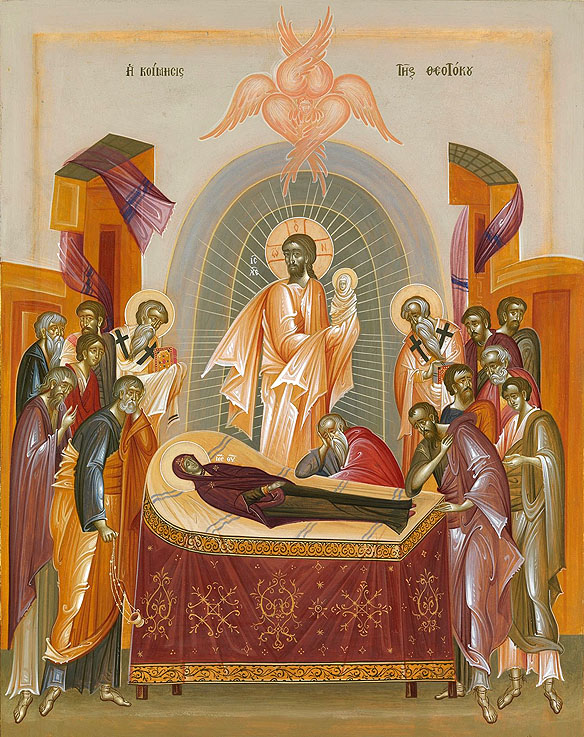
Dormition of Theotokos, by hand of Georgios Kordis, egg tempera on wood

Just as the incarnate God rose from the dead, so the holy body of His Mother was taken up into the heavenly domain. On their return from the grave, the apostles talked to Thomas, the preacher of the truth, about how he was transported on the cloud. They recalled the words of the song of the Mother of God, her miracles and her final resting in the grave. He in turn related the persecutions, the temptations and the hardships he’d suffered on his journey. He named the cities, the residents of which had come to believe through his preaching, and also told them what he saw when he was taken up in the cloud. He told them all of this. Then they went to eat and thereafter began to elevate the portion which had been placed in honour of Christ the Saviour.

When the deacon who was performing this rite took this bread in his hands, he raised it and said ‘Great is the name’ and the apostles replied ‘of the Holy Trinity’. And when he said ‘Glory to you our God glory to you’- oh, how ineffable and delightful are Your mysteries, Christ our King, through which you perform miracles! Wishing to satisfy the great desire of the Apostle Thomas to see the All Holy and Ever-Virgin Mother of God, You allowed him to see You and Your holy Mother, all the heavenly powers and all those who had fallen asleep throughout the ages ascending from earth to heaven. The apostles gazed in terror at Our Lady and her Only-Begotten Son. And instead of saying ‘Glory to You, our God, glory to You’, they exclaimed ‘Most Holy Mother of God, help us!’ And other apostles shouted ‘Through her intercessions, God, have mercy upon us and save us!’ Since then, this elevation of the ‘Panayia’, Our Most Holy Lady, has been celebrated in commemoration of the Mother of God herself.

And so we celebrate the elevation of the ‘Panagia’ when we rise from the table, for the sanctifying of our souls and bodies. Who can praise in an appropriate way her innumerable miracles, which are still being performed to this day? Were we able to concentrate the eloquence of all orators into one mouth and a single voice, we still wouldn’t be able to find a way to tell the secrets of her wonders, which she performs on land and sea: illnesses disappear, demons are put to flight, prisoners are liberated from bitter enslavement, the down-trodden are freed from the misery that oppresses them. And from what I’ve seen and heard, anyone who raises a finger, a stone, or some plant in her memory and her name receives the same deliverance from tribulations as the person who elevates the bread in honour of the Ever-Virgin Mary, the Mother of God.

Her Son, our Lord Jesus Christ, took the bread in His hands and said ‘Take, eat; this is my body’ and ‘do this in remembrance of me’. Christ is the head, which is why those who partake of His great mystery, if they receive it worthily, will receive His glory and become gods by grace.

Those who instituted the sacraments were pleased to confirm that, because of this bread which is elevated in honour of the holy name of the Mother of God, we should be delivered from every evil and should partake of her holy body. And, thanks to her protection, that we should be delivered from eternal torments and be counted worthy of the eternal blessings, through her prayers and those of all the saints throughout the ages. Amen.
 
http://pemptousia.com/2017/08/the-story-behind-the-elevation-of-the-bread-in-honour-of-the-most-holy-mother-of-god/