Friday, August 25, 2017

The longer you wait to seek forgiveness, the more you allow the evil one to spread his roots within you. ( Elder Joseph the Hesychast )

 
I received your letter, my child, and I saw your anxiety. But don’t be sad, my child. Don’t worry so much. Even though you have fallen again, get up again. You have been called to a heavenly road. It is not surprising for someone running to stumble. It just takes patience and repentance at every moment.

Therefore, always do a metanoia when you are wrong and don’t lose time, because the longer you wait to seek forgiveness, the more you allow the evil one to spread his roots within you. Don’t let him make roots to your detriment.

Therefore, don’t despair when you fall, but get up eagerly and do a metanoia saying, “Forgive me, my dear Christ. I am human and weak.” The Lord has not abandoned you. But since you still have a great deal of worldly pride, a great deal of vainglory, our Christ lets you make mistakes and fall, so that you perceive and come to know your weakness every day, so that you become patient with others who make mistakes, and so that you do not judge the brethren when they make mistakes, but rather put up with them.

So every time you fall, get up again and at once seek forgiveness. Don’t hide sorrow in your heart, because sorrow and despondency are the joy of the evil one. They fill one’s soul with bitterness and give birth to many evils. Whereas the frame of mind of someone who repents says, “I have sinned! Forgive me Father!” and he expels the sorrow. He says, “Am I not a weak human? So what do I expect?” Truly, my child this is how it is. So take courage.

Only when the grace of God comes does a person stand on his feet. Otherwise, without grace, he always changes and always falls. So be a man and don’t be afraid at all.
Do you see how that brother you wrote about endured the temptation? You, too, should do likewise. Acquire a brave spirit against the temptations that come. In any case, they will come. Forget about what your despondency and indolence tell you. Don’t be afraid of them. Just as the previous temptations passed by the grace of God, these, too, will pass once they do their job.

Temptations are medicines and healing herbs that heal our visible passions and our invisible wounds. So have patience in order to profit every day, to store up wages, rest, and joy in the heavenly kingdom. For the night of death is coming when no one will be able to work anymore. Therefore, hurry. Time is short.

You should know this too: a victorious life lasting only one day with trophies and crowns is better than a negligent life lasting many years. Because one man’s struggle, with knowledge and spiritual perception that lasts one day, has the same value as another man’s struggle, who struggles negligently without knowledge for fifty years.

Without a struggle and shedding your blood, don’t expect freedom from the passions. Our earth produces thorns and thistles after the Fall. We have been ordered to clean it, but only with much pain, bloody hands, and many sighs are the thorns and thistles uprooted. So weep, shed streams of tears, and soften the earth of your heart. Once the ground is wet, you can easily uproot the thorns.

Elder Joseph the Hesychast

Sunday, August 20, 2017

I am at this moment in some pain, and I call on the Name of Jesus ( Fr. Seraphim Rose )


“Why do men learn through pain and suffering, and not through pleasure and happiness? Very simply, because pleasure and happiness accustom one to satisfaction with the things given in this world, whereas pain and suffering drive one to seek a more profound happiness beyond the limitations of this world. I am at this moment in some pain, and I call on the Name of Jesus—not necessarily to relieve the pain, but that Jesus, in Whom alone we may transcend this world, may be with me during it, and His will be done in me. But in pleasure I do not call on Him; I am content then with what I have, and I think I need no more. And why is a philosophy of pleasure untenable?—because pleasure is impermanent and unreliable, and pain is inevitable. In pain and suffering Christ speaks to us, and thus God is kind to give them to us, yes, and evil too—for in all of these we glimpse something of what must lie beyond, if there really exists what our hearts most deeply desire.”


Fr. Seraphim Rose

Thursday, August 17, 2017

The Elevation of the Bread in Honour of the Most Holy Mother of God ( Saint Maximos the Greek )


The Only-Begotten Son and Word of God, who became a human person for us (though He was sinless), voluntarily underwent the crucifixion, death and burial so that our human nature, which the father of evil had caused to be cast out of paradise in olden times, could be elevated. Christ rose, however, and was elevated to His initial glory, and then sent the Comforter, the Holy Spirit, to his disciples and apostles. After the God/Man/Word ascended into heaven, the eye-witnesses and servants of the Lord were in the upper room, as Saint Luke tells us, and after they had received the Holy Spirit they were unwilling to neglect preaching the Word of God in order to wait on tables. So they appointed deacons in their place. When the preachers of salvation sat down at table, they placed on it a napkin with a loaf on it, which was the Saviour’s portion and similar to those He had eaten when He was still incarnate among them, before His passion.

When the holy apostles rose from the table, the oldest and first among them took the loaf in his hands, raised it up and proclaimed ‘Great is the name’. The other disciples of the Word responded ‘of the Holy Trinity’. Then the deacon who was serving said ‘Glory to You in the name of Christ the Saviour’. And the apostles again answered ‘Glory to You our God’. The name of the Holy Consubstantial Trinity without beginning was said once and ‘glory to You our God, glory to You’ twice, because of the two elements, divinity and humanity, the two energies and two natures, and their perfect union in the God/Man/Word.

The holy apostles performed this rite both when they were together and when they were apart, after they’d gone out to teach all the nations. At the Dormition of the Holy, Most Pure, Ever-Virgin Mary, the Sinless, Uncorrupt, Mother of the Word, the Most Honourable and Sublime of all celestial concepts, the renewal of our race, the most precious, God-receiving vessel of the whole of the Divinity, the apostles, who were at the ends of the known world, were taken up in clouds and transported to Gethsemane to offer their services at the burial of the most pure body of the Mother of God the Word. By God’s will, which sees and arranges all things, the holy and great Apostle Thomas was not with the others at the burial of the Mother of the Word, just as, when the Saviour appeared to His disciples behind closed doors after His resurrection and taught them about peace, Thomas wasn’t there and didn’t believe the other disciples and companions.

Because of this good disbelief, he taught us, through touching the most pure members of the Saviour’s body- the ribs and the hands- that we should believe that He Who suffered the Passion while still among us is indeed the perfect God. So, in this instance, too, by the ineffable and unspoken will of Him Who orders all things and governs all things well, Thomas wasn’t present at the funeral of the Mother of God. He came three days later, borne on a cloud and immediately hastened to the grave, together with the other apostles, in order to venerate the life-receiving body of the Mother of God. And so the whole of the human race was given salvation and the correct faith.


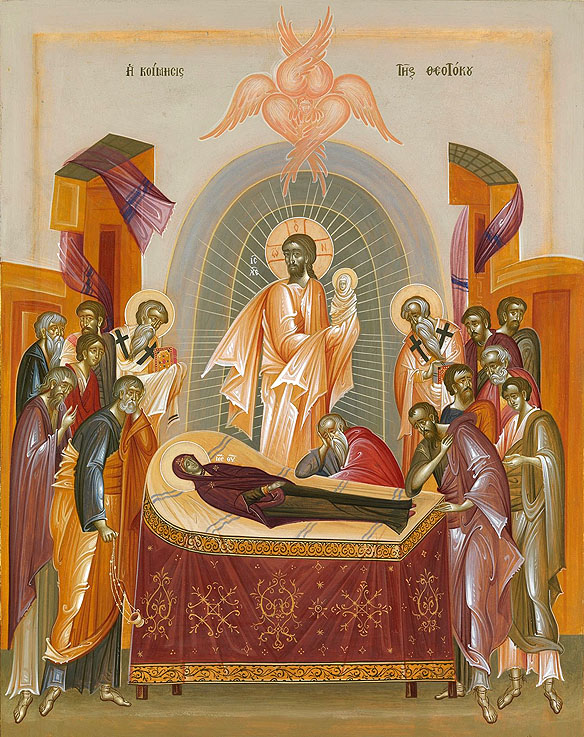
Dormition of Theotokos, by hand of Georgios Kordis, egg tempera on wood

Just as the incarnate God rose from the dead, so the holy body of His Mother was taken up into the heavenly domain. On their return from the grave, the apostles talked to Thomas, the preacher of the truth, about how he was transported on the cloud. They recalled the words of the song of the Mother of God, her miracles and her final resting in the grave. He in turn related the persecutions, the temptations and the hardships he’d suffered on his journey. He named the cities, the residents of which had come to believe through his preaching, and also told them what he saw when he was taken up in the cloud. He told them all of this. Then they went to eat and thereafter began to elevate the portion which had been placed in honour of Christ the Saviour.

When the deacon who was performing this rite took this bread in his hands, he raised it and said ‘Great is the name’ and the apostles replied ‘of the Holy Trinity’. And when he said ‘Glory to you our God glory to you’- oh, how ineffable and delightful are Your mysteries, Christ our King, through which you perform miracles! Wishing to satisfy the great desire of the Apostle Thomas to see the All Holy and Ever-Virgin Mother of God, You allowed him to see You and Your holy Mother, all the heavenly powers and all those who had fallen asleep throughout the ages ascending from earth to heaven. The apostles gazed in terror at Our Lady and her Only-Begotten Son. And instead of saying ‘Glory to You, our God, glory to You’, they exclaimed ‘Most Holy Mother of God, help us!’ And other apostles shouted ‘Through her intercessions, God, have mercy upon us and save us!’ Since then, this elevation of the ‘Panayia’, Our Most Holy Lady, has been celebrated in commemoration of the Mother of God herself.

And so we celebrate the elevation of the ‘Panagia’ when we rise from the table, for the sanctifying of our souls and bodies. Who can praise in an appropriate way her innumerable miracles, which are still being performed to this day? Were we able to concentrate the eloquence of all orators into one mouth and a single voice, we still wouldn’t be able to find a way to tell the secrets of her wonders, which she performs on land and sea: illnesses disappear, demons are put to flight, prisoners are liberated from bitter enslavement, the down-trodden are freed from the misery that oppresses them. And from what I’ve seen and heard, anyone who raises a finger, a stone, or some plant in her memory and her name receives the same deliverance from tribulations as the person who elevates the bread in honour of the Ever-Virgin Mary, the Mother of God.

Her Son, our Lord Jesus Christ, took the bread in His hands and said ‘Take, eat; this is my body’ and ‘do this in remembrance of me’. Christ is the head, which is why those who partake of His great mystery, if they receive it worthily, will receive His glory and become gods by grace.

Those who instituted the sacraments were pleased to confirm that, because of this bread which is elevated in honour of the holy name of the Mother of God, we should be delivered from every evil and should partake of her holy body. And, thanks to her protection, that we should be delivered from eternal torments and be counted worthy of the eternal blessings, through her prayers and those of all the saints throughout the ages. Amen.
 
http://pemptousia.com/2017/08/the-story-behind-the-elevation-of-the-bread-in-honour-of-the-most-holy-mother-of-god/

The Dormition of the Mother of God: a liturgical approach

The feast of the Dormition of the Mother of God is celebrated on August 15 by the Christian world and is the greatest of those established by the Church in honour of the Mother of the Lord. It may be the oldest of all. The first evidence we have for it dates from the 5th century, round about the time when the 3rd Ecumenical Synod was called in Ephesus (451), at which the dogma of the Mother of God was defined and the honour due to her was developed. It appears that it was first held in Jerusalem on 13 August and was transposed soon afterwards to the 15th of the same month. It was a general feast of the Virgin, without particular reference to her Dormition.

It was called “the day of Mary, the Mother of God”. The centre for the celebrations initially was a kathisma (seat), a church in her name, which was located outside Jerusalem, some three miles along the road leading to Bethlehem. The association of the feast with the Dormition of the Mother of God occurred at the famous church of Our Lady in Gethsemane, “Mavrikios’ house of prayer”, where her grave was. This church quickly acquired the status of the most important pilgrimage site of the Mother of God, and its renown became the reason why the feast on 15 August quickly spread throughout the Christian world, East and West, as the feast of the Dormition.


The feast was later elevated, with a preparatory fast and the extension of the feasting until 23 August or even to the end of the month and so it became not only the greatest of the feasts of the Mother of God but also one of the most important in the Church’s year. It was only natural that this should be so, because Our Lady is the best-loved and holy person after Christ, which is why she has attracted the honour and veneration of all generations of Christians. Countless churches and monasteries have been built in honour of her Dormition; in every church, behind the main entrance, wonderful wall-paintings of astonishing composition depict her funeral; her service his been embellished with choice hymns; and fine words and encomia have been expressed by the Fathers and modern Church figures on the day when we commemorate her. All generations of humankind have rivalled each other in presenting the best they have to offer, to praise and bless the Virgin Mary in word and deed.

THE FESTAL CONTENT OF THE FEAST

If we are to understand the festal content of the feast of the Dormition, and indeed, that of the other feasts of the Mother of God, the Conception, the Nativity, and the Entry, we need to look back briefly at the sources from which the information concerning her was drawn. Otherwise, it’s impossible to interpret all the things associated with this celebration: the narratives, the hymnography and the iconography. The authentic historical sources, the Gospels and the other books of the New Testament have not preserved any information about her life before the Annunciation or after the Ascension of the Lord. The intention of the authors was to narrate the life and the work of salvation of Christ, and whatever was directly linked with Him; not to satisfy the devout curiosity or the historical interests of their readers. By word of mouth, however, the tradition of the Church preserved various pieces of information having to do with the life of the Mother of God before the Conception of the Lord and after His Resurrection. Thereafter different authors, devout for the most part, took this information and embellished it throough their imagination, and, to give their works greater kudos, affixed great apostolic names to them. The Church rejected these works and called them apocryphal and falsified. In later times, many of these narratives, in their most basic forms, provided the subject matter for the formation of feasts, the construction of narratives, the poetry of hymns and the composition of icons. In any case, as we’ve said, the core of these narratives had as its base very old historical traditions concerning the person of the Mother of God.

STORY OF THE EVENT OF THE DORMITION

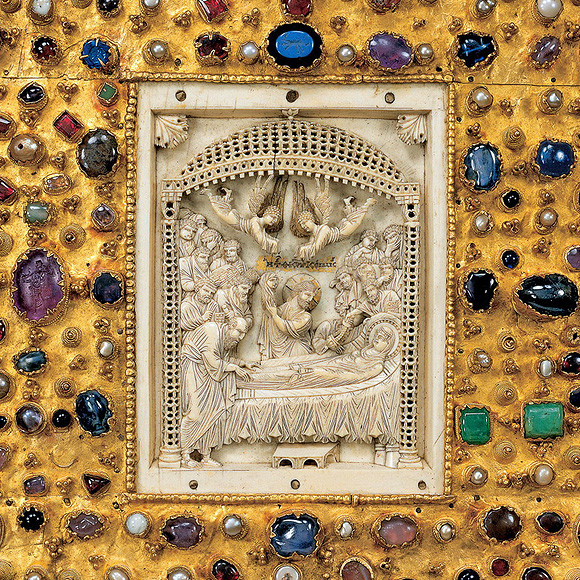
The event of the Dormition, in particular, is told, apart from elsewhere, in an apocryphal narrative which bears the name John, the disciple beloved of Christ. We shall present a summary of this lengthy text here. At each point, the reader will recall corresponding phrases from the hymns and synaxarion of the feast and details from the icon of the Dormition, which was composed by Byzantine artists.

After Christ’s Ascension, the Mother of God went to the life-receiving tomb every day and prayed. One Friday, the Archangel Gabriel appeared to her and saluted her: “Hail, you who bore Christ our God. The Lord has heard your prayer and you will leave the world and enter the true and eternal life”. The Mother of God returned home, burned incense and prayed to Christ to send her John and the other apostles, so that they could be present at her death. Her petition was heard and the first to arrive, snatched up in a cloud was John and then the others were borne by clouds and came from the ends of the earth, to which they had scattered. The Lord arrived in his radiant glory and, with thousands of angels, He received the soul of His Mother. She blessed the apostles and the world, interceded for the salvation of all and, having been given the assurance that any soul invoking her name would not be put to shame but would find mercy and comfort and defence and boldness in the present life and that of the future, she gave up her holy soul into the hands of her Son.

The apostles surrounded the body and, chanting, lifted up her bed with the body lying upon it, to be buried. A Jew by the name of Jeronias made to attack the bed, but an angel of the Lord, with a sword of fire, cut off his arms at the shoulder, and they remained attached to the bed. He repented and they were re-attached, while the apostles continued the cortege undisturbed. The body was buried in a new tomb in Gethsemane, but on the third day was transported to Paradise.

CHURCH POETRY

The poetry of the Church has embellished this simple narrative. The three stikhira (poetic hymns) in the first tone at Vespers (the first an automelos [contrafactum] and the others based upon it) praise the Mother of God and her Dormition in a wonderful manner. The substructure, however, can easily be recognized as the apocryphal narrative: Gethsemane, the words of Gabriel, the presence of the angelic powers, the transition from the grave to heaven.

The stikhira at Lauds in the 4th tone have the same theme. In the first, the whole cosmos, heavenly and earthly, rejoices, accompanying the mother of Christ and singing a funeral song for her. The other two describe the arrival of the apostles and their chanting at the graveside, as well as the presence of the angelic powers and the reception of her spotless soul by Christ.

Finally, let us take a look at the most exceptional tropario of her feast, and, indeed, of all our troparia. It is the doxastiko at Vespers. It takes its subject matter from the apocryphal narrative. The exceptional nature of the hymn lies in the fact that it is not sung in only one tone, as are all the other Church hymns, but in all eight.

Tone 1

By the royal command all the God-bearing apostles were snatched up into clouds on high

Tone Plagial 1

On reaching your immaculate and life-giving body, they embraced it fervently.

Tone 2

The highest powers of heavens attended, with their own master,

Tone Plagial 2

Seized with awe, they accompanied your inviolate body which had held God, and went on high before you, calling, unseen, to the ranks above: “Behold the Maid of God, the Queen of all, is at hand”.

Tone 3

Open wide the gates and welcome the mother of the everlasting light.

Tone Plagial 3

For through her the salvation of mortals has come; we are not strong enough to look upon her and are unable to render honours worthy of her.

Tone 4

For her excellence is beyond all conception

Tone Plagial 4

Therefore, most pure Mother of God, living forever with your Son and life-bearing King, pray without ceasing that your young people may be sheltered and saved from every adverse assault, for we have your protection.

Tone 1

And we bless you in beauty and light unto all ages.

Source: Λογική Λατρεία [Logical Worship], Apostoliki Diakonia Publications, Athens 1984.

(www.apostoliki-diakonia.gr)

Sunday, August 13, 2017

Christ, Church, Husband, And Wife

Image result for orthodox wedding

“For the husband is the head of the wife, as also Christ is head of the Church; and He is the Savior of the body. Therefore just as the Church is subject to Christ, so let the wives be to their own husbands in everything. Husbands, love your wives, just as Christ loved the Church and gave Himself for it” (Ephesians 5:23)

Some brides-to-be resent this epistle read at every Orthodox Church wedding. They think it’s sexist—not politically correct in this era of liberation of women. But that objection is misdirected. This advice of St. Paul is not about subordination of woman to man, nor is it about control. This is about love. The holy apostle is not putting wives down; he’s raising the vision of husbands to a spiritual awareness of responsibility.

It’s a daring equation, comparing the husband with Christ. Can a Christian who wears a cross at his neck and hangs a cross in his bedroom not comprehend the great, sacrificial love that Jesus Christ has demonstrated for His Church? There is not an atom of selfishness in it. Who reading the gospels can find somewhere or some word of the loving Lord that suggests, “What’s in it for Me?” Show me a place that implies the Church doing something for Christ, rather than what Christ is doing for the Church.

St. Paul is speaking to all married men. Do you expect or even demand obedience from your wives? Look up at Christ on the cross. Will you ever do that for her? You insist that your wife love you exclusively. That’s your right as a husband and her obligation as your wife. Then you must first demonstrate your willingness to lay down your life in her behalf. If it comes to one of you making a sacrifice for the sake of the family, step out smartly and be the one who offers his life for wife and family. Yes, granted, St. Paul wrote that the husband is the head of the wife, but that’s not all he wrote on the subject. The love of Christ for the Church is your measure of your own adoration of your wife. God forbid that you ever terrorize her, intimidate her or control her by temper tantrums or any of the more subtle mind control methods rampant in our culture. You were commissioned by Christ in the sacred sacrament of marriage to love and honor her—she is ever your queen, and you must look for the crown still worn on her head, albeit invisibly.

Your love for her must be always pure and sacred. She is a temple of the Holy Spirit, and you must do nothing to defile that living temple. She is baptized in the blessed water of Jordan. It takes nothing from the romance or the love act to treat your wife as a being precious in the sight of the Lord. Any expression of love that degrades, humiliates or plain uses the partner is unworthy of your marriage. Any violation of your marital obligations to one another, adultery or lewdness, will invite the serpent of evil into your bed, cause you deceit and hypocrisy, and reduce you to shame and self-rejection.

True love will be constantly in search of ways to please your spouse, not yourself. Real affection is given through a glance, a touch, a card or flower. This woman is not your cook, your washerwoman or maid. She is far more than the one who cares for your children. If that’s all she is to you, you are unworthy of calling yourself her husband.

If as you heard at the wedding, you “leave father and mother and cleave to your wife,” she has become your very body. You are one flesh and blood with her. You can no more separate yourself from her that you would hack off your right arm. Despite our wicked society, you don’t change partners; you live with the one that God gave you.

Most of all, your love is a reflection of the love of Christ for your spiritual family and the Church of which you all are a part. Your home is an extension of your parish, a chapel where love is the binding ingredient between your family members and with the loving Lord and yourself.
 
http://www.pravmir.com/christ-church-husband-and-wife/