Sunday, June 12, 2016

God is Where There is Humility ( Elder Arsenie Papacioc )


—Fr. Arsenie, tell us, how can we be saved from our many earthly cares, so that we might have more time for prayer?
—Fr. Ioannichie, pure prayer from the heart and lips to God is a great work! Prayer is a sharp arrow that all the saints have aimed at heaven for thousands of years, and not only they, but also the simplest Christians. Prayer has pierced the heart of the heavens, perhaps it has reached those who were displeased with the earth's inhabitants, and salvific replies have returned along the same path; thus was faith preserved on earth from generation to generation.
Brother Christian, you also have your own history: you have entered into the great Christian union—the Church—and are forever redeemed by the Savior's sacrifice. That means that you are of great worth, and you have a great and noble responsibility. Is it so difficult for each of us to simply and directly ask God to help us in our troubles and sufferings, and to thank Him?!
Where is the man who has nothing to ask of our Lord Jesus Christ and the Mother of God? They say that the Mother of God is offended by those who never ask her for anything! She is the prayerful intercessor for people; and as much as God can do through His power, so much can the Mother of God do by Her prayer. Show that you are the child of the Mother of God, having a child's heart in your breast!
And we can be free of earthly cares only if we want to be—after all, our salvation depends upon us. As souls given by God, we must show more will, in order not to immerse ourselves in these earthly cares and burden ourselves with them to such an extent. We shall manage our lives as people of higher thought, and as responsible human beings. If we were to ask those who are saved and living in heaven, "What did it cost you to attain such blessedness?" they would reply, "Time, a little time well spent on the earth!" That means that we have absolutely no other time to bring our souls to perfection—souls that are called, gifted, and full of such resolve.
We must think about the fact that we are called "the angelic ranks" [the monastic rank is called the angelic rank. –OC]. Angels pray unceasingly, throughout eternity.
—What is the easiest way to overcome in the struggle against fornication and fleshly thoughts?
—In order to overcome in the struggle against fornication, in whatever stage it may be, we must first of all ask for grace from the Good God. This is not a short term battle, because we must definitely achieve total victory. At first, each one sees that he is powerless to withstand it; but with God all things are possible.
He who enters into this struggle must:
–want to be freed of this struggle, no matter what happens;
–pray with all his heart to the Mother of God, and ask her help;
–avoid, as much as possible, all circumstances that might arouse passions;
–do not accept into your mind those suggestions that might seem innocent, but then begin to solidify into images. Route all these thoughts, changing your mind to prayer—but your own prayer, and not something someone else recommended, no matter who that might be; into prayer with your own sighing, even if it is without words.
If the attack is aggressive, pleasurable, and vanquishing, one must call out to the Mother of God, and not give in. During the first phases, he should confess contritely and purely, not sparing himself and not blaming incidents, circumstances, or other individuals. He will be greatly helped if he goes to confession often.
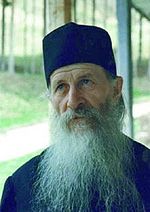

Fr. Ioannichie (Balan)

The father-confessor will understand him, console him, and assure him that he is not alone, yet not allow him to harden in his motivations, as if it were all "necessary and perfectly natural."
The father-confessor should have zeal and kindness in order to be able to tear his spiritual child away from this secret and many-headed passion. It is recommended to read books and everything that has as its goal the preparation for death. The lost one will be forgiven through repentance, no matter what sin he committed, and this will be a great achievement; but let no one deceive himself or suppose that he can find any forgiveness without repentance. Because of this sin, you cannot ever know what heaven and hell really are; and one should think about this and pray.
A person who is more spiritually inclined, but nevertheless gets wounded to a greater or lesser extent and then passes through the bath of repentance, counts this as a misfortunate accident. He will have a serious reason for truly meek humility—and this gives God more joy than when someone thinks highly of himself as never having fallen.
This is not a paradox, but divine justice and mercy. He, the Master of the house and Good Pastor, left his sheepfold of sheep and went to find the lost sheep, and then happily put it on His shoulders and carried it into the gates of the Kingdom of glory. I once read what I am telling you now: "Brother Christian, believe me, there are two kinds of joy, which cannot be combined—you cannot rejoice here on earth in pleasures that are transient and sinful, and then reign with Jesus Christ." "Then, iniquity will stop its mouth" (cf. Ps. 106:42). "Thou fool, the time that you use for evil digs a pit for you, and tomorrow eternity will come!" Saying this, I think that the father confessor can encourage the person who is struggling with onslaughts from without, and with nature from within.
—How can one conquer and route ambition and prideful thoughts from himself?
—A hideous and impure passion! All evil catches a fish in this murky water! God does not even want to hear about a proud person! He takes all grace away from him, so that he might stumble—maybe then he will become humble, as the Scripture says (cf. 1 Pet. 5:5).
He abandons him, and that person becomes a great abomination; He takes from him all sense of beauty, leaves him to roam around in chaos, in all manner of filthy back alleys of the world. He has no image, or likeness, or healthy reason. The holy fathers say truly, "Wherever there was a fall, pride first did its work." No other passion will liken you to a devil like pride.
All passions can, let's say, be excused due to nature and bad life circumstances; but pride cannot be justified by anything! It has an unbearable insolence—it attaches itself to any virtue if it can, and it even hides behind humility, which serves as its shield. We see this very often, and to prove what I am saying, it is as one father said: "That proud one is so humble!"
Because it is so dangerous and so broadly present in all ages and ranks, it would be good if no one would disdain any person, no matter how unimportant he may be—for Christ is within him—and would even ask his opinion, even if it is for a lark. This would be the first step, one length along the path of the Gospels.
It would be good to ask everyone's opinion, no matter who you are; for who knows? After all, God's grace rests more often upon the simple and unnoticed. Make a prostration, as they say, if only for the sake of humbling the body—for this also shows good manners—and you will see how much you need these people with whom God has assigned you to live. You will see, and will be convinced in life that wisdom really does abide more in places where there is humility—for God is there.
Lucifer fell irreparably; his grandiose fall happened due to one word only: "I". Having fallen, he became an adversary for eternity, an abomination of desolation. Let no one be deceived, thinking that without true purification in the only water of humility he can enter into the Kingdom from which the angels fell!
These are, in brief, my thoughts and exhortations about this, so that one might realize that God created us beautiful only for Himself!
—What can one do to restrain the tongue and acquire the gift of silence?
—This is truly a serious matter—to not be the master of your tongue. As the saints say, "The tongue leads us to great falls." More vanity than benefit comes from loquacity, and malignant gossip brings great danger not only in this world, but also in the next. They say that most of the people in hell are those who murdered with malicious words!
Brother, you must love you brother. Isn't this the Savior's most important commandment? He gave this commandment as the crown of all His teachings—that the only way to salvation is love; and He ascended the unforgettable and soul-rending Golgotha!
We must always reiterate to people the responsibility that we bear for our lifetime, the only time given to us, so that we would set a lock upon our tongue and purify our hearts from evil. St. Gregory the Theologian says: "We must answer for every superfluous word, even more so for every shameful word"; how much more horribly for every murderous word! The Patericon is very useful in this regard with its chapter on "The benefit of silence."
St. Isidore of Pelusium says, "Speaking with benefit is a blessing, but if it is reinforced by deeds, it is crowned." "For life without words brings greater benefit, while a commanding word evokes anger. If word and life are united they comprise the personification of all philosophy."
Treasure the Lord in your heart and let your attention abide there, and remain there before the Lord without leaving. Then you will notice every speck of dust in yourself. This is how mystical knowledge begins. It is a mirror for the mind and a lamp for the conscience. It dries up lust, extinguishes rage, humbles anger and disperses sorrow, tames insolence, scatters despondency, gives clarity to the mind, casts out sloth, truly humbles you and makes your reason undeceivable; it wounds the demons, and purifies the body. Such a person is no longer the participant in any wicked deed, but rather is alien to it. He thinks all the time, "Who shall I go to? I am a worm…" This is something different, having to do with remembrance of death and man's eternal lot, and belongs to mystical knowledge.

Source: Ne vorbeşte părintele Arsenie. Ediţia îngrijită de а Arhimandrit Ioanichie Bălan. Vol. 1–3. Editura Mănăstirea Sihăstria, 2004. 

http://agapienxristou.blogspot.ca/2015/04/god-is-where-there-is-humility-elder.html

Thursday, June 9, 2016

Our prayers help the departed ( Nun Makrina )


 Maria (this was Mother Makrina’s name before she became a nun)lost her parents and was orphaned when she was nine years old. When she was twelve years old, she found work at a tobacco factory in Volos.

She used the first money she earned from this job to have a forty-day Liturgy for the souls of her parents. Her spiritual father began the Liturgies
for forty consecutive days, and she would attend the service daily. She would wake up at 3:00 am, and walk for approximately one hour from her
home to the chapel of Saint Apostle the New Martyr.

At the conclusion of the Liturgy, she would immediately leave for her work. During the forty-day period that the Liturgies were being served, she would pray in private in her home as well, for God to rest the souls of her parents.

On the fortieth day, when the final Liturgy was to
beheld, a little before she woke up, in a state
half-way between sleep and vigilance, she found herself in a green pasture with flowering trees,
similar to almond trees when their branches of are in bloom in the spring. She heard a voice telling her that this place belonged to her parents. Deeply moved, she began to call out to them, and they appeared to her, at which time she asked them anxiously if they are in a place of rest. They joyfully replied, “It was nice where we were before, but now we are even better.”

After this, she prepared to go to the final Liturgy.
At the conclusion of the service, as her spiritual father was handing out the antidoron, he asked
her to stay behind for a while because he wanted to speak to her.

Maria waited and shortly thereafter her spiritual father came to ask her how she felt while praying for her parents. Before Maria was able to respond, he told her that he also had seen them the night before just as she had seen them.

Maria then comprehended the immense value of the forty-day Liturgies, and when she later became an abbess, she always recommended to people to perform liturgies for both the deceased, as well
as for health and support of the living during life’s various difficulties.

from the life of  Nun Makrina (†1995) 


http://agapienxristou.blogspot.ca/2014/03/our-prayers-help-departed-part-2-nun.html

Entering the gate into Paradise ( St. Paisios )

God is kind. He wants us all to be saved. If only a few were to be saved, why then was Christ crucified? The gate into Paradise is not narrow. There is room for all those who bow humbly and are not puffed up with pride, as long as they repent and give the burden of their sins to Christ.

Then there is plenty of room to pass through the gate.Man can be saved with a single humble thought, or with a proud one, lose everything.


St. Paisios

Monday, June 6, 2016

All things are the fruit of God's love...


Orthodox Christians believe that God is "the Creator of heaven and earth, and of all things visible and invis­ible". The world is not eternal; only God is eternal. He created the entire world out of nothing: "for he spoke, and it came to be; He commanded, and it stood forth" (Ps. 33,9).

Man cannot determine the manner in which the world came into being; for it is not an object of scien­tific examination, for it transcends man's "rational" ability (his logic). Man is part of created reality, he cannot become an "observer" of the manner in which he himself was created!

The world is not of the same nature with God; "by nature" it is entirely different. The world is not a creation from the essence of God, "light from light" but the fruit of God's volition and freedom; there is an insurmountable chasm separating God's essence from the essence of the created world.

God need not have created the world. The world, however, was pre-eternally in God's "thought". Thus the creation of the world does not mean a change in God's life. The world came into being according to God's plan and at a time which pre-eternally existed in God's will.

Before making visible creation, God created the spiritual world, i.e. the angels: "When the stars were created, all my angels with a loud voice praised me", says God to Job (Job 38,7). Neither angels nor men existed pre-eternally. Angels are spiritual persons. They were created in time and are limited by space; the swiftness, however, of the angelic nature allows them to act everywhere; only God is not limited by space.

Also, the angels, like men, were created mutable, but through God's grace and their own disposition, they became firm and unshakable in virtue and remain faithful in their original mission: to glorify God and to minister unto man's salvation (Isaiah, 6,3; Luke 2,14; Hebr. 1,14).

Man was from the beginning created as body and soul; man's soul did not pre-exist. Holy Scripture states: "And God created man, taking earth from the ground and breathed into his face the spirit of life, and man became a living being" (Gen. 2,7).

Underlining the distinction between the Creator and the creatures, the Orthodox Christian does not make an idol of nature or of himself. He does not hope that in "identifying" with nature, he will broaden his existence; he does not seek out certain apocryphal transcendental powers within nature, believing that by "activating" them he will solve the problems he faces. His hope has reference to God the Creator, for He has created us from the beginning "according to His image" with a purpose to achieve the "according to the Image" (Gen. 1,26); he does not refer to the created world or to his own self. The meaning of life is to be found in achieving the "according to the likeness", our Archetype, which is outside our own essence and not "within us".

All that exists was created by God "very good"; "And God saw everything that He had made, and behold, it was very good" (Gen. 1,31). The Orthodox Christian therefore evaluates all of material creation positively.

All things are the fruit of God's love, all things are sanctified in the Orthodox Church: not only man's soul, but his body as well, and all of material creation: all things contain within them the "seed" of perfection and are foreordained to life, free from corruption and death.

http://artoklasia.blogspot.ca/2015/04/all-things-are-fruit-of-gods-love.html

Friday, June 3, 2016

Eternal Life ( St. Hesychius, St. Isaac the Syrian, St. Anthony )


LET US ALWAYS REMEMBER DEATH, for from this remembrance is born in us the putting aside of all cares and vanities, the preservation of the mind and unceasing prayer, a healthy attitude toward the body and a loathing of sin, and, if the truth be told, almost every live and active virtue flows forth from it. Therefore, let us, if possible, do this work as uninterruptedly as our breathing is uninterrupted.  ( St. Hesychius ) .


The Saviour called the many mansions of the Father the various capacities of the mind of those dwelling in that realm, that is, the distinction and diversity of spiritual gifts which they enjoy according to the capacity of the mind. For, not according to a diversity of places, but according to the degree of gifts does he call the mansions many.

Just as each man enjoys the perceptible sun, depending on the purity and receptivity of his power of sight, and just as illumination from one lamp varies in a house, although the light is not divided into many lights, so in the future age all the righteous will abide indivisibly in one realm, but each, according to his own capacity, is illumined by one noetic Sun, and, according to his worthiness, attracts joy and gladness to himself, even though from one air, from one place, throne, sight and image. And no one sees the measure of his friend, both higher and lower, lest, if he see the superior grace of his friend and his own deprivation, this be a cause of sorrow and grief for him. There, each, according to the grace given to him, is glad inwardly in his measure. Outside them all is one sight and realm ­ and besides these two degrees, I understand just one realm on high and another below, in the midst of them is variety in a diversity of gifts. ( St. Isaac the Syrian ).


Death, for men who understand it, is immortality; while for the simple, who do not understand it, it is death. And one should not fear this death, but ought to fear the perdition of the soul, which is ignorance of God. This is what is terrible for the soul! Life is the uniting and joining of the mind (spirit), soul and body; while death is not the perdition of these joined parts, but the dissolution of their union; God preserves all this even after the dissolution. Just as a man comes forth from his mother's womb, so does a soul come forth naked from the body. Some are pure and bright, some are spotted by falls, and some are black from many transgressions. That is why the wise and God­loving soul, remembering and considering the calamities and extremities that come after death, lives piously lest it be condemned and subjected to them. But the unbelievers, the mindless in soul, do not perceive and they sin, despising what is to come. Just as on issuing forth from the womb thou dost not remember what was in the womb, so on issuing forth from the body thou dost not remember what was in the body. Just as on issuing forth from the womb thou becamest better and greater in body, so on issuing forth from the body pure and undefiled, thou wilt be better and incorrupt, abiding in the heavens.

Mortal men ought to care about themselves, knowing in advance that death awaits them. For blessed immortality is the lot of the holy soul when it is good, and death eternal meets it when it is evil. Remember that thy youth is past and thy powers exhausted, while thine infirmities have grown and already the time of thy departure is near, when thou wilt give an account of all thy deeds; and know that there, neither will brother redeem brother, nor will father deliver son. Always remember thy departure from the body, and do not let eternal condemnation out of thy thoughts; if thou wilt act thus, thou wilt not sin unto the ages.  ( St. Anthony the Great )


 http://agapienxristou.blogspot.ca/2014/01/eternal-life-st-hesychius-st-isaac.html