 By Metropolitan Hierotheos of Nafpaktos
I once visited Father Paisios with a student of theology who was at a critical stage. He asked him about his studies. The student naively told him about a work of his dealing with the creation of man. At one point he told Father Paisios: "At one point God didn’t know what to do, so He formed Adam and Eve, to pass His time." I saw Father Paisios with lightning speed raise his hand and gave him a heavy smack. The student lost it, became dizzy, he stood briefly with bulging eyes trying to realize what happened, and then he began to cry, sobbing like a small child.
Father Paisios was looking at him, not saying anything, and let him cry. After much weeping, he said: "Blessed one, what is this that you said? Come with me." He took him by the hand, like a mother with a young child, and brought him to the sink and said: "Wash your face." Then he gave him a towel to wipe his face of the tears and brought him back to his seat. He then began with humor, tenderness and much love to indicate his error, and to say that we should not speak about God and His work with indecency. Moreover, he even wrote a graceful dedication in one of his books and gave it to him. Needless to say, I followed this entire scene speechless and ecstatic.
When I would visit him, after asking his advice on issues dealing with my personal life, I would ask him about issues I was facing with my spiritual children. I told him about a child who was very lively and reactive and asked for an opinion on how to treat him. He replied disarmingly: "Do what a mule driver does with the animal. Hold him securely by the reins and sit far away so you don’t get kicked."
When I recall my memories of that holy figure, I am moved, I shed tears and I pray. May we have his holy prayers.
Excerpt from the book Μαρτυρίες Προσκυνητῶν – Γέροντας Παϊσιος ὁ Ἁγιορείτης – 1924-1994, σὲλ 43-44, ἐκδόσεις Ἁγιοτοκος Καππαδοκίας, Νικόλαος Α. Ζουρνατζόγλου, ἐπισμηναγὸς Ε.Α.
http://agapienxristou.blogspot.ca/2013/04/when-elder-paisios-smacked-theology.html

Many of the Orthodox Christians piously wear at their hands a "bracelet" made of wool knots or wooden beads. Fewer however know its true significance. The first thing we should stress is that it is not a piece of jewelry but an actual prayer rope. Its purpose is not just as decoration or to show others we are Orthodox, as many believe, but to be used as an aid in accomplishing our daily prayers.

 The use of the prayer ropes is ancient in itself, going back to the origins of Christian monasticism. The prayer rope, creation attributed to Saint Pachomius in the fourth century, was intended as an aid for monks that could not read to accomplish a consistent number of prayers and prostrations in their cells. The use of the rope made it possible to pray the Jesus Prayer unceasingly, whether inside the cell or out, in accordance with Saint Paul's injunction to "Pray without ceasing" (I Thessalonians 5:17).
The method of tying the prayer rope also goes back to the fathers of monasticism. Saint Anthony the Great it is said to have started by tying a leather rope with a simple knot for every time he prayed Kyrie Eleison ("Lord have Mercy"), but the Devil would come and untie the knots to throw off his count. He then devised a way--inspired by a vision he had of the Theotokos--of tying the knots so that the knots themselves would constantly make the sign of the cross. This is why prayer ropes today are still tied using knots that each contain seven little crosses being tied over and over. The Devil could not untie it because the Devil is vanquished by the Sign of the Cross.
The prayer ropes are not to be confused with worry beads used as a pass-timer or calming device. The prayer ropes are to be used only in prayer. They come in various shapes and sizes but always they have a fixed number of knots or beads. This can be 33 (for the normal "bracelets") or 40, 50, 100, 200, 300, etc. for the longer ropes.
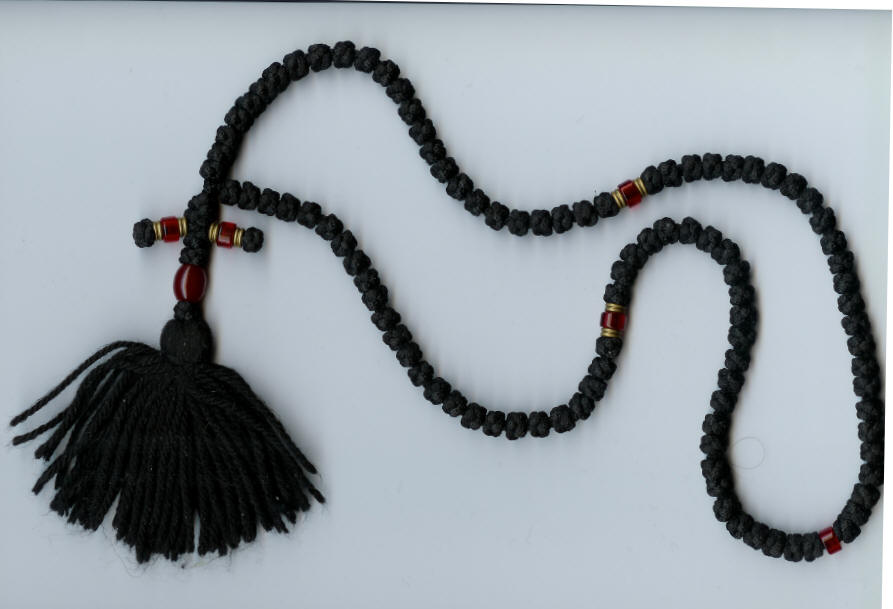
The use of the Jesus prayer with prostrations is sanctioned by our Church, which directs that one can (in cases of need) replace the common worship services with a definite number of prostrations and the Jesus Prayer (which would be difficult to carry out without the rope). Here is a guide we find at the end of some Psalter books.
Instead of the entire Psalter: 6000 Jesus Prayers
One kathisma: 300 prayers; for each stasis: 100
Midnight Service: 600
Matins: 1500
Vespers: 600
Great Compline: 700
Small Compline: 400
An Akathist to the Blessed Theotokos: 500
All those who are zealous for their salvation are invited to this unceasing remembrance of the saving name of Jesus, both laymen and monastics, for the spirit of life in Christ is one and the same for both. Many of our spiritual elders, men of prayer, ascetics and directors in faith and piety, down to the most recent time have recommended the use of the prayer rope to laymen and at times have even given them their own prayer ropes as a blessing.
For this reason we also recommend to the lay people today to properly use the prayer ropes around their hands to pray wherever they are, at home, at work, or driving, with a simple prayer: "Lord Jesus Christ Son of God have mercy on me the sinner" or simply "Lord Jesus Christ have mercy on me".
http://agapienxristou.blogspot.ca/2013/07/prayer-rope-r-design-bracelet-which-is.html

Miracles
“If a prophet rises among you....”
The Lord said if a prophet (i.e., charlatan) performs signs and wonders, don’t get excited about it (like little children). Don’t get carried away like a leaf on the wind. Don’t believe in other gods. Stay true to the Lord.
The Lord is testing you to see if you love Him with all your heart and with all your soul.
So it’s possible that mediums and so on can, as a concession by God and with the power of the Evil One, work “wonders.” Here are some of them:
“Communication” with the Dead
“There are some people who are so heartbroken by the loss of a loved one that they go to a medium (i.e., the devil), in order to hear the voice of the departed person, to talk to them, to find some kind of relief. Do they really hear the voice of the dead? Victor H. Ernest, the former medium, gave a blunt answer. The voice they heard isn’t that of their loved one but of a devil. And the poor unfortunate people are left with the illusion that they’re in contact with the soul of the person who passed away!
Telepathy
There are two kinds of telepathy.
A) Reading other people’s thoughts: According to Victor H. Ernest, this happens when a person’s intelligence is working hand in glove with an evil spirit, or when the whole person is actually under the control of an evil spirit. Doreen Irvine, a former prostitute and stripper who was actually crowned Queen of the Witches of Europe, had no difficulty, as a Satanist, in reading other people’s thoughts.
B) Seeing something that’s happening far away in a dream or in a trance: Two people at the séance attended by Victor H. Ernest were able to read the headlines of morning newspapers while they were still being run off at the printer’s, hours before they were delivered to the town. Some, who are even more “advanced”, can see into your house as if with a camera and can find hidden objects, etc.
“Miracles” with Fire
In Kalamata, some years ago, an occultist did the following in front of the audience: He drew lines on his hand with a lighted cigarette without feeling any pain at all.
Something similar happens every year in the village of Agia Eleni in Northern Greece on the day of the feast of Sts Constantine and Helen. A group of people holding icons of the saints dance in their bare feet on burning charcoal without getting burnt.
Victor H. Ernest comments that this is not an illusion. He says that fire-walkers really do walk on burning coals or sometimes on molten lava. Behind firewalking, he maintains, is the total surrender of the practitioner to the forces of darkness.
“Soap Bubbles”
A while ago, in the main street of the town of Patras, in Greece, a magician, with the aid of evil spirits, was doing tricks. Through a variety of invocations, chairs and tables were lifted into the air as if made of paper. A crowd of people rushed to see this devilish spectacle. But by God’s providence a certain priest of the city, Fr A. K., was passing by and he made the sign of the Cross over these flying chairs and tables. They fell to the ground and remained there no matter what the occultist tried to do to move them. The power of the Cross had deadened that of the evil spirits.
Conclusion
No matter how impressive are the “wonders” performed by the agents of Satan (mediums, magicians, etc.), they can’t stand up to the power of the presence of the Cross. They disperse. They burst just as if they were soap bubbles. As indeed they are.
The Devil: Demonic Possession
The best proof of the existence of the devil is a person who is possessed. To anyone who doesn’t believe in the existence of the devil, we would say, “Come and see. Come and see the devil alive within a possessed person.”
Distress
Possessed people (when the fit is upon them) become unrecognizable: the face becomes distorted, the head twists, the mouth gapes. The tongue is thrust out and the victim howls. It is truly a horrible sight.
In this state, a possessed person is capable of revealing all your “achievements” (i.e., sins). It is not just general and vague, either, but specific and in detail. Without knowing you, they can tell you for example, your name, where you were and what you were doing the previous evening, and who you were with. (It’s worth noting that if you’ve confessed to a priest, the possessed are unable to do this).
Questions:
- How do they manage to know your secrets?
- Why is it that sins confessed aren’t able to be seen?
Trembling
During their fit, however, they show other symptoms.
- At the Divine Liturgy they feel as if they’re burning (although when they see fire they don’t).
- Before the Precious Cross, they feel as if they’re being cut to ribbons (although when they see a butcher’s knife they don’t).
- When a priest makes the sign of the Cross over them with the “spear” used in the Divine Liturgy by the priest to cut the Communion Bread, they feel as if their flesh is being pierced. One priest did this and the possessed person howled: “Why are you sticking that spear into my flesh. Why are you pulling at the spear and tearing my flesh?” (Yet the same person was able to bear the touch of a sharp knife without howling).
- When they look upon holy relics, they feel as if they themselves are on fire.
Questions:
- Why should the possessed fear the Divine Liturgy yet not fear, for example, heart surgery?
- Why do they fear the Precious Cross, which, after all, is only two bits of wood, yet don’t fear a sharp butcher’s knife?
- Why is it that they feel they’re being cut open when the sign of the Cross is made over them?
- Why do they fear the relics of saints such as St Gerasimos, a poverty-stricken little monk who was full of love, yet don’t fear the remains of bloodthirsty Lenin, who slaughtered millions of his fellow-citizens?
“Something...”
All the above show us that there’s something about the possessed person that is very badly disturbed by the Precious Cross, the Divine Liturgy, and the relics of our saints. And this “something” is the same thing that can reveal your secret sins, unless you’ve confessed them.
For us Christians, this “something” is the devil. What about unbelievers? Do they just put it down to parapsychology and be done with it?
There are of course, those scientists who declare that all of this will one day be explained by the goddess of “science”. They’re sure of this. Yet this may not be the case, since it’s still in the future, so why are they so sure? What sort of logic is that? But never mind. If in the future science demonstrates that this something really is the devil, will they then believe it?
The Devil’s Bloodthirstiness
The possessed show just how bloodthirsty the devil is and how cruelly he tortures people. Here are a few instances:
The father whose son was possessed said to Christ: “Every time the devil bothers him, it throws him down, foam comes from his mouth and he gnashes his teeth and becomes catatonic" (Mark 9:18). Some know-it-alls explain this by saying the boy was epileptic. But so was Julius Caesar, who lived before Christ. People in the ancient world were familiar with the difference between epilepsy and possession. They weren’t as “backward” as we like to think.
Another possessed man never stayed at home, but went wandering around the deserts and graveyards. Summer and winter he walked around stark naked (Luke 8:27-39).
Another threw himself into the fire to be burnt and yet another into the water to drown (Matthew 17:16). The two possessed men of the Gaderenes were “exceedingly fierce”. They were so wild and aggressive that no one could approach them They were the bane of people’s lives (Matthew 8:28).
Unnatural Strength
If a criminal is arrested by the police and is handcuffed, then no matter how strong he is, he can’t
break his bonds. His hands are tied, as it were. This isn’t true of people possessed. If they’re handcuffed, for example, even if they’re paralyzed, they’re capable of breaking open handcuffs. St Luke tells us in the Gospel that the Gadarene man who was possessed “was kept bound in chains and fetters, and he broke the bonds.” He was completely immobolized, but despite that he broke the chains!
It wasn’t the man who broke the chains, but the devil who was in the man. This demonstrates quite clearly that the devil has superhuman strength. So, he can work signs and wonders. If he wanted, he could:
- Bring up a hurricane to destroy houses and uproot trees.
- Whip up a storm that would sink all the shipping in the area.
- Drown men and beasts.
- Make an earthquake that would level towns and cities.
But he refrains from this. Why?
Wouldn’t he like to turn everything upside down? Certainly he would, if he could. He’s prevented from doing so by God. If God didn’t keep the mania of the demons in check, we’d see them playing with the world like a ball.
How Does He Fight Us?
The misanthropic devil doesn’t fight us with weapons that can be seen and which make a noise (stones, clubs, etc.), but with silent, invisible ones. ONE of these is THOUGHTS. He puts (bad) thoughts into our minds in order for us to put them into practice. If the bad thoughts don’t take root, then he’ll fight us with supposedly good ones, in order to trap us. Given this, you should be concerned and should ask yourself:
- Is what you have in mind perhaps seed sown by the devil? Is it perhaps misleading you towards seemingly good thoughts?
- Is, perhaps, your philosophy of life and death (which you think is correct), really a set of thoughts from the devil?
- Are even your thoughts on spiritual matters, as an Orthodox Christian, perhaps really thoughts of the devil? Perhaps.
One thing you can be sure of: the devil hasn’t made an exception of YOU.
From the book Confronting the Devil, Magic & the Occult, Orthodox Book Centre, Athens 2003
Archimandrite Vasilios Bakoyiannis
http://agapienxristou.blogspot.ca/2013/07/demonic-possession-magic-spiritualism.html

As Orthodox Christian adults, we have only to compare the moral climate of today with that of our childhood to know that we are living in an age of increasing apostasy. Thirty, forty, fifty years ago, the secular culture offered children wholesome entertainment basically supportive of a Christian upbringing. The films and TV programs of those times — e.g. Lassie, Leave it to Beaver, My Friend Flicka, The Lone Ranger-- were all characterized by a well-developed sense of morality that is so essential to a child's proper development. In the past decade, the focus of children’s entertainment has radically changed into what can justifiably be perceived as a conspiracy against Christian parents. This neglect of morality — caused by the pervasive greed that favors cheap sensationalism and anything that sells over quality — is not just limited to television programs — today, games, toys, comics and even coloring books are filled with nightmarish images offering a barely disguised invitation into hell.
For those who think such a statement is a gross exaggeration, a visit to the “toys and games” aisles of the local department store will deliver an unpleasant shock. There, besides “Snow White” and “Kitten Friends,” is a macabre coloring book featuring the TV-based “Skeleton Warriors,” proudly advertised as “bad to the bone!!” On the back cover is a cut-out mask with fangs. “Hey kids,” reads the package of a menacing turtle figure, “with your help, Don can instantly mutate from his Ordinary Turtle Teen self into a sewer secret Night Ninja! the world's most dangerous dude!” (“Ninja,” in Japanese, is a martial arts warrior). In company with the “Teen-age Mutant Ninja Turtles” are a host of other mutants, aliens and extra-terrestrial “heroes,” such as “Transformers” and other soulless robots that sport such names as “Dr. Terror,” “Rampage,” “Tantrum,” and “Razorclaw.” There are “cuddly” monsters and grotesque monsters like the “Berserkers,” a “roaring band of renegade Mutant Viking Cyborgs.” The popular New Age “Star Wars” film and “Star Trek” TV series have spawned whole lines of toys and “play sets” — i.e. outerspace environments and space ships like “Death Star.” And now, Disney Productions--once synonymous with family values — has come out with a film, “Gargoyles.” TV Guide assures parents that these demonic-looking creatures, with their huge claws and enormous bat-like wings, “only look scary”; they are actually “decent and moral.” The cast of characters includes the “noble” Goliath and his cohort Xanatos (meaning “death” in Greek). Then there are macho soldiers such as Rambo and the now long popular G.I. Joe, who come with a whole arsenal of sophisticated weaponry and “battle machines” like “Steel Monster” and “Terror Dome.” Most of these toys are characters from films or cartoons, which “show” a child how the toys are supposed to behave. Promoted as “action toys,” they inspire violent and aggressive play. Video games, such as “Mortal Combat,” have become another source of violent children's entertainment. Other toys are familiarizing children with elements of the occult and Eastern religions. In their cartoons, the innocent-looking Care Bears, the Smurfs and My Little Pony are all heavily laced with occult and New Age symbolism.
And then there's sex. Since her debut in 1959, the glamorous, buxom Barbie has been the queen of dolls, and has become something of an obsession among many young girls. With regular baby dolls, girls naturally practice parenting—after all, toys are effective learning mechanisms--but with Barbie, the focus is on physical attractiveness, boyfriends, and dating, which, in today's sexually-charged atmosphere, is particularly unhealthy. A board game designed for mid-teens spells it out: “Hey, let's be honest. At this stage of our lives, what's more important than finding the perfect member of the opposite sex? Not much. Basically, you play girls against guys. That's cool for starters. You get to make the other team do all this bizarre stuff. If they don't do it, you stamp them and they become your personal party-slaves. Naturally, they have to do whatever you say. Cool. . . Don't be stupid. Try it!”
The toy industry, which is spewing out such abominations, is enjoying a profitable partnership with the film industry. Cartoons have become essentially 30 minute advertisements, and children have responded by becoming aggressive consumers of whatever film-character toys are in fashion — in addition to the bed-sheets, lunch-boxes, T-shirts, posters and other articles bearing the image of their favorite TV-toy, whether it is the macho G.I. Joe or the New Age Pocahontas. This gross abuse of children's souls is a lucrative business.
The task of raising Christian children has never been an easy one. “A young child,” writes St. Dimitri of Rostov (l709), “is like a board | prepared for icon painting. Whatever the iconographer paints on it, honorable or dishonorable, holy or sinful, an angel or a demon, it remains forever. The same applies to a young child: that upbringing which he is given, those manners he is taught--whether God-pleasing or God-despised, angelic or demonic--shall be part of him for the rest of his life.” Because children are so impressionable, parents must be especially vigilant regarding the influences surrounding their children, ensuring as much as possible that these make a positive contribution to their development, towards making them worthy citizens of the Kingdom of Heaven.
The powerful influence of images on the soul is one reason why icons should have a prominent place in the Orthodox home. In his book, The Meaning of Icons, Leonid Ouspensky writes that the icon “transmits, or rather testifies visually to. . . the reality of God and of the world of grace and of nature.” Iconography, he says, is a means which the Church employs to convey its teaching, to transmit the revelation of the divine world, to point to the Kingdom of Heaven. Icons are reflections of men who have been regenerated into eternity; they aid us in uncovering and developing the beauty of holiness. In other words, they help men attain likeness to God, following the basic principle that “we become like that which we habitually contemplate” (Constantine Cavarnos, Orthodox Iconography.).
The same principle holds true for the abominable images which have invaded the world of children's toys. “It is well known,” writes Bishop Theophan the Recluse (l894), “how powerfully corrupt images act upon the soul, no matter in what form they might touch it.” Children are particularly vulnerable; their consciousness and their identities are not yet developed. And so, Satan has targeted them with his own perverse form of “iconography”: images which harden their souls and accustom them to a world of darkness — a world where traditionally demonic images are considered “good,” where ugliness and brutishness are glorified, and where aggression is rewarded. The lines of good and evil are blurred. There is no God. The “saviours” of the world come from outer space. Or they come in the form of Nietzsche's superman, who wields power without conscience. Far from being repulsed by these monstrous inventions, many children describe them as “cool, “awesome,” and, approvingly, “bad.” Should Satan visit these children in their dreams, they would have no fear, and no defense.
What can and should Christian parents do to protect their children from such “soul-corrupting evils"? It is, of course, normal for children to have a certain fascination with scary monsters, and a child who plays with a magic wand or a Power Ranger isn't necessarily harming his soul. What is essential here is that the child be surrounded by a strong Christian culture in the home, and that parents be attentive and take an active part in the child's development. Providing opportunities for genuine play is important, and there are many healthy alternatives to the toys and games we have described. As most toys today are priced beyond the range of a child's allowance, it is up to parents to exercise control. Non specific toys — i.e. those that give the greatest scope to the child's imagination and creativity — are best; these include card board boxes, blocks, tinker toys, crayons and other art and craft supplies; for an older child, a supply of scrap wood with a hammer and nails. Children enjoy playing with parents, and there are many board games that are fun for the whole family; these include Parcheesi, Monopoly, Pictionary, and Scrabble. Reading aloud is another valuable pastime which brings children and parents together.
The world is full of images that pull the soul in the wrong direction. Parents should surround children with images conducive to salvation, images that make the soul receptive to grace. Raising Christian children in this post-Christian age is a daunting responsibility and a real podvig. It requires a serious investment of time, patience, love and prayer. But the rewards are incomparable — and eternal.
http://agapienxristou.blogspot.ca/2015/07/what-can-and-should-christian-parents.html

John weighed seven pounds, seven ounces on the day he was born. His first days of life were highlighted by bouts of crying and long periods of sleeping. On the drive home from the hospital, a few days later, John’s mother glanced down, looked at her new baby, and for a moment she smiled.
Then she looked ahead. “Honey,” she began, as she stared at her husband, “I know we decided to keep our careers so that we can be financially secure, but now I’m having second thoughts. I want to give our son the most attention we can. I want us to reconsider having me stay at home with him.”
Her husband shook his head in frustration. “We discussed this, remember?” he shot back. “We can’t afford to have one of us at home all the time. It doesn’t make sense.” For the next few minutes the proud new parents shared their thoughts and uneasiness of leaving their child in the care of someone other than his parents.
Conversations like the one above are common among new parents. Every parent wants the best for their child, yet mapping out how to exactly deliver that parenting has become more and more difficult. This struggle of parenting in contemporary society can be encapsulated by one word: time. We know that parenting takes time, but modern parenting has divided the concept of time into two categories – quality time and quantity time.
For so many hardworking parents “quality time” has become a very important concept. But what exactly is quality time? At a very basic level it can be defined as an activity that promotes communicating and sharing. For time to be deemed “quality time” it needs to be enriching and stimulating. Spending time watching television isn’t the ideal, but spending time working on a project or playing a game together is. A quick look at the historical development of the notion of quality time reveals some important information. Quality time arrived on the scene in the early 1970’s. Research indicated that the more actively mothers were involved with their babies, talking and cooing and so forth, the better it was for the babies’ cognitive and social development. The implication was that in order to have high-quality time, a fair amount of pure time had to be invested. Therefore, quality time originally assumed quantity time, but eventually the “quality not quantity” philosophy of parenting won out, simply because in our over scheduled and stressed society there was little opportunity for quantity time. Parents hoped that quality time at least made up for the lack of quantity time—so long as it was better and bigger, and more meaningful time.
Yet this ideology is flawed because parents simply can’t plan special moments of bonding or epiphanies with their child as they are unpredictable. They tend to happen within the every day mundane activities of parenting and within the notion of quantity time.
St. Theophan the Recluse touches on the issue of parenting time in his book titled: On the Upbringing of Children. He advises parents to preserve the blessing that baptism gives their child and to immerse their lives in its upbringing. The father and mother are to “disappear into the child and put their whole soul into his welfare,” he says. One of St. Theophan’s teachings on the upbringing of children centers on the establishment of developing a sound foundation – a foundation that takes a lot of effort and time. The development of this foundation is necessary to stand firm against what he refers to as the “shock waves of youth.” In other words, everything parents say and do in the early years is reflected in the latter ones. A great deal of this depends on the time we spend on our children. Much of good parenting also involves discipline and teaching. It’s through this process that children not only develop a sound conscience as good behavior becomes automatic; but it’s also through this process that good, productive habits become cemented into the child’s life. These skills need close and constant monitoring. And this is why quantity time is also important.
“The reason why the grace of Baptism is not preserved,” St. Theophan states, “is because the order, rules and laws of an upbringing are not kept.” And so the challenge for new parents is not only to establish order and rules, but to be around to see that their children live by them. Spiritually, we know that children form their ideas about God through their parents. It’s in the praying together, the listening of stories about Saints, in reading the Bible and especially in modeling Christlike behavior, that children form a lasting perception of God. When this doesn’t occur there is a void. “The family is recognized as the ‘home church,’ says Sophie Koulomzin in her book Our Church and Our Children, “and the task of parents is really a kind of a lay priesthood. Within a Christian family our Christian faith must be incarnated; it must be brought to life in the daily, hourly experience of living.”
Make no mistake, parenting isn’t simple and there are no cookie-cutter families. There are many legitimate reasons for parents to leave their child to the care of a friend or a day care center. Nowadays, most couples rely on two incomes and many single parents are trying to raise their child with minimum support. However, our faith calls for time to be both quality and quantity; therefore it’s good for parents to openly assess how much of a balance there is in the way they parent. For if parents want their children to develop consistent habits, if they want their children to develop a quality relationship with Christ, they have to sacrifice time and energy.
Next time your child asks you what time it is, and you look to give the chronological answer, remember that the most important time together isn’t measured merely by minutes, but by quantity and quality time.
Fr. Athanasios Papagiannis is a recently ordained priest serving at Assumption Church in Chicago. A licensed clinical social worker and former teacher, he is a 2010 graduate of Holy Cross School of Theology and a 2002 graduate of Aurora University.
The Orthodox Observer
Fr. Athanasios Papagiannis
25 / 10 / 2011
http://agapienxristou.blogspot.ca/2013/02/what-time-is-it-for-your-child.html


