Saturday, April 7, 2018

Homily on Pascha ( St. Gregory the Theologian )

Yesterday I was crucified with Him; 
today I am glorified with Him; 
yesterday I died with Him; 
today I am quickened with Him; 
yesterday I was buried with Him; 
today I rise with Him. 
 
But let us offer to Him Who suffered and rose again for us, you will think perhaps that I am going to say gold, or silver, or woven work or transparent and costly stones, the mere passing material of earth, that remains here below, and is for the most part always possessed by bad men, slaves of the world and of the Prince of the world.
 
 Let us offer ourselves, the possession most precious to God, and most fitting; let us give back to the Image what is made after the Image. Let us recognize our Dignity; let us honour our Archetype; let us know the power of the Mystery, and for what Christ died.

St. Gregory the Theologian

Tuesday, April 3, 2018

Holy and Great Wednesday


On GreatWednesday the Church commemorates the act of contrition and love of the sinful woman who poured precious myrrh-oil on our Savior's head, and, though she did not know it, "prepared Him for burial." And in contrast we hear of the dark act of Judas, whose greed led him to betray his Master. All the readings and hymns of the day warn us to beware of greed and love of money, which even tempted a disciple of Christ. We too can betray Him, if we let greed and selfishness get hold of us, while every deed of humility and love at once brings us near to Him.

Concerning these incidents recorded in the Holy Gospels, the Synaxarion has the following account:

Two women — say the more discerning interpreters of the Gospel — anointed the Lord with myrrh; the one, a long time before His Passion; the other, a few days before. The one was a harlot and sinner; the other, chaste and virtuous. The Church commemorates this reverent act today. While mentioning herein the person of the harlot, it also mentions Judas' betrayal; for, according to the account in Matthew, both of these deeds took place two days before the Passover, on Wednesday.

That woman, then, anointed Jesus' head and feet with very precious myrrh, and wiped them with the tresses of her hair. The disciples, especially the avaricious Judas, were scandalized, supposedly because of the waste of the myrrh. Jesus reproved them and told them not to trouble the woman. Indignant, Judas went to the high priests, who were gathered in the court of Caiaphas and were already taking counsel against Jesus. On agreeing with them to betray his Teacher for thirty pieces of silver, Judas sought from that time opportunity to betray Him (Matt. 26:14-16). Because the betrayal took place on Wednesday, we have received the tradition from Apostolic times to fast on Wednesday throughout the year.

It is on this day also that one of the most beautiful and compunctionate hymns ever composed is chanted in the Holy Church. This hymn, composed in the early part of the ninth century by the nun Cassiane, has as its theme the anointing of our Savior's feet by the harlot:

The Troparion of Cassiane

O Lord, the woman who had fallen into many sins perceived Thy divinity, and taking upon herself the duty of a myrrh-bearer, with lamentation she bringeth Thee myrrh-oils before Thine entombment. Woe unto me! saith she, for night is become for me a frenzy of licentiousness, a dark and moonless love of sin. Receive the fountain of my tears, O Thou Who gatherest into clouds the water of the sea. Incline unto me, unto the sighings of my heart, O Thou Who didst bow the Heavens by Thine ineffable condescension. I will kiss Thine immaculate feet and wipe them again with the tresses of my head; those feet, at whose sound Eve hid herself for fear when she heard Thee walking in Paradise in the cool of the day. As for the multitude of my sins and the depths of Thy judgments, who can search them out, O Savior of souls, my Savior? Do not disdain me, Thy handmaiden, O Thou Who art boundless in mercy.

The Kontakion for this day continues the theme of contrition and remorse, and confronts us with our unworthiness before God:

The Kontakion (Fourth Tone)

Though I have transgressed more than the harlot, O Good One, I have in no wise brought forth streams of tears for Thee; but in silence I supplicate Thee and fall down before Thee, kissing Thine immaculate feet with love, so that, as Master that Thou art, Thou mayest grant me the forgiveness of debts, as I cry to Thee, O Savior: From the mire of my deeds do Thou deliver me.

On Holy Wednesday night the Orthodox Church administers the Mystery of the Holy Unction for the bodily and spiritual health of the participants. At this Mystery, the oil is consecrated by prayer and the clergy anoint the people. When this is done, the priest recites the prayers for the remission of sins, while the clergy hold the open Gospel over the heads of the people.

The Psalter is not used after Holy Wednesday until Thomas Sunday.

Friday, March 30, 2018

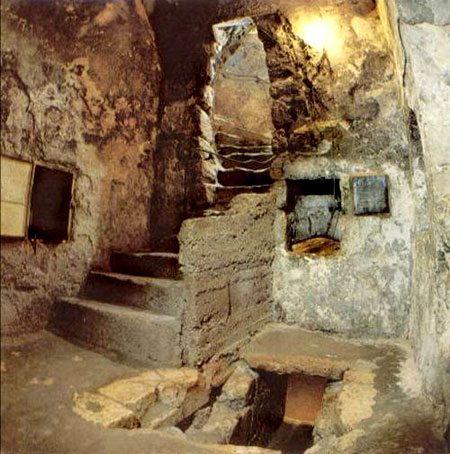
In the Tomb of Lazarus , Bethany


St. Lazarus’ tomb, Bethany.

Largely ignored by much of Christendom, the Orthodox today celebrate ”Lazarus Saturday” in something of a prequel to next weekend’s Pascha. It is, indeed a little Pascha just before the greater one. And this, of course, was arranged by Christ Himself, who raised His friend Lazarus from the dead as something of a last action before entering Jerusalem and beginning His slow ascent to Golgotha through the days of next week (Orthodox celebrate Pascha a week later than Western Christians this year).


One of the hymns of the Vigil of Lazarus Saturday says that Christ ”stole him from among the dead.” I rather like the phrase. Next weekend there will be no stealing, but a blasting of the gates of hell itself. What he does for Lazarus he will do for all.

Lazarus, of course, is different from those previously raised from the dead by Christ (such as the daughter of Jairus). Lazarus had been four days day and corruption of the body had already set in. ”My Lord, he stinks!” one of his sisters explained when Christ requested to be shown to the tomb.


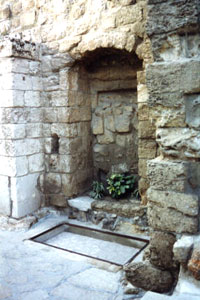
Steps leading to Lazarus’ tomb, Bethany.

I sat in that tomb last September, as I mentioned in my last post. It is not particularly notable as a shrine. It is today, in the possession of a private, Muslim family. You pay to get in. Several of our pilgrims did not want to pay to go in. I could not stop myself.

Lazarus is an important character in 19th century Russian literature. Raskolnikov, in Crime and Punishment, finds the beginning of his repentance of the crime of murder, by listening to a reading of the story of Lazarus. It is, for many, and properly so, a reminder of the universal resurrection. What Christ has done for Lazarus He will do for all.


For me, he is also a sign of the universal entombment.

That even before we die, we have frequently begun to inhabit our tombs. We live our life with the doors closed (and we stink). Our hearts are often places of corruption and not the habitation of the good God. Or, at best, we ask Him to visit us as He visited Lazarus.

That visit brought tears to the eyes of Christ. The state of our corruption makes Him weep. It is such a contradiction to the will of God. We were not created for the tomb.

I also note that in the story of Lazarus – even in his being raised from the dead – he rises in weakness.

He remains bound by his graveclothes. Someone must ”unbind” him. We ourselves, having been plunged into the waters of Baptism and robed with the righteousness of Christ, too often exchange those glorious robes for graveclothes.

Christ has made us alive, be we remain bound like dead men.

I sat in the tomb of Lazarus because it seemed so familiar.

Monday, March 26, 2018

Why God wants us to Love Him ( St. Nektarios )

But why, someone may ask, does God demand for man to love Him so rigorously?
 Saint John the Evangelist answers this very critical question in this manner:
because[he says]“God is love.”
Thus, as love, He wants us to love Him;
so that by loving Him, we may in turn be loved by
Him. For love is born of God and knows God. 
He who does not love does not know God, for God is love (1 Jn. 4:7-8).

Since God is love, this is why He wants us to love Him. Confirming that God is love and that He loves mankind immensely.
Saint John the Evangelist states:  
In this the love of God was manifested toward us, that God has sent His only begotten Son into the world, that we might live through Him” (1 Jn. 4:9).
What measure of love exists greater than this love? Who can any longer remain uncertain concerning God’s love? 
And what is more:
we never sought this love; rather, it was
God Himself Who voluntarily showered us with this love. and this is love,observes the
Evangelist,not that we loved God, but
that He love us and sent His Son to be the propitiation for our sins(1 Jn. 4:10).
Therefore, this is the reason God asks for
love: because He loves us, He wants us to love Him so that we may “have life, and have it more
abundantly” (Jn. 10:10).
For, “in Him was life, and the life was the light
of men” (Jn. 1:4).
 God wants us to love Him so we can remain in Him (vid. 1 Jn. 4:12-13).
Because whoever remains in Him remains in life,
and he possesses eternal life (vid.1 Jn. 4:16).
 God thus asks for us to love Him not because He wants to receive something from us, but
in order for Him to give to us.
What immeasurable love! How necessary it is
indeed for man’s life, salvation, and well-being!
St. Nektarios
http://www.stnektariosmonastery.org/en/index.php
  

Saturday, March 24, 2018

Repenting before death closes the door...( St. Nikolai Velimirovich )

Repent before death closes the door of your life and opens the door of judgement.

Repent before death and since you do not know the hour of death, repent today, even now, and cease to repeat your sin.

Thus, St. Ephraim the Syrian prays:

Before the wheel of time stops in my life, have mercy on me;

Before the wind of death blows and diseases, the heralds of death, appear on my body, have mercy on me;

Before the majestic sun in the heights becomes darkened for me, Have mercy on me; and may Your light shine for me from on high and disperse the dreadful darkness of my mind;

Before the earth returns to earth and becomes decay and before the destruction of all the features of its beauty, have mercy;

Before my sins deceive me at the judgment and shame me before The Judge, have mercy O Lord, filled with gentleness;

Before the hosts come forth, preceding the Son of the King to assemble our miserable race before the throne of the Judge, have mercy,

Before the voice of the trumpet sounds before Your coming, spare Your servants and have mercy, O Lord our Jesus;

Before You lock Your door before me, O Son of God, and before I become food for the unquenchable fires of Gehenna, have mercy on me.

St. Nikolai Velimirovich