Showing posts with label Elder Joseph the Hesychast. Show all posts

Wednesday, February 6, 2019

Becoming a practiced soldier of Christ ( Elder Joseph the Hesychast )


For it is absolutely necessary for the grace of God to leave, once a tried struggler has acquired a good taste of it in the beginning, so that he may be tested and become a practiced soldier of Christ.

And without such temptations, no one has ever ascended to perfection. This stage that we mentioned where many fall into delusion is the stage where the grace of God withdraws in order to make us, as we have said, practiced soldiers of war, so that we are not infants forever. But the Lord wants us to become worthy men and brave fighters able to guard His riches. That is why He allows us to be tempted.

Elder Joseph the Hesychast

Saturday, July 21, 2018

Leave all things in the hands of God ( Elder Joseph the Hesychast )


Question yourself as to whether this faith is within you, or perhaps you are led by worldly wisdom. And if you leave all things in the hands of God, behold! You have acquired faith and undoubtedly, without any question, you will find God to be your helper. And so, even should you be tried a myriad of times and should satan tempt you to abandon faith, prefer death a thousand times more and don’t obey worldly wisdom. 
 
In this way the door of the mysteries will be opened to you and you will be amazed how the chains of worldly wisdom previously bound you. Now you will fly with divine wings above the earth and breathe the new air of freedom, which, of course, others are deprived of. If, however, you see that within you, you are governed by worldly wisdom, and in the smallest danger you lose hope and despair, know that you have not yet acquired faith, and consequently also hope, in God.

Elder Joseph the Hesychast

Excerpt taken from the book- Precious Vessels of the Holy Spirit.

Wednesday, February 7, 2018

The theory of evolution emits a foul stench.. ( Elder Joseph the Hesychast )


When Elder Joseph was still living at the skete of St. Basil, one day he went to a neighboring church to visit Fr. Gerasimos. That day there happened to be a certain layman visiting from the world.

When Elder Joseph saw the man, he approached him and said: “You have a mistake, a serious problem.”

The layman asked: “What mistake do I have?”
“I don’t know,” replied Elder Joseph. “All I know is that there is something seriously wrong with you.”
“Can we find out what it is?”
“We cannot determine this now during the day. If you’d like, come down to my hut tonight.”
“I will be there after midnight, Elder.”
Indeed, during the middle of the night the laymen went to visit him.
They started talking, and eventually Elder Joseph discovered that this person, who had obtained a college degree in theology, had written an entire book in support of Darwin’s theory of evolution of the species.

Elder Joseph advised him, “When you want to support a theory or opinion, why don’t you draw from the writings of the holy Fathers? A theory or viewpoint is confirmed when it is validated by either the Holy Scriptures or the holy and God-bearing Fathers.”
The theologian ultimately admitted that he had made a mistake to believe in this theory. He then asked Elder Joseph to tell him how he knew he was mistaken.

“Yesterday, as I approached you,” explained the Elder, “ I sensed a foul odor and smelled a bad stench coming from you, and from this I realized that there was something wrong with you.”

from the book My Elder Joseph the Hesychast

Saturday, January 20, 2018

Spiritual journey ( Elder Joseph the Hesychast )


Our natural state is darkness in comparison to divine grace. How much more so when the gloomy demons approach us, which are dark
by nature! So when the light of grace comes, everything evil disappears---just as when the sun rises the darkness leaves, and we can clearly see even the smallest details that escaped notice before dawn. But once the sun sets, the darkness overtakes us naturally once more, and whoever walks in the darkness suffers great damage and
grievous incidents.

Likewise, the same thing happens to us in our spiritual journey. When we have divine light, we can see everything clearly, and the demons flee far away, as they are unable to stand before divine grace. But once divine grace leaves again, the darkness remains, that is, our natural state. Then the thievish demons come and fight us.

And so, since our nature is subject to so many changes, and since in a time of darkness we, without the discernment of divine grace, work many deeds that harm us, and since many times we are mortally wounded by the enemies, because it is dark and we cannot see the enemies that are hiding.

Therefore, we should never grow bold and think that everything we do is pleasing to God, nor should we trust in our own weapons and skill. But we should call upon divine aid and trust only in it, and should say with great fear, for we do not know, "I wonder, is what I say pleasing to God, or do I perhaps sadden Him?" And in times of change, we must be patient.

Elder Joseph's
"Epistle to a Hesychast Hermit"
(Chapters XI & XII & Epilogue)
From the book "Monastic Wisdom"

Friday, August 25, 2017

The longer you wait to seek forgiveness, the more you allow the evil one to spread his roots within you. ( Elder Joseph the Hesychast )

 
I received your letter, my child, and I saw your anxiety. But don’t be sad, my child. Don’t worry so much. Even though you have fallen again, get up again. You have been called to a heavenly road. It is not surprising for someone running to stumble. It just takes patience and repentance at every moment.

Therefore, always do a metanoia when you are wrong and don’t lose time, because the longer you wait to seek forgiveness, the more you allow the evil one to spread his roots within you. Don’t let him make roots to your detriment.

Therefore, don’t despair when you fall, but get up eagerly and do a metanoia saying, “Forgive me, my dear Christ. I am human and weak.” The Lord has not abandoned you. But since you still have a great deal of worldly pride, a great deal of vainglory, our Christ lets you make mistakes and fall, so that you perceive and come to know your weakness every day, so that you become patient with others who make mistakes, and so that you do not judge the brethren when they make mistakes, but rather put up with them.

So every time you fall, get up again and at once seek forgiveness. Don’t hide sorrow in your heart, because sorrow and despondency are the joy of the evil one. They fill one’s soul with bitterness and give birth to many evils. Whereas the frame of mind of someone who repents says, “I have sinned! Forgive me Father!” and he expels the sorrow. He says, “Am I not a weak human? So what do I expect?” Truly, my child this is how it is. So take courage.

Only when the grace of God comes does a person stand on his feet. Otherwise, without grace, he always changes and always falls. So be a man and don’t be afraid at all.
Do you see how that brother you wrote about endured the temptation? You, too, should do likewise. Acquire a brave spirit against the temptations that come. In any case, they will come. Forget about what your despondency and indolence tell you. Don’t be afraid of them. Just as the previous temptations passed by the grace of God, these, too, will pass once they do their job.

Temptations are medicines and healing herbs that heal our visible passions and our invisible wounds. So have patience in order to profit every day, to store up wages, rest, and joy in the heavenly kingdom. For the night of death is coming when no one will be able to work anymore. Therefore, hurry. Time is short.

You should know this too: a victorious life lasting only one day with trophies and crowns is better than a negligent life lasting many years. Because one man’s struggle, with knowledge and spiritual perception that lasts one day, has the same value as another man’s struggle, who struggles negligently without knowledge for fifty years.

Without a struggle and shedding your blood, don’t expect freedom from the passions. Our earth produces thorns and thistles after the Fall. We have been ordered to clean it, but only with much pain, bloody hands, and many sighs are the thorns and thistles uprooted. So weep, shed streams of tears, and soften the earth of your heart. Once the ground is wet, you can easily uproot the thorns.

Elder Joseph the Hesychast

Sunday, August 6, 2017

Hope in God ( Elder Joseph the Hesychast )


Question yourself as to whether this faith is within you, or perhaps you are led by worldly wisdom. And if you leave all things in the hands of God, behold! 
 
You have acquired faith and undoubtedly, without any question, you will find God to be your helper. And so, even should you be tried a myriad of times and should satan tempt you to abandon faith, prefer death a thousand times more and don’t obey worldly wisdom.
 
 In this way the door of the mysteries will be opened to you and you will be amazed how the chains of worldly wisdom previously bound you.
 
 Now you will fly with divine wings above the earth and breathe the new air of freedom, which, of course, others are deprived of. If, however, you see that within you, you are governed by worldly wisdom, and in the smallest danger you lose hope and despair, know that you have not yet acquired faith, and consequently also hope, in God. 
 
Elder Joseph the Hesychast

Monday, May 8, 2017

God is everywhere... ( Elder Joseph the Hesychast )

 God is everywhere. There is no place God is not…You cry out to Him, ‘Where art Thou, my God?’ And He answers, “I am present, my child! I am always beside you.’ Both inside and outside, above and below, wherever you turn, everything shouts, ‘God!’ In Him we live and move. 
 
We breathe God, we eat God, we clothe ourselves with God. Everything praises and blesses God. All of creation shouts His praise. Everything animate and inanimate speaks wondrously and glorifies the Creator. 
Let every breath praise the Lord!

Elder Joseph the Hesychast

Monday, April 17, 2017

Let every breath praise the Lord! ( Elder Joseph the Hesychast )

God is everywhere. There is no place God is not…You cry out to Him, ‘Where art Thou, my God?’ And He answers, “I am present, my child! I am always beside you.’ Both inside and outside, above and below, wherever you turn, everything shouts, ‘God!’ In Him we live and move. We breathe God, we eat God, we clothe ourselves with God. Everything praises and blesses God. All of creation shouts His praise. Everything animate and inanimate speaks wondrously and glorifies the Creator. Let every breath praise the Lord!

Elder Joseph the Hesychast

Saturday, September 24, 2016

Experiences, Teachings and Struggles ( Elder Joseph the Hesychast )


         The Differences between the Trials

Trials (peirasmoi) are so called because they engender experience (peira), since in the unseen war they do indeed afford spiritual knowledge to those who are attentive. Anything is called a trial if it is in opposition to our struggle for faith and true piety while we are pressing on towards submission to God, but they are subdivided into various kinds, according to the understanding of the Fathers. There are the trials of those taking part in the struggle, so that they may make additional gains and progress in their struggle. There are the trials of the slothful and unwilling, to make them beware of things that are harmful and dangerous. There are the trials of those who are drowsy or sleeping, in order to wake them up. Then again there are the trials of those who have distanced themselves and gone astray, to make them draw near to God. Different again are the trials of the righteous and friends of God, so that they may inherit the promise. There are also trials of the perfect, which God permits in order to bring them forward in the Church for the strengthening of the faithful and as an example to be emulated. There is also another kind of trial, again of the perfect, such as those endured by our Lord and the Apostles, who fulfilled the law of communion with the world by taking up the trials which are ours.

Spiritual Fathers also participate in this law of ‘communion’ by bearing the burdens and the weaknesses of their spiritual children through prayers and other struggles which supplement what is lacking in others. There is also another way, according to the Fathers, in which one person may be a sharer in someone else’s trials, and this is as follows: the accuser shares in the trials of the accused, the slanderer in those of the slandered, the wrongdoer in those of the wronged – especially when those who are wronged endure the harm done to them without a murmur.

We shall speak at this point of the trials of those who are making progress as a result of their attentiveness and willingness to struggle, which – again in the judgement of our Fathers – are usually the following: indolence, heaviness of body, languor of the limbs, listlessness, confusion of the mind, suspicion of bodily sickness – faintheartedness, in other words – darkening of the thoughts, being abandoned by human help, constriction in their external needs and the like. All these things, when – by God’s consent – they befall participants in the struggle, give rise to a sense of dereliction. Their faith then begins to be waver, as if the hope which had given them heart up till then had been cut off. But secretly grace consoles them so that they do not change their regime, because it convinces them that the trial has not come from themselves, since everything testifies that they have not abandoned their consistent good practice. After facing this difficulty and receiving the mystical consolation of grace, they turn with faith and yearning towards God who has power to save them, and fall down in humility asking His salvation, which is the end to which they have endured these trials. Such, according to the Fathers, are the trials of those who are advanced and making progress in spiritual matters.

In those who chance to neglect their duties or, which is the most terrible, fall into self-conceit and pride, the trials are different and harsher, in the same way as surgical operations and excisions are called for in cases of serious illness. The demons at first make war on them openly and quite shamelessly and insistently, and beyond their strength (cf. 1 Cor. 10:13). They experience a darkening of the intellect so that they lose the power of discrimination altogether, and imbecility and idiotic thoughts abound; an intense war of the flesh, pressing their will to go contrary to nature; anger for no reason and intractability in whatever concerns their own will; quarrelling on the spur of the moment and rebuking people at random; blasphemous thoughts against God; a loss of courage in the heart; being mocked by the demons, secretly and openly; lack of restraint in idle talk and, in general, a desire for the world and for idle vanities. After that, trials which are severe and hard to dispel: strange and unaccustomed symptoms of illness and painful wounds, a poverty and dereliction that is unaccustomed and defies consolation and everything else that is impossible and insoluble, which gives rise to despair and fear because the heart is devoid of hope. All these things are consequences mainly of pride, and come upon the person who has been led astray into believing in himself; and all these are the medicines for his healing, to make him sober up and humble himself and vomit out the bile of this devastating perversion.

As in matters of grace there are means of assistance which augment our progress both in time and in quantity, so also on the side of error there are factors which contribute to its fluctuation. On the side of grace, when by the grace of Christ someone treads the strait and narrow way (Mt 7:14) of the commandments according to the measure of his understanding, he increases the aid and illumination given by grace if he also acquires humility and sympathy in the service of love. Something comparable happens on the side of error. If impatience and grumbling are added to it, one’s cross becomes twice as heavy if not more. Faintheartedness and lack of hope are the most excruciating horrors of the unseen war, and are reserved for hard and unhumbled characters as the harshest lesson, which is a taste of hell itself and of punishment, a palpable sign of desertion and dereliction. Here it takes the prayers of saints and the intervention of a miracle for the heart to be softened. Many prayers and tears are needed for this sick soul to be reunited with grace and so be healed: otherwise it is inevitable that error will conquer, and that way lies madness and destruction.

O blessed humility and gratitude! Who is wise and will keep thy ways and understand thy statutes, that he may win thee totally and have thee as his intimate companion: that thou mayest go before him and follow him in all his ways, until thou presentest him to thy Master and King, who has taken thee as His delight and sharer of His throne and has revealed thee to us! For he says, ‘Learn from me, for I am gentle and lowly in heart’ (and not just in appearance) ‘and you will find rest for your souls’! (Mt 11:29).

It was not our intention to repeat so many problems and explanations well known from our Fathers; we were carried away by our train of thought, since almost unintentionally we found ourselves amidst the whirlwinds of trials to which we so often fall victim through our many deficiencies and lapses in attention.

The ever-memorable Elder never stopped explaining to us at every stage of our life, in his own delightful way, the aim and purpose of these ‘contractual afflictions’. We saw the movement and functioning of these afflictions constantly within the framework of the spiritual law which regulated everything in our lives in detail. Indeed, how much wisdom is concealed here in those who have understanding in the science of the spiritual life, when they chart their course over this ocean of life using nothing but this lodestone of the spiritual law, ‘the law of the spirit of life’! (Rom. 8:2).


http://agapienxristou.blogspot.ca/2013/09/experiences-teachings-and-struggles.html

Tuesday, June 14, 2016

Becoming a practiced soldier of Christ ( Elder Joseph the Hesychast )


For it is absolutely necessary for the grace of God to leave, once a tried struggler has acquired a good taste of it in the beginning, so that he may be tested and become a practiced soldier of Christ.

And without such temptations, no one has ever ascended to perfection. This stage that we mentioned where many fall into delusion is the stage where the grace of God withdraws in order to make us, as we have said, practiced soldiers of war, so that we are not infants forever. But the Lord wants us to become worthy men and brave fighters able to guard His riches. That is why He allows us to be tempted.

Elder Joseph the Hesychast 


http://agapienxristou.blogspot.ca/2015/06/becoming-practiced-soldier-of-christ.html

Friday, March 4, 2016

Struggle against anger ( Elder Joseph the Hesychast )


Therefore, when anger comes, close your mouth tightly, and do not speak to him who curses, dishonors, reproaches, or bothers you in any way without reason.

Then this snake will writhe around in your heart, rise up to your throat, and (since you don’t give it a way out) will choke and suffocate. When this is repeated several times, it will diminish and cease entirely…

  Elder Joseph the Hesychast

Thursday, February 18, 2016

Man’s Union with God: Guiding the Nous in Theoria ( Elder Joseph the Hesychast )


The Prayer Stops, the Bodily Members Cease to Move, and Only the Nous Is in Theoria within an Extraordinary Light…

Source: An excerpt taken from the letters of Elder Joseph the Hesychast, from “Monastic Wisdom,” thirty-fifth letter (Florence, Arizona, St Anthony’s Greek Orthodox Monastery, 1988).

My beloved little child and all the sisters in Christ according to rank, rejoice and be healthy in the Lord. I begin once more to speak into ears which desire and seek to hear. Ask, says our sweet Jesus, and it shall be given you; seek, and ye shall find; knock, and it shall be opened unto you! (Mt 7:7). I honor your good intentions; I praise your zeal; I appreciate your love, and I emulate you.
So, listen to me once more.
First of all, the method of beginning your prayer that you mention, my child, is very good. With such thoughts you are able to keep your mind from wandering by thinking that the prayers of the elder and the eldress ascend like a pillar of fire and that they converse noetically with God. When the nous thinks and believes such things, it stops for a moment, the prayer is sweetened, and tears start to trickle. Then that grace which is found in beginners, which you mentioned, approaches and like a mother teaches her young how to walk. When she goes away and leaves them, they seek her. They cry, shout, and look for her. After a little while she comes back, only to withdraw once more. Again they cry and shout; again she returns. Until she rears us, there is no way for her to stay with us because our passions prevent her.
The passions are a hard material. Ural mountains! Thousands of feet high! Grace is like the sun. The sun rises, but the shadow of the mountains does not allow it to warm the entire noetic man. As soon as a beam finds him, he is immediately set on fire with joy. The rest of his soul, though, is still beneath the shadow of the passions, and the demons are able to act as soon as grace retracts. Many times they obstruct it as clouds obstruct the sun’s light, for the shadow of the passions raises steam that obscures the little beam of light just dawning. This steam is the thoughts of despair you wrote about. Cowardice, fear, impudence, profanities, and other such things wither the soul and deprive it of its boldness towards God.
Every thought that brings despair and heavy sorrow is from the devil. It is the steam of the passions, and you must expel it at once with hope in God, with confession to the eldress, and with the prayers of those older than you, by thinking that they are praying and entreating God for you.
A small sorrow mixed with joy, tears, and consolation in the soul is from the grace of God throughout our life, it guides us towards repentance whenever we err. A sin drives away boldness towards God, but repentance brings it back at once. Grace does not bring despair, but it continually brings to repentance a person who has fallen. On the other hand, the words of the demons bring despair at once; they blight him like hail falling upon delicate little leaves that have just sprouted.
Now pay attention to this little lesson of praxis: When you see grace acting and your soul rejoicing and tears falling effortlessly (because of the mercies that God has given you), if you are praying, be still. If you are standing, don’t move. If you are sitting, remain seated. If you are saying the prayer, keep saying it without any childish thoughts, and accept the rain of the Spirit for as long as it comes upon you. For even if it comes while you are working, if you get up to pray, it stops. It wants you to remain wherever it found you, so that you do not become its master. It wants to teach you never to trust in yourself, as long as you are in this life. The rainfall of grace of a single day provides enough water for the things planted in the soul for the entire period that grace leaves.
The grace of the priesthood is one thing, the grace of the great schema is another, the grace of the Mysteries is different, and the action of grace in ascesis is also different. They all spring from the same source, but each one differs from the other in eminence and glory. The grace of repentance, which acts in those who struggle, is a patristic inheritance. It is a divine transaction and exchange in which we give dust and receive heaven. We exchange matter for the Spirit. Every drop of sweat, every pain, every ascesis for God is an exchange: a loss of blood, and an influx of the Spirit. The magnitude of this grace depends on how much a person can contain, in proportion to how much his own vessel can hold. This grace of praxis is also called purifying grace.
Now then, illumination follows praxis. Illuminating grace is the second stage. That is, once a struggler has been trained well with the grace of praxis and has fallen and risen countless times, he is given the enlightenment of knowledge and clarity of the nous, which perceives the truth. He sees things as they are, without artifices and methods and human syllogisms. Everything stands naturally in its true state. However, many trials and painful changes are encountered before arriving at this point. But here he finds peace in his thoughts and rest from the temptations.
Illumination is followed by interruptions in the prayer and frequent theorias, rapture of the nous, cessation of the senses, stillness, profound silence of the bodily members, and union of God and man into one. This is the divine exchange in which, if one endures temptations and does not stop struggling along the way, one exchanges the material for the immaterial. Therefore, run behind the heavenly Bridegroom, deers of my Jesus. (cf Song of Solomon 1:4). Smell the noetic myrrh. Make your life, soul and body fragrant with chastity and virginity. I do not know of anything else that pleases our sweet Jesus and His All-pure Mother more than chastity and virginity. Whoever desires to enjoy their great love should see to it that he makes his soul and body pure and chaste. Thus will he receive every heavenly good.
Now, let me explain what the phrase interruption of the prayer means, when grace abounds in a person. The grace of praxis is likened to the radiance of the stars; whereas the grace of illumination is like the full moon; but the perfecting grace of theoria is like the midday sun traversing over the horizon; for the Fathers have divided the spiritual life into three categories.
So when grace abounds in a person and he knows all that we have written, he attains great simplicity; his nous expands and has great capacity. Just as you tasted that drop of grace when much joy and exultation came upon you, it comes again in the same manner when the nous remains in prayer. But much more comes, like a subtle breeze, like a mighty gust (Acts 2:2) of fragrant wind. It overflows throughout, the prayer, it stops; the bodily members cease to move, and only the nous is in theoria within an extraordinary light. A union of God and man occurs. Man is unable to distinguish himself. It is just like iron: before it is thrown into the fire it is called iron, but once it ignites and becomes red-hot, it is one with the fire. It is also like wax which melts when it approaches fire; it cannot remain in its natural state.
Only when the theoria has passed does he return to his former state. Whereas during theoria, he is not functioning in this world. He is totally united with God. He thinks that he has neither a body nor a hut. He is entirely rapt. Without a body he ascends to heaven! Truly great is this mystery, for one sees things that a human tongue cannot express.
When this theoria has passed, he has such a deep humility that he cries like a small child, wondering why the Lord gives him such blessings, since he himself does nothing. He then obtains so much awareness of who he is that if you were to ask him, he would say that he considers himself destitute and unworthy to exist in this life. And the more he thinks like this, the more he is given.
“It is enough!” he cries out to God, and grace abounds even more. He becomes the son of the King. And if you were to ask: “Whose are these things you like wearing?”
“My Lord’s,” he answers. “And the bread and food you eat?”
“My Lord’s,” he again answers. “The money you carry?”
“My Lord’s,” he says. “What do you have of your own?”
“Nothing. I am dirt, I am mud, I am dust. If you lift me up, I stand. If you throw me down, I fall. If you take me up, I fly. If you toss me, I hit myself on the ground. My nature is nothing.”
He never has enough of saying this. And what is this nothing? It is what existed before God created the heaven and the earth: nothing. This is the beginning of our existence. We come from clay; this is the raw material we are made of. And our power? It is the divine inbreathing, the breath of God.
So receive, o God, Lover of good desires and Creator of every good thing, receive the divine inbreathing which You breathed into our face, giving us thus a living spirit, and we shall decompose into clay once more.
Therefore, what hast you, o proud man, that you did not receive? Now if you received it, why do thou glory as if thou hadst not received it? (1Cor 4:7). Acknowledge, lowly soul, your Benefactor and be careful not to usurp things belonging to others, things of God, as your own accomplishments. Realize, wretched soul, your existence, be aware of your ancestry. Don’t forget that you are a foreigner here and that everything is foreign! Now, if God the sweet Benefactor gave you something, render it with a clear conscience, Your own from Your own.
If you have ascended to the heavens and seen the natures of the angels and heard the voices of the divine Powers, if you theologize and teach, if you have defeated the wiles of the demons, if you write and speak and do things, all are a gift of God.
So say to your Lord, “Receive, o my sweet zephyr, my Jesus, Your own from Your own!” And then oh, then, my soul! What things you will see when the treasures of God open and He says to You, Receive everything, my son, for you proved to be a faithful and good ruler! (Mt 25:21).
† † †
Some Terms that All Orthodox Should Know
By George Karras, “Orthodox Heritage” Editor.
The terms discussed below appear often in patristic texts and present a significant challenge to the understanding of our worldly intellect. The definitions presented constitute a general and very elementary explanation. They are derived from various Orthodox books, primarily “Orthodox Psychotherapy” by Metropolitan Hierotheos Vlachos (published by Birth of Theotokos Monastery, Greece, 2005). It is a book that is strongly recommended for all those seeking to attain a greater understanding of these key terms.

 
Nous is the eye of the soul, which some Fathers also call the heart; it is the center of man and is where true (spiritual) knowledge is validated. Man’s soul is intelligent and noetic. God created man with a capacity to receive the Spirit and to attain knowledge of Himself; God did this by creating mankind with intelligence and noetic facilities.
Angels have intelligence and nous, whereas men have reason, nous and sensory perception. Furthermore, the soul of a man is created in the image of God. Since God is Trinitarian, mankind is Nous, Word and Spirit. The same is held true of the soul (or heart): it has nous, word and spirit. For those seeking to better understand this, a study of St. Gregory Palamas’ teaching that man is a representation of the Trinitarian mystery should be pursued.
Theoria is the vision of God and takes on a number of meanings that pertain to union with God (theo-) and holiness, the quintessential goals of Christianity (see the Philokalia). Theoria is the experience of the highest or absolute truth when one is in complete union with God. It is the penetration of the divine darkness or cloud of unknowing, beyond rational understanding. St. Gregory the Theologian says that theoria and praxis (the practice of faith, especially worship and the deeds of a virtuous life) are beneficial because theoria guides him to the holy of holies and restores him to his original nature; whereas praxis receives and serves Christ and tests love with actions. Thus, theoria is the vision of God and praxis is whatever deeds it takes to lead to this love.
Phronema is the understanding of Christian faith that guides the follower of Christ. It is a mindset or outlook; it is the Orthodox mind. The attaining of phronema is a matter of practicing the correct faith (orthodoxia) in the correct manner (orthopraxia). Attaining phronema is regarded as the first step toward theosis which is the state of glorification.
Theosis, meaning divinization (or deification, or to make divine) is the call to man to become holy and seek union with God, beginning in this life and later consummated in the resurrection.
The Holy Orthodox Fathers teach us that theoria is the source or means of growth toward union with God, praxis is the faith practiced along the way, and theosis is the overall path or journey. 


http://tokandylaki.blogspot.ca/2013/02/mans-union-with-god-guiding-nous-in.html

Saturday, January 30, 2016

Man’s Union with God: Guiding the Nous in Theoria ( Elder Joseph the Hesychast )


The Prayer Stops, the Bodily Members Cease to Move, and Only the Nous Is in Theoria within an Extraordinary Light…

Source: An excerpt taken from the letters of Elder Joseph the Hesychast, from “Monastic Wisdom,” thirty-fifth letter (Florence, Arizona, St Anthony’s Greek Orthodox Monastery, 1988).


My beloved little child and all the sisters in Christ according to rank, rejoice and be healthy in the Lord. I begin once more to speak into ears which desire and seek to hear. Ask, says our sweet Jesus, and it shall be given you; seek, and ye shall find; knock, and it shall be opened unto you! (Mt 7:7). I honor your good intentions; I praise your zeal; I appreciate your love, and I emulate you.
So, listen to me once more.
First of all, the method of beginning your prayer that you mention, my child, is very good. With such thoughts you are able to keep your mind from wandering by thinking that the prayers of the elder and the eldress ascend like a pillar of fire and that they converse noetically with God. When the nous thinks and believes such things, it stops for a moment, the prayer is sweetened, and tears start to trickle. Then that grace which is found in beginners, which you mentioned, approaches and like a mother teaches her young how to walk. When she goes away and leaves them, they seek her. They cry, shout, and look for her. After a little while she comes back, only to withdraw once more. Again they cry and shout; again she returns. Until she rears us, there is no way for her to stay with us because our passions prevent her.
The passions are a hard material. Ural mountains! Thousands of feet high! Grace is like the sun. The sun rises, but the shadow of the mountains does not allow it to warm the entire noetic man. As soon as a beam finds him, he is immediately set on fire with joy. The rest of his soul, though, is still beneath the shadow of the passions, and the demons are able to act as soon as grace retracts. Many times they obstruct it as clouds obstruct the sun’s light, for the shadow of the passions raises steam that obscures the little beam of light just dawning. This steam is the thoughts of despair you wrote about. Cowardice, fear, impudence, profanities, and other such things wither the soul and deprive it of its boldness towards God.
Every thought that brings despair and heavy sorrow is from the devil. It is the steam of the passions, and you must expel it at once with hope in God, with confession to the eldress, and with the prayers of those older than you, by thinking that they are praying and entreating God for you.
A small sorrow mixed with joy, tears, and consolation in the soul is from the grace of God throughout our life, it guides us towards repentance whenever we err. A sin drives away boldness towards God, but repentance brings it back at once. Grace does not bring despair, but it continually brings to repentance a person who has fallen. On the other hand, the words of the demons bring despair at once; they blight him like hail falling upon delicate little leaves that have just sprouted.
Now pay attention to this little lesson of praxis: When you see grace acting and your soul rejoicing and tears falling effortlessly (because of the mercies that God has given you), if you are praying, be still. If you are standing, don’t move. If you are sitting, remain seated. If you are saying the prayer, keep saying it without any childish thoughts, and accept the rain of the Spirit for as long as it comes upon you. For even if it comes while you are working, if you get up to pray, it stops. It wants you to remain wherever it found you, so that you do not become its master. It wants to teach you never to trust in yourself, as long as you are in this life. The rainfall of grace of a single day provides enough water for the things planted in the soul for the entire period that grace leaves.
The grace of the priesthood is one thing, the grace of the great schema is another, the grace of the Mysteries is different, and the action of grace in ascesis is also different. They all spring from the same source, but each one differs from the other in eminence and glory. The grace of repentance, which acts in those who struggle, is a patristic inheritance. It is a divine transaction and exchange in which we give dust and receive heaven. We exchange matter for the Spirit. Every drop of sweat, every pain, every ascesis for God is an exchange: a loss of blood, and an influx of the Spirit. The magnitude of this grace depends on how much a person can contain, in proportion to how much his own vessel can hold. This grace of praxis is also called purifying grace.
Now then, illumination follows praxis. Illuminating grace is the second stage. That is, once a struggler has been trained well with the grace of praxis and has fallen and risen countless times, he is given the enlightenment of knowledge and clarity of the nous, which perceives the truth. He sees things as they are, without artifices and methods and human syllogisms. Everything stands naturally in its true state. However, many trials and painful changes are encountered before arriving at this point. But here he finds peace in his thoughts and rest from the temptations.
Illumination is followed by interruptions in the prayer and frequent theorias, rapture of the nous, cessation of the senses, stillness, profound silence of the bodily members, and union of God and man into one. This is the divine exchange in which, if one endures temptations and does not stop struggling along the way, one exchanges the material for the immaterial. Therefore, run behind the heavenly Bridegroom, deers of my Jesus. (cf Song of Solomon 1:4). Smell the noetic myrrh. Make your life, soul and body fragrant with chastity and virginity. I do not know of anything else that pleases our sweet Jesus and His All-pure Mother more than chastity and virginity. Whoever desires to enjoy their great love should see to it that he makes his soul and body pure and chaste. Thus will he receive every heavenly good.
Now, let me explain what the phrase interruption of the prayer means, when grace abounds in a person. The grace of praxis is likened to the radiance of the stars; whereas the grace of illumination is like the full moon; but the perfecting grace of theoria is like the midday sun traversing over the horizon; for the Fathers have divided the spiritual life into three categories.
So when grace abounds in a person and he knows all that we have written, he attains great simplicity; his nous expands and has great capacity. Just as you tasted that drop of grace when much joy and exultation came upon you, it comes again in the same manner when the nous remains in prayer. But much more comes, like a subtle breeze, like a mighty gust (Acts 2:2) of fragrant wind. It overflows throughout, the prayer, it stops; the bodily members cease to move, and only the nous is in theoria within an extraordinary light. A union of God and man occurs. Man is unable to distinguish himself. It is just like iron: before it is thrown into the fire it is called iron, but once it ignites and becomes red-hot, it is one with the fire. It is also like wax which melts when it approaches fire; it cannot remain in its natural state.
Only when the theoria has passed does he return to his former state. Whereas during theoria, he is not functioning in this world. He is totally united with God. He thinks that he has neither a body nor a hut. He is entirely rapt. Without a body he ascends to heaven! Truly great is this mystery, for one sees things that a human tongue cannot express.
When this theoria has passed, he has such a deep humility that he cries like a small child, wondering why the Lord gives him such blessings, since he himself does nothing. He then obtains so much awareness of who he is that if you were to ask him, he would say that he considers himself destitute and unworthy to exist in this life. And the more he thinks like this, the more he is given.
“It is enough!” he cries out to God, and grace abounds even more. He becomes the son of the King. And if you were to ask: “Whose are these things you like wearing?”
“My Lord’s,” he answers. “And the bread and food you eat?”
“My Lord’s,” he again answers. “The money you carry?”
“My Lord’s,” he says. “What do you have of your own?”
“Nothing. I am dirt, I am mud, I am dust. If you lift me up, I stand. If you throw me down, I fall. If you take me up, I fly. If you toss me, I hit myself on the ground. My nature is nothing.”
He never has enough of saying this. And what is this nothing? It is what existed before God created the heaven and the earth: nothing. This is the beginning of our existence. We come from clay; this is the raw material we are made of. And our power? It is the divine inbreathing, the breath of God.
So receive, o God, Lover of good desires and Creator of every good thing, receive the divine inbreathing which You breathed into our face, giving us thus a living spirit, and we shall decompose into clay once more.
Therefore, what hast you, o proud man, that you did not receive? Now if you received it, why do thou glory as if thou hadst not received it? (1Cor 4:7). Acknowledge, lowly soul, your Benefactor and be careful not to usurp things belonging to others, things of God, as your own accomplishments. Realize, wretched soul, your existence, be aware of your ancestry. Don’t forget that you are a foreigner here and that everything is foreign! Now, if God the sweet Benefactor gave you something, render it with a clear conscience, Your own from Your own.
If you have ascended to the heavens and seen the natures of the angels and heard the voices of the divine Powers, if you theologize and teach, if you have defeated the wiles of the demons, if you write and speak and do things, all are a gift of God.
So say to your Lord, “Receive, o my sweet zephyr, my Jesus, Your own from Your own!” And then oh, then, my soul! What things you will see when the treasures of God open and He says to You, Receive everything, my son, for you proved to be a faithful and good ruler! (Mt 25:21).
† † †
Some Terms that All Orthodox Should Know
By George Karras, “Orthodox Heritage” Editor.
The terms discussed below appear often in patristic texts and present a significant challenge to the understanding of our worldly intellect. The definitions presented constitute a general and very elementary explanation. They are derived from various Orthodox books, primarily “Orthodox Psychotherapy” by Metropolitan Hierotheos Vlachos (published by Birth of Theotokos Monastery, Greece, 2005). It is a book that is strongly recommended for all those seeking to attain a greater understanding of these key terms.
Nous is the eye of the soul, which some Fathers also call the heart; it is the center of man and is where true (spiritual) knowledge is validated. Man’s soul is intelligent and noetic. God created man with a capacity to receive the Spirit and to attain knowledge of Himself; God did this by creating mankind with intelligence and noetic facilities.
Angels have intelligence and nous, whereas men have reason, nous and sensory perception. Furthermore, the soul of a man is created in the image of God. Since God is Trinitarian, mankind is Nous, Word and Spirit. The same is held true of the soul (or heart): it has nous, word and spirit. For those seeking to better understand this, a study of St. Gregory Palamas’ teaching that man is a representation of the Trinitarian mystery should be pursued.
Theoria is the vision of God and takes on a number of meanings that pertain to union with God (theo-) and holiness, the quintessential goals of Christianity (see the Philokalia). Theoria is the experience of the highest or absolute truth when one is in complete union with God. It is the penetration of the divine darkness or cloud of unknowing, beyond rational understanding. St. Gregory the Theologian says that theoria and praxis (the practice of faith, especially worship and the deeds of a virtuous life) are beneficial because theoria guides him to the holy of holies and restores him to his original nature; whereas praxis receives and serves Christ and tests love with actions. Thus, theoria is the vision of God and praxis is whatever deeds it takes to lead to this love.
Phronema is the understanding of Christian faith that guides the follower of Christ. It is a mindset or outlook; it is the Orthodox mind. The attaining of phronema is a matter of practicing the correct faith (orthodoxia) in the correct manner (orthopraxia). Attaining phronema is regarded as the first step toward theosis which is the state of glorification.
Theosis, meaning divinization (or deification, or to make divine) is the call to man to become holy and seek union with God, beginning in this life and later consummated in the resurrection.
The Holy Orthodox Fathers teach us that theoria is the source or means of growth toward union with God, praxis is the faith practiced along the way, and theosis is the overall path or journey.

Friday, December 25, 2015

Hope of Salvation ( Elder Joseph the Hesychast )


“The only hope of salvation from the delusions and the heresies, the innovations and the traps of wicked people and of the devil is prayer, repentance and humility.”
 

 Elder Joseph the Hesychast

Friday, November 13, 2015

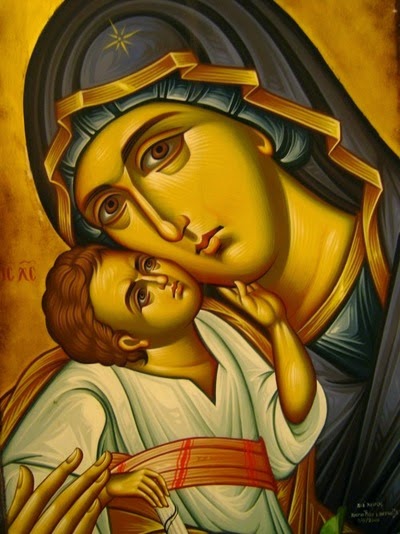
Have our Panagia, His dear, sweet Mother, as your protectress and entreat her constantly. ( Elder Joseph the Hesychast )


Have our Panagia, His dear, sweet Mother, as your protectress and entreat her constantly.

Embrace her holy icon as if she were alive, and wet it with tears as the myrrh-bearer did to Jesus' feet. And you will derive substantial consolation as if she were beside you.


Elder Joseph the Hesychast

Sunday, November 1, 2015

Noetic Prayer ( Elder Joseph the Hesychast )


Heart prayer is not susceptible to delusion, unless one is passionate and already deluded. With heart prayer, as soon as the nous enters the heart, immediately its darkness is cleared and straightaway it becomes peaceful and calm. It rejoices, is sweetened, rests, and is cleansed. It rejoices and becomes like a small child free from passions. Bodily members which used to tempt him become peaceful and humble, just like the hand, the nose, and the rest of the members of the body.

Therefore, whoever wants to, let him taste this honey, and it will become a fountain of joy and happiness within him, unless one is cunning, hypocritical, envious, miserly, sensual, vainglorious, or in general passionate; if one wants to say the prayer while voluntarily remaining with his passions, unrepentant, incorrigible. Such a person obviously disdains the action of the prayer and the mercy of the Lord. The prayer helps everyone, but each person must struggle in accordance with his own strength. God gives His grace according to one’s intention. If anyone says the prayer without repenting, either the prayer will cease, or he will fall into delusion.

Women in particular make progress in the prayer more easily because of the self-denial and obedience they have to their spiritual guide. However, the faster they make progress, the more easily they fall into delusion, if they proceed thoughtlessly without caution.

It is not just a matter of saying the prayer, but it is also a matter of being attentive. You must be vigilant with your thoughts, masterfully controlling them. Otherwise, they will take control of you and in the end you will become the laughing-stock of the demons. I have never seen a soul make progress in the prayer without frankly confessing secret thoughts.

My child, do you want to crush the head of the serpent? Openly reveal your thoughts in confession. The strength of the Devil lies in cunning thoughts. Do you hold on to them? He remains hidden. Do you bring them to the light? He disappears. And then Christ rejoices, the prayer progresses, and the light of grace heals and brings peace to your nous and heart.

Elder Joseph the Hesychast. "Monastic Wisdom".

Saturday, October 24, 2015

True Joy - Elder Joseph the Hesychast


Don’t expect to find joy and rest in anything that grieves your soul and upsets divine grace. Joy is a gift of God to our soul…

And if you dishonor it, it will not come back, unless you feel sorry and repent with much pain for every sin you committed. But what is the point of thoughtlessly chasing away the dove of grace, and then with regret and many sighs seeking it back again?

Many people have chased joy away by foolishly dishonoring it, and then it never came back.

Elder Joseph the Hesychast, Monastic Wisdom, Forty-ninth Letter, p. 23

Monday, September 28, 2015

A prayer Elder Joseph the Hesychast would recite before beginning to pray


Lord Jesus Christ, sweetest Father, God and
Lord of mercy, and Creator of the entire universe:
Look upon my humility and forgive all my sins
which I have committed all the years of my life up
to this very day and hour. Send forth Thine All-
Holy Spirit, the Comforter, so that He may teach,
illuminate, and safeguard me so that I no longer
sin, so that with a pure soul and heart I may adore,
worship, glorify, thank, and love Thee with all my
soul and heart, my sweetest Savior, Benefactor, and God, Who is worthy of all love and worship. Yes, good eternal Father, co-eternal Son, and All-Holy Spirit, count me worthy of enlightenment and divine spiritual knowledge, so that by beholding Thy sweet grace I may bear the burden of this vigil  tonight, and render unto Thee my prayers and thanksgiving, through the intercessions of the Most Holy Theotokos and all the Saints. Amen.

Sunday, September 6, 2015

My dear Mother, Panagia ( Elder Joseph the Hesychast )


All the saints wrote many praises to our Panagia. But I, the poor one, have found no words more elegant or sweet to describe her, than to cry out to her at every moment: '' My dear Mother! My dear,
sweet Mother! When my soul departs may it come into thy hands, and through them may it be given to its Creator, thine Only-begotten Son.

Elder Joseph the Hesychast

Wednesday, September 2, 2015

The road towards the fountain (Elder Joseph the Hesychast)


Today, many virtuous people who lead good lives, who please God with their deeds and words, and who benefit their neighbor, think they have (and
are thought of having) attained Love through their insignificant work or mercy and compassion they show towards their neighbor. But this is not the truth.

They are only fulfilling the commandment of love for the Lord, Who said, "Love one another." He who keeps this commandment is worthy of praise as a keeper of the divine commandments---but this is not an action of divine Love. It is a road towards the fountain, but not the fountain. It is stairs towards the palace, but not the gate of the palace. It is a royal garment, but not the King. It is a commandment of God, but not God.

Elder Joseph the Hesychast 


http://agapienxristou.blogspot.ca/2014/09/the-road-towards-fountain-elder-joseph.html