Orthodox Christians believe that God is "the Creator of heaven and earth, and of all things visible and invisible". The world is not eternal; only God is eternal. He created the entire world out of nothing: "for he spoke, and it came to be; He commanded, and it stood forth" (Ps. 33,9).
Man cannot determine the manner in which the world came into being; for it is not an object of scientific examination, for it transcends man's "rational" ability (his logic). Man is part of created reality, he cannot become an "observer" of the manner in which he himself was created!
The world is not of the same nature with God; "by nature" it is entirely different. The world is not a creation from the essence of God, "light from light" but the fruit of God's volition and freedom; there is an insurmountable chasm separating God's essence from the essence of the created world.
God need not have created the world. The world, however, was pre-eternally in God's "thought". Thus the creation of the world does not mean a change in God's life. The world came into being according to God's plan and at a time which pre-eternally existed in God's will.
Before making visible creation, God created the spiritual world, i.e. the angels: "When the stars were created, all my angels with a loud voice praised me", says God to Job (Job 38,7). Neither angels nor men existed pre-eternally. Angels are spiritual persons. They were created in time and are limited by space; the swiftness, however, of the angelic nature allows them to act everywhere; only God is not limited by space.
Also, the angels, like men, were created mutable, but through God's grace and their own disposition, they became firm and unshakable in virtue and remain faithful in their original mission: to glorify God and to minister unto man's salvation (Isaiah, 6,3; Luke 2,14; Hebr. 1,14).
Man was from the beginning created as body and soul; man's soul did not pre-exist. Holy Scripture states: "And God created man, taking earth from the ground and breathed into his face the spirit of life, and man became a living being" (Gen. 2,7).
Underlining the distinction between the Creator and the creatures, the Orthodox Christian does not make an idol of nature or of himself. He does not hope that in "identifying" with nature, he will broaden his existence; he does not seek out certain apocryphal transcendental powers within nature, believing that by "activating" them he will solve the problems he faces. His hope has reference to God the Creator, for He has created us from the beginning "according to His image" with a purpose to achieve the "according to the Image" (Gen. 1,26); he does not refer to the created world or to his own self. The meaning of life is to be found in achieving the "according to the likeness", our Archetype, which is outside our own essence and not "within us".
All that exists was created by God "very good"; "And God saw everything that He had made, and behold, it was very good" (Gen. 1,31). The Orthodox Christian therefore evaluates all of material creation positively.
All things are the fruit of God's love, all things are sanctified in the Orthodox Church: not only man's soul, but his body as well, and all of material creation: all things contain within them the "seed" of perfection and are foreordained to life, free from corruption and death.
http://artoklasia.blogspot.ca/2015/04/all-things-are-fruit-of-gods-love.html

LET US ALWAYS REMEMBER DEATH, for from this remembrance is born in us the putting aside of all cares and vanities, the preservation of the mind and unceasing prayer, a healthy attitude toward the body and a loathing of sin, and, if the truth be told, almost every live and active virtue flows forth from it. Therefore, let us, if possible, do this work as uninterruptedly as our breathing is uninterrupted. ( St. Hesychius ) .
The Saviour called the many mansions of the Father the various capacities of the mind of those dwelling in that realm, that is, the distinction and diversity of spiritual gifts which they enjoy according to the capacity of the mind. For, not according to a diversity of places, but according to the degree of gifts does he call the mansions many.
Just as each man enjoys the perceptible sun, depending on the purity and receptivity of his power of sight, and just as illumination from one lamp varies in a house, although the light is not divided into many lights, so in the future age all the righteous will abide indivisibly in one realm, but each, according to his own capacity, is illumined by one noetic Sun, and, according to his worthiness, attracts joy and gladness to himself, even though from one air, from one place, throne, sight and image. And no one sees the measure of his friend, both higher and lower, lest, if he see the superior grace of his friend and his own deprivation, this be a cause of sorrow and grief for him. There, each, according to the grace given to him, is glad inwardly in his measure. Outside them all is one sight and realm and besides these two degrees, I understand just one realm on high and another below, in the midst of them is variety in a diversity of gifts. ( St. Isaac the Syrian ).
Death, for men who understand it, is immortality; while for the simple, who do not understand it, it is death. And one should not fear this death, but ought to fear the perdition of the soul, which is ignorance of God. This is what is terrible for the soul! Life is the uniting and joining of the mind (spirit), soul and body; while death is not the perdition of these joined parts, but the dissolution of their union; God preserves all this even after the dissolution. Just as a man comes forth from his mother's womb, so does a soul come forth naked from the body. Some are pure and bright, some are spotted by falls, and some are black from many transgressions. That is why the wise and Godloving soul, remembering and considering the calamities and extremities that come after death, lives piously lest it be condemned and subjected to them. But the unbelievers, the mindless in soul, do not perceive and they sin, despising what is to come. Just as on issuing forth from the womb thou dost not remember what was in the womb, so on issuing forth from the body thou dost not remember what was in the body. Just as on issuing forth from the womb thou becamest better and greater in body, so on issuing forth from the body pure and undefiled, thou wilt be better and incorrupt, abiding in the heavens.
Mortal men ought to care about themselves, knowing in advance that death awaits them. For blessed immortality is the lot of the holy soul when it is good, and death eternal meets it when it is evil. Remember that thy youth is past and thy powers exhausted, while thine infirmities have grown and already the time of thy departure is near, when thou wilt give an account of all thy deeds; and know that there, neither will brother redeem brother, nor will father deliver son. Always remember thy departure from the body, and do not let eternal condemnation out of thy thoughts; if thou wilt act thus, thou wilt not sin unto the ages. ( St. Anthony the Great )
http://agapienxristou.blogspot.ca/2014/01/eternal-life-st-hesychius-st-isaac.html
Of course, love is higher than everything. If you find that you have no love within you but wish to obtain it, then perform acts of love, even though at the beginning without love. God will see your desire and suffering and will implant love into your heart. "Those who have an unsightly heart should not despair, because with God’s help they can reform it. All you need to do is watch yourself attentively, do not allow an opportunity to be beneficial to your close one slip by, disclose your thoughts to your elders and be benevolent to the utmost. Of course this cannot be done suddenly, but God is very patient. He only terminates the life of a person when He sees that he is ready to cross over into eternity, or, when He sees that there is no hope for improvement in him.
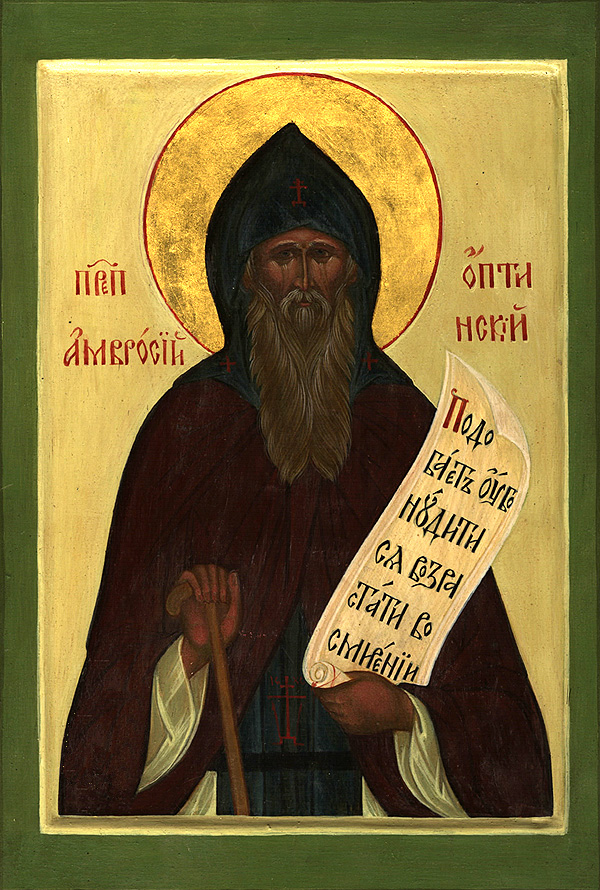
Elder Ambrose of Optina

The following story is told by John Chrysopoulou, an architect from Alexandroupoli:
I’m married to Evanthia Siontopoulou, and we have three children. A few years ago when my son Christos was three and a half years old, he was watching his mother burn incense in the home. He followed her around the whole house with a wooden rattle which looked like a censer, while she censed [the house], repeating, “Lord have mercy.”
One day, while playing his censing game as he usually did, he neglected to “burn” incense in the corner of the living room where the TV was. My wife noticed this and asked why he didn’t cense the whole living room.
Christos replied, quite naturally, that the stranger sitting on the TV would not allow him to burn incense there.
“But what stranger?” my wife asked.
“Him, dear mother, who sits on the TV, don’t you see [him]?“
Christos saw, with the pure eyes of his soul the devil on the TV, who inhibited even Christos’ make-believe incense.
https://lessonsfromamonastery.wordpress.com/2013/06/28/the-stranger-sitting-on-the-television/
Many and various are the demons' plots against humans. However, the help God provides to humans is incomparably greater. Indeed! If God did not defend us with His divine protection, the entire human race would have ceased to exist a long time ago due to the demons' onslaughts.
Truly! When have the demons ever allowed an opportunity to pass without creating temptations for man? When did they ever pause preparing traps for human beings or planning calamities for us?
Of course, the devil is not evil by nature, but he chose to incline toward wickedness. The Creator had appointed him to rule over the air, as St. Paul,
the beholder of heavenly mysteries revealed to us:
“According to the prince of the power of the air, the spirit who now works in the sons of disobedience”(Eph. 2:2).
However, when he desired to rise above his
appointed position and when he subsequently
lost his honorary distinction and was displaced from his throne on account of his high-minded arrogance, he turned his malice toward human beings, in order to manifest his vengefulness toward the Creator. Since he was unable to strike back at God directly, he devised a different plan of attack: he decided to instruct God's creations to revolt against Him. Thus, as soon as the first man was created in the image of the Creator, the devil advised him to oppose God:
“For God knows that when you eat from it your eyes will open and you will become gods, knowing good and evil”(Gen. 3:5).
In following, when the human race began to multiply, he imparted thoughts of idolatry to man,
who became so darkened that he began to worship the creation instead of the Creator.
However, the demons were not content with deceiving humans in this way or even with receiving worship from them. They proceeded to harm and forcefully take up residence within
people.
Even so, God did not leave his creature helpless. He ceaselessly used various methods to heal man, and ultimately set in motion His wise plan of
Dispensation in Christ to trigger the downfall
of the demons.
This is clearly seen in the Gospel, where Christ censures the oppression of the demons and makes manifest God’s help to people.
“And when He stepped out on the land, there met Him a certain man from the city who had demons
for a long time. And he wore no clothes, nor did he live in a house, but in the tombs”(Lk. 8:27).
This is the hostility the demons have toward humans. They desire to destroy everyone, but
they are deeply distressed since they cannot harm
everyone.
http://www.stnektariosmonastery.org/